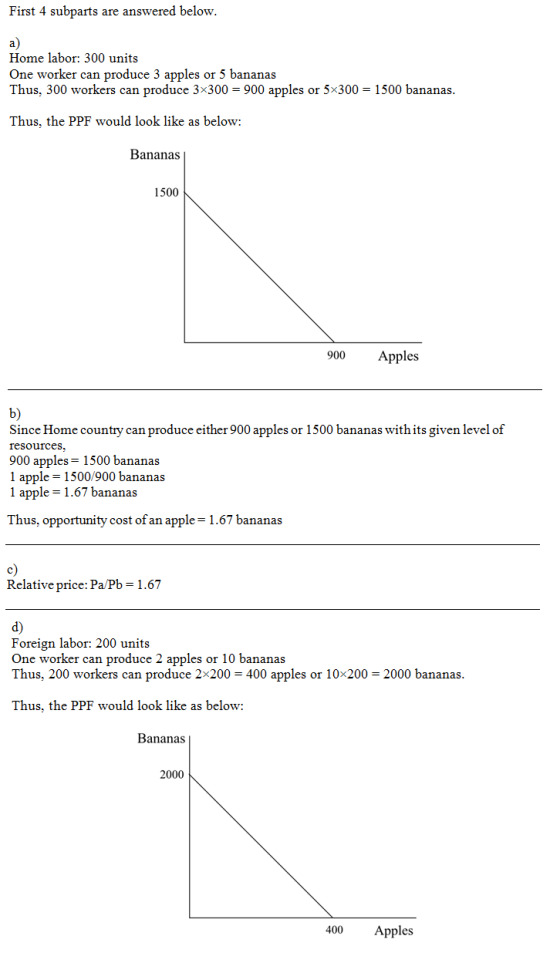
Suppose Home has 300 units of labor. It can produce two goods, apples and bananas. In Home a worker can produce 3 apples or 5 bananas.
a. Graph Home's PPF, with apples in the horizontal axis
. b. What is the opportunity cost of apples?
c. In the absence of trade – when Home is isolated ‐ what would the relative price be?
d. Now suppose there is another country, Foreign, with a labor force of 200. In Foreign a worker can produce 2 apples or 10 bananas
. e. Graph Foreign's PPF, with apples in the horizontal axis.
f. Construct the world relative supply curve, expressing the relative price of apples (PA/PB) in terms of the relative quantity of apples (QA/QB).
g. Now suppose that world relative demand takes the following form: RD: Qa/Qb = Pb/Pa (Hint: this is just the inverse function.) h. Graph the relative demand curve together with the relative supply curve.
i. What is the equilibrium relative price of apples? j. Describe the pattern of trade (who exports what).
k. Assume Home workers are less productive in both industries. What happens (conceptually) to the gains from trade for each country compared to before?
I need f-k answered please
Homework Answers

Add Answer to:
Suppose Home has 300 units of labor. It can produce two goods,
apples and bananas. In...
Suppose Home has 300 units of labor. It can produce two goods, apples and bananas. In...
Suppose Home has 300 units of labor. It can produce two goods, apples and bananas. In Home a worker can produce 3 apples or 5 bananas. a. Graph Home's PPF, with apples in the horizontal axis. b. What is the opportunity cost of apples? c. In the absence of trade – when Home is isolated ‐ what would the relative price be? d. Now suppose there is another country, Foreign, with a labor force of 200. In Foreign a worker...
3. Home has 1.200 units of labor available. It can produce two goods, apples and bananas....
 3. Home has 1.200 units of labor available. It can produce two goods, apples and bananas. The unit labor requirement in apple production is 3. while in banana production it is 2. Foreign has 800 units of labor available. Foreign's unit labor requirement in apple production is 5. while in banana production it is 1. a Graph the production possibility frontier for Home and the production possibility frontier for Foreign Please put Apples on the y axis. Now suppose world...
Home has 1200 units of labor available. It can produce two goods, apples and bananas. The...
Home has 1200 units of labor available. It can produce two goods, apples and bananas. The labor productivity in apple production is 1/3 apples per unit of labor, while in banana production it is 1/2 bananas per unit of labor. Graph Home’s production possibility frontier with apples on the horizontal axis and bananas on the vertical axis. What is the opportunity cost of apples in terms of bananas in Home? In the absence of trade, what would the price of...
Consider two countries Home and Foreign that can produce two goods, apples and bananas, using labour...
 Consider two countries Home and Foreign that can produce two goods, apples and bananas, using labour as the sole production factor. Home and Foreign have, respectively, 2400 and 1600 units of labour available and the unit labour requirements in the production of both goods are as shown in the following table: Home Foreign Apple 6 hours 10 hours Bananas 4 hours 2 hours 1. Construct the world relative supply curve and graph the relative demand curve along with the relative...
Relative price of apples Pa/Pb There are two countries Home and Foreign. Home has 1,200 units...
 Relative price of apples Pa/Pb There are two countries Home and Foreign. Home has 1,200 units of labor available. It can produce two goods, apples and bananas. The unit labor requirement in apple production is 3, while in banana production it is 2. Foreign has a labor force of 800. Foreign's unit labor requirement in apple production is 5, while in banana production it is 1. Suppose world relative demand takes the following form: Demand for apples/demand for bananas =...
The "Home" country has 1200 units of labor at its disposal. It can produce two goods:...
The "Home" country has 1200 units of labor at its disposal. It can produce two goods: apples and bananas. To produce 1 kg of apples, 3 units of labor are required, for 1 kg of bananas, 2 units of labor are required. a) Graphically represent the production options curve of Home. b) What is the opportunity cost for the Home of apples in terms of bananas? c) In the absence of trade, what will be the price of apples in...
5. Assume that the economy of Fruitland can produce two goods, apples (A) and bananas (B)....
5. Assume that the economy of Fruitland can produce two goods, apples (A) and bananas (B). The production of one apple requires one unit of labor (L) and two units of capital (K). One banana requires two units of labor and one unit of capital. Fruitland is endowed with 600 units of labor and 600 units of capital. a. Draw the production possibilities frontier (curve) for Fruitland. Put apples (A) on the vertical axis. (HINT: For every 20 apples, determine...
1a. Suppose that each worker in Home can produce 2 pound of cheese or 3 gallons...
1a. Suppose that each worker in Home can produce 2 pound of cheese or 3 gallons of wine. Assume that Home has 40 workers. a. Graph the production possibilities frontier (PPF) for Home? What is the no-trade relative price of cheese in Home? Why? b. Suppose that each worker in Foreign can produce 1 pounds of cheese or 2 gallons of wine. Assume that Foreign also has 40 workers. Graph the PPF for Foreign? What is the no-trade relative price...
The Ricardian Model I Consider two countries, Brazil and Italy and two goods, bananas and apples....
The Ricardian Model I Consider two countries, Brazil and Italy and two goods, bananas and apples. In Brazil the number of working hours necessary to produce one kilo of apples and bananas is respectively equal to 3 and 2. In Italy the number of working hours necessary to produce one kilo of apples and bananas is instead equal to respectively 5 and 1. The labor supply in Brazil is equal to 1200 workers, while in Italy it is equal to...
Answer question 4 based on previous information. 1. Suppose that each worker in the home country...
 Answer question 4 based on previous information.
1. Suppose that each worker in the home country can produce three loaves of bread or two shirts. Assume that Home has four workers a. Graph the production possiblities frontier for the Home country. b. What is the no-trade relative price for bread at Home? 2. Suppose that each worker in the Foreign country can produce two loaves of bread or three shirts. Assume that Foreign also has four workers. a. Graph the...
Answer question 4 based on previous information.
1. Suppose that each worker in the home country can produce three loaves of bread or two shirts. Assume that Home has four workers a. Graph the production possiblities frontier for the Home country. b. What is the no-trade relative price for bread at Home? 2. Suppose that each worker in the Foreign country can produce two loaves of bread or three shirts. Assume that Foreign also has four workers. a. Graph the...
 3. Home has 1.200 units of labor available. It can produce two goods, apples and bananas. The unit labor requirement in apple production is 3. while in banana production it is 2. Foreign has 800 units of labor available. Foreign's unit labor requirement in apple production is 5. while in banana production it is 1. a Graph the production possibility frontier for Home and the production possibility frontier for Foreign Please put Apples on the y axis. Now suppose world...
 Consider two countries Home and Foreign that can produce two goods, apples and bananas, using labour as the sole production factor. Home and Foreign have, respectively, 2400 and 1600 units of labour available and the unit labour requirements in the production of both goods are as shown in the following table: Home Foreign Apple 6 hours 10 hours Bananas 4 hours 2 hours 1. Construct the world relative supply curve and graph the relative demand curve along with the relative...
 Relative price of apples Pa/Pb There are two countries Home and Foreign. Home has 1,200 units of labor available. It can produce two goods, apples and bananas. The unit labor requirement in apple production is 3, while in banana production it is 2. Foreign has a labor force of 800. Foreign's unit labor requirement in apple production is 5, while in banana production it is 1. Suppose world relative demand takes the following form: Demand for apples/demand for bananas =...
 Answer question 4 based on previous information.
1. Suppose that each worker in the home country can produce three loaves of bread or two shirts. Assume that Home has four workers a. Graph the production possiblities frontier for the Home country. b. What is the no-trade relative price for bread at Home? 2. Suppose that each worker in the Foreign country can produce two loaves of bread or three shirts. Assume that Foreign also has four workers. a. Graph the...
Answer question 4 based on previous information.
1. Suppose that each worker in the home country can produce three loaves of bread or two shirts. Assume that Home has four workers a. Graph the production possiblities frontier for the Home country. b. What is the no-trade relative price for bread at Home? 2. Suppose that each worker in the Foreign country can produce two loaves of bread or three shirts. Assume that Foreign also has four workers. a. Graph the...
Most questions answered within 3 hours.
-
Where is the error in this code sequence?
String s1 = "Hello";
String s2 = "ello";...
asked 11 months ago -
Financial data for Joel de Paris, Inc., for last year
follow:
Joel de Paris, Inc.
Balance...
asked 11 months ago -
Consider this reaction:
Al2(SO4)3 (aq)+ BaCl3
(aq) Al2Cl6 (aq)- +
3BaSO4(s) . What is the...
asked 11 months ago -
Suppose that Savneet is considering increasing her
recent random sample from 20 car rentals to 40...
asked 11 months ago -
Trucks arrive at an unloading terminal at an average rate of 120
per hour.
Trucks arrive...
asked 11 months ago -
Why are methanol and ethanol completely soluble in water while
octanol is not very little soluble....
asked 11 months ago -
A facilities manager at a university reads in a research report
that the mean amount of...
asked 11 months ago -
When the CuSO4 is rehydrated by adding water to the anhydrous
compound, is this an endothermic...
asked 11 months ago -
A ray of sunlight is passing from diamond into crown glass; the
angle of incidence is...
asked 11 months ago -
A block of mass 0.249 kg is placed on top of a light, vertical
spring of...
asked 11 months ago -
how do the kidneys compensate in the presences of acidosis
a) trigger hyperventilate
b) reserve acid...
asked 11 months ago -
Question 501 pts
The rental rate of capital to the firm increases. Which of the
following...
asked 11 months ago