
Homework Answers

Add Answer to:
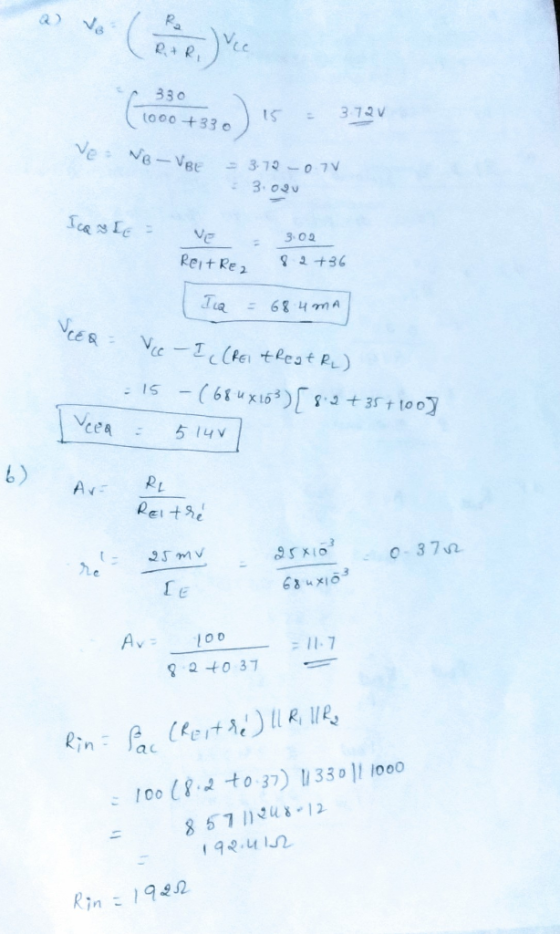
1. Figure 1 shows a CE power amplifier in which the collector resistor serves also as...
Apply the concept of Multistage O0000 O0000 The amplifier in Figure 5-36 is a low-power andio...
 Apply the concept of Multistage
O0000 O0000 The amplifier in Figure 5-36 is a low-power andio amplifier. The transfomer is step-down impedance-matching transformer designed to give a reflected reaistance in the primary of 1000 2 when the load is 8 2 (such as the speaker).. The dc resistance of the primary winding is 66 2 and B= 150 (a) Compute Va and the Ig for the transistor (b) Compote A A, and power delivered to the load when the input...
Apply the concept of Multistage
O0000 O0000 The amplifier in Figure 5-36 is a low-power andio amplifier. The transfomer is step-down impedance-matching transformer designed to give a reflected reaistance in the primary of 1000 2 when the load is 8 2 (such as the speaker).. The dc resistance of the primary winding is 66 2 and B= 150 (a) Compute Va and the Ig for the transistor (b) Compote A A, and power delivered to the load when the input...
Perform a simple initial design of an ac coupled common-emitter amplifier with four resistor biasing and emitter by-pass...
 Perform a simple initial design of an ac coupled common-emitter
amplifier with
four resistor biasing and emitter by-pass capacitor, to have a
voltage gain of about
100, for the following conditions. Justify any approximations used.
(Assume Ic=1/300 A)
i)Transistor ac common-emitter gain, B, 100 ii) Supply voltage ofV0c-20V iii) Allow 10% Vcc across RE DC collector voltage of 10 V iv) v) DC current in the base bias resistors should be ten times greater than the DC base current. Assume...
Perform a simple initial design of an ac coupled common-emitter
amplifier with
four resistor biasing and emitter by-pass capacitor, to have a
voltage gain of about
100, for the following conditions. Justify any approximations used.
(Assume Ic=1/300 A)
i)Transistor ac common-emitter gain, B, 100 ii) Supply voltage ofV0c-20V iii) Allow 10% Vcc across RE DC collector voltage of 10 V iv) v) DC current in the base bias resistors should be ten times greater than the DC base current. Assume...
You are required to design a 2-stage voltage amplifier (find values for RE, RC1, RC2) to meet the following criteria: an...
 You are required to design a 2-stage voltage amplifier (find
values for RE, RC1, RC2) to meet the following criteria: an input
resistance of 400 kΩ and an overall voltage gain equal to or
greater than 250, with a resistor output load, RL. Use a
common-emitter with emitter degradation (RE) stage for the input,
followed by a commonemitter amplifier with bias current equal to
0.5 mA. (VCC = 20 V, βo = 200 and the DC levels of the first...
You are required to design a 2-stage voltage amplifier (find
values for RE, RC1, RC2) to meet the following criteria: an input
resistance of 400 kΩ and an overall voltage gain equal to or
greater than 250, with a resistor output load, RL. Use a
common-emitter with emitter degradation (RE) stage for the input,
followed by a commonemitter amplifier with bias current equal to
0.5 mA. (VCC = 20 V, βo = 200 and the DC levels of the first...
1. For the cascade amplifier of the figure, calculate the polarization voltages and current colle...
 For the cascade amplifier of the figure, calculate the
polarization voltages
Please clarity answer, thanks!!
1. For the cascade amplifier of the figure, calculate the polarization voltages and current collector of each stage. Also, calculate the voltage gain for each stage and the total voltage gain for cascade amplifier. 2. Repeat the previous steps using a load resistance of 2.2 kΩ 3. Calculate the input and output impedances for the cascade amplifier and the cutoff frequencies (fi) for the cascade...
For the cascade amplifier of the figure, calculate the
polarization voltages
Please clarity answer, thanks!!
1. For the cascade amplifier of the figure, calculate the polarization voltages and current collector of each stage. Also, calculate the voltage gain for each stage and the total voltage gain for cascade amplifier. 2. Repeat the previous steps using a load resistance of 2.2 kΩ 3. Calculate the input and output impedances for the cascade amplifier and the cutoff frequencies (fi) for the cascade...
Figure Qlc) below shows a transistor amplifier circuit in which the quiescent DC collector current is...
 Figure Qlc) below shows a transistor amplifier circuit in which the quiescent DC collector current is ImA (the bias resistors are omitted). Assuming that rce and RE are large enough to be neglected, draw the equivalent circuit and calculate the voltage gain, v/r. State an application for this amplifier. The collector resistor, Re Rc 0 RE 0V Figure Q1c)
Solve for the over-all Power Gain, Output Power, Quiescent Power, and Efficiency Vee 12V Qa 0, 0....
 Solve for the over-all Power Gain, Output Power, Quiescent Power, and Efficiency Vee 12V Qa 0, 0.22 pP 10 pF o Ln OkH 00 pF 33 Ω 2 W 100 pF 3 Class C(15pts) 2.1 For a class B amplifier providing a 20-V peak signal to a 16- ohm load (speaker) and a power supply of VCC 30 V, determine the A class C amplifier is driven by a 100 kHz signal. The transistor is on for 2 us, and...
QUESTION 12 To improve the efficiency of an amplifier, you have to a reduce load power...
 QUESTION 12 To improve the efficiency of an amplifier, you have to a reduce load power b. increase supply current OC. reduce supply voltage od decrease unwanted power losses QUESTION 13 If the output of a transistor amplifier is 5 V rms and the input is 100 mVrms the voltage gain is O as w 6.500 O c 50 d. 100 QUESTION 14 If the DC current gain of a certain transistor operating in the linear region is 30 and...
4. Consider the BJT cascade amplifier shown below Vcc 18V R1 3.3ko 15uF r Vo RL...
 4. Consider the BJT cascade amplifier shown below Vcc 18V R1 3.3ko 15uF r Vo RL B 150 Rsa 500? 56k? Vi B 150 C1 CE 2.2k? a) Find the DC collector current (approximately the same in both transistors). b) Find the input impedance, output impedance, and no-load voltage gain. c) Find the Av, Avs, and Ai d) Estimate the lower cutoff frequency e) Why does this amplifier have better high-frequency performance thana common-emitter built using the same type of...
Answer all parts to get 100% feedback !! Voc Rb Rs C1 VS Re =ce SRL...
 Answer all parts to get 100% feedback !!
Voc Rb Rs C1 VS Re =ce SRL VO Figure 1 For the circuit of Figure 1 the following parameters are given with Vcc = 20 volts DC: Rs = 0 ohm C1 = 10 microfarads Ce = 0.1 microfarads rn = 1000 ohm gm = 30ms Re = 145 ohms Rb = 1750 ohms RL = 50 ohms C2 may be considered very large vs is a sinusoidal voltage source of...
Answer all parts to get 100% feedback !!
Voc Rb Rs C1 VS Re =ce SRL VO Figure 1 For the circuit of Figure 1 the following parameters are given with Vcc = 20 volts DC: Rs = 0 ohm C1 = 10 microfarads Ce = 0.1 microfarads rn = 1000 ohm gm = 30ms Re = 145 ohms Rb = 1750 ohms RL = 50 ohms C2 may be considered very large vs is a sinusoidal voltage source of...
3. Connect the capacitors and the load resistor as shown in the figure below. For V1...
 3. Connect the capacitors and the load resistor as shown in the figure below. For V1 us a 5 kHz sine wave and adjust the amplitude so kant of the amplifier (across RL) is at its maximum (with no clipping, of course). Use the Tektronix oscilloscope to measure V, and kauhe Sketch V, and Laute on the same oscilloscope window below showing voltage and phase. Clearly label the scale for both axes. In a physical lab we would also note:...
 Apply the concept of Multistage
O0000 O0000 The amplifier in Figure 5-36 is a low-power andio amplifier. The transfomer is step-down impedance-matching transformer designed to give a reflected reaistance in the primary of 1000 2 when the load is 8 2 (such as the speaker).. The dc resistance of the primary winding is 66 2 and B= 150 (a) Compute Va and the Ig for the transistor (b) Compote A A, and power delivered to the load when the input...
Apply the concept of Multistage
O0000 O0000 The amplifier in Figure 5-36 is a low-power andio amplifier. The transfomer is step-down impedance-matching transformer designed to give a reflected reaistance in the primary of 1000 2 when the load is 8 2 (such as the speaker).. The dc resistance of the primary winding is 66 2 and B= 150 (a) Compute Va and the Ig for the transistor (b) Compote A A, and power delivered to the load when the input...
 Perform a simple initial design of an ac coupled common-emitter
amplifier with
four resistor biasing and emitter by-pass capacitor, to have a
voltage gain of about
100, for the following conditions. Justify any approximations used.
(Assume Ic=1/300 A)
i)Transistor ac common-emitter gain, B, 100 ii) Supply voltage ofV0c-20V iii) Allow 10% Vcc across RE DC collector voltage of 10 V iv) v) DC current in the base bias resistors should be ten times greater than the DC base current. Assume...
Perform a simple initial design of an ac coupled common-emitter
amplifier with
four resistor biasing and emitter by-pass capacitor, to have a
voltage gain of about
100, for the following conditions. Justify any approximations used.
(Assume Ic=1/300 A)
i)Transistor ac common-emitter gain, B, 100 ii) Supply voltage ofV0c-20V iii) Allow 10% Vcc across RE DC collector voltage of 10 V iv) v) DC current in the base bias resistors should be ten times greater than the DC base current. Assume...
 You are required to design a 2-stage voltage amplifier (find
values for RE, RC1, RC2) to meet the following criteria: an input
resistance of 400 kΩ and an overall voltage gain equal to or
greater than 250, with a resistor output load, RL. Use a
common-emitter with emitter degradation (RE) stage for the input,
followed by a commonemitter amplifier with bias current equal to
0.5 mA. (VCC = 20 V, βo = 200 and the DC levels of the first...
You are required to design a 2-stage voltage amplifier (find
values for RE, RC1, RC2) to meet the following criteria: an input
resistance of 400 kΩ and an overall voltage gain equal to or
greater than 250, with a resistor output load, RL. Use a
common-emitter with emitter degradation (RE) stage for the input,
followed by a commonemitter amplifier with bias current equal to
0.5 mA. (VCC = 20 V, βo = 200 and the DC levels of the first...
 For the cascade amplifier of the figure, calculate the
polarization voltages
Please clarity answer, thanks!!
1. For the cascade amplifier of the figure, calculate the polarization voltages and current collector of each stage. Also, calculate the voltage gain for each stage and the total voltage gain for cascade amplifier. 2. Repeat the previous steps using a load resistance of 2.2 kΩ 3. Calculate the input and output impedances for the cascade amplifier and the cutoff frequencies (fi) for the cascade...
For the cascade amplifier of the figure, calculate the
polarization voltages
Please clarity answer, thanks!!
1. For the cascade amplifier of the figure, calculate the polarization voltages and current collector of each stage. Also, calculate the voltage gain for each stage and the total voltage gain for cascade amplifier. 2. Repeat the previous steps using a load resistance of 2.2 kΩ 3. Calculate the input and output impedances for the cascade amplifier and the cutoff frequencies (fi) for the cascade...
 Figure Qlc) below shows a transistor amplifier circuit in which the quiescent DC collector current is ImA (the bias resistors are omitted). Assuming that rce and RE are large enough to be neglected, draw the equivalent circuit and calculate the voltage gain, v/r. State an application for this amplifier. The collector resistor, Re Rc 0 RE 0V Figure Q1c)
 Solve for the over-all Power Gain, Output Power, Quiescent Power, and Efficiency Vee 12V Qa 0, 0.22 pP 10 pF o Ln OkH 00 pF 33 Ω 2 W 100 pF 3 Class C(15pts) 2.1 For a class B amplifier providing a 20-V peak signal to a 16- ohm load (speaker) and a power supply of VCC 30 V, determine the A class C amplifier is driven by a 100 kHz signal. The transistor is on for 2 us, and...
 QUESTION 12 To improve the efficiency of an amplifier, you have to a reduce load power b. increase supply current OC. reduce supply voltage od decrease unwanted power losses QUESTION 13 If the output of a transistor amplifier is 5 V rms and the input is 100 mVrms the voltage gain is O as w 6.500 O c 50 d. 100 QUESTION 14 If the DC current gain of a certain transistor operating in the linear region is 30 and...
 4. Consider the BJT cascade amplifier shown below Vcc 18V R1 3.3ko 15uF r Vo RL B 150 Rsa 500? 56k? Vi B 150 C1 CE 2.2k? a) Find the DC collector current (approximately the same in both transistors). b) Find the input impedance, output impedance, and no-load voltage gain. c) Find the Av, Avs, and Ai d) Estimate the lower cutoff frequency e) Why does this amplifier have better high-frequency performance thana common-emitter built using the same type of...
 Answer all parts to get 100% feedback !!
Voc Rb Rs C1 VS Re =ce SRL VO Figure 1 For the circuit of Figure 1 the following parameters are given with Vcc = 20 volts DC: Rs = 0 ohm C1 = 10 microfarads Ce = 0.1 microfarads rn = 1000 ohm gm = 30ms Re = 145 ohms Rb = 1750 ohms RL = 50 ohms C2 may be considered very large vs is a sinusoidal voltage source of...
Answer all parts to get 100% feedback !!
Voc Rb Rs C1 VS Re =ce SRL VO Figure 1 For the circuit of Figure 1 the following parameters are given with Vcc = 20 volts DC: Rs = 0 ohm C1 = 10 microfarads Ce = 0.1 microfarads rn = 1000 ohm gm = 30ms Re = 145 ohms Rb = 1750 ohms RL = 50 ohms C2 may be considered very large vs is a sinusoidal voltage source of...
 3. Connect the capacitors and the load resistor as shown in the figure below. For V1 us a 5 kHz sine wave and adjust the amplitude so kant of the amplifier (across RL) is at its maximum (with no clipping, of course). Use the Tektronix oscilloscope to measure V, and kauhe Sketch V, and Laute on the same oscilloscope window below showing voltage and phase. Clearly label the scale for both axes. In a physical lab we would also note:...
Most questions answered within 3 hours.
-
Where is the error in this code sequence?
String s1 = "Hello";
String s2 = "ello";...
asked 10 months ago -
Financial data for Joel de Paris, Inc., for last year
follow:
Joel de Paris, Inc.
Balance...
asked 10 months ago -
Consider this reaction:
Al2(SO4)3 (aq)+ BaCl3
(aq) Al2Cl6 (aq)- +
3BaSO4(s) . What is the...
asked 10 months ago -
Suppose that Savneet is considering increasing her
recent random sample from 20 car rentals to 40...
asked 10 months ago -
Trucks arrive at an unloading terminal at an average rate of 120
per hour.
Trucks arrive...
asked 10 months ago -
Why are methanol and ethanol completely soluble in water while
octanol is not very little soluble....
asked 10 months ago -
A facilities manager at a university reads in a research report
that the mean amount of...
asked 10 months ago -
When the CuSO4 is rehydrated by adding water to the anhydrous
compound, is this an endothermic...
asked 10 months ago -
A ray of sunlight is passing from diamond into crown glass; the
angle of incidence is...
asked 10 months ago -
A block of mass 0.249 kg is placed on top of a light, vertical
spring of...
asked 10 months ago -
how do the kidneys compensate in the presences of acidosis
a) trigger hyperventilate
b) reserve acid...
asked 10 months ago -
Question 501 pts
The rental rate of capital to the firm increases. Which of the
following...
asked 10 months ago