
Please anawer all the parts of the question
Homework Answers
To calculate equivalent resistance i just have used simple formula for series and parallel combinations. For series R = R1 + R2
for parallel 1/R = 1/R1 + 1/R2
20 Ohm and 10 Ohm in series and then this combination is parallel to 10 Ohm between d and e
To find all currents Ohm's law can be used.
In parallel combination the potentials across ends is same therefore potential across points b and c is also 1.5 V and potential across points d and e is also 1.5 V
Battery will be completely drained when it losses all energy in the dissipation into heat. Therefore i have used formula for heat .
Solution and calculation is attached on the scanned sheet.

Add Answer to:
Please anawer all the parts of the question
3. a. Determine the equivalent resistance of the...
Please anawer all the parts of the question . A 10 ohm and a 15 ohm...
 Please anawer all the parts of the question
. A 10 ohm and a 15 ohm resistor are connected in parallel and placed across the terminals of a 15 volt battery a. Sketch the circuit diagram. b. Calculate the equivalent resistance of the circuit. c. Calculate the total current through the entire circuit. d. Calculate the current in each branch.
Please anawer all the parts of the question
. A 10 ohm and a 15 ohm resistor are connected in parallel and placed across the terminals of a 15 volt battery a. Sketch the circuit diagram. b. Calculate the equivalent resistance of the circuit. c. Calculate the total current through the entire circuit. d. Calculate the current in each branch.
Part A) Find the equivalent resistance of all the resistors in the circuit below. Part B)...
 Part A)
Find the equivalent
resistance of all the resistors in the circuit below.
Part B)
Find the current
through the battery.
Part C)
Find total amount of
energy stored across all the capacitors once they are completely
charged by a 1.5V battery.
10Ω 15Ω ΛΜΑ 40Ω 30Ω 20Ω 1.5V
Part A)
Find the equivalent
resistance of all the resistors in the circuit below.
Part B)
Find the current
through the battery.
Part C)
Find total amount of
energy stored across all the capacitors once they are completely
charged by a 1.5V battery.
10Ω 15Ω ΛΜΑ 40Ω 30Ω 20Ω 1.5V
All question parts Determine the equivalent resistance of the "ladder" of equal 215-Omega resistors shown in...
 All question parts
Determine the equivalent resistance of the "ladder" of equal 215-Omega resistors shown in (Figure1). In other words, what resistance would an ohmmeter read if connected between points A and B? Express your answer to three significant figures and include the appropriate units. What is the current through resistor a if a 50.0-V battery is connected between points A and B? Express your answer to three significant figures and include the appropriate units.
All question parts
Determine the equivalent resistance of the "ladder" of equal 215-Omega resistors shown in (Figure1). In other words, what resistance would an ohmmeter read if connected between points A and B? Express your answer to three significant figures and include the appropriate units. What is the current through resistor a if a 50.0-V battery is connected between points A and B? Express your answer to three significant figures and include the appropriate units.
Please anawer all the parts of the question (a) Summarize the conditions that are necessary for...
 Please anawer all the parts of the question
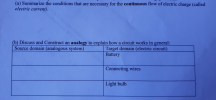
(a) Summarize the conditions that are necessary for the continuous flow of electric charge (called electric current). b) Discuss and Construct an analogy to explain how a circuit works in general: Source domain (analogous system) Target domain (electric circuit) Battery Connecting wires Light bulb
Please anawer all the parts of the question
(a) Summarize the conditions that are necessary for the continuous flow of electric charge (called electric current). b) Discuss and Construct an analogy to explain how a circuit works in general: Source domain (analogous system) Target domain (electric circuit) Battery Connecting wires Light bulb
Please anawer all the parts of the question 2. The electrical device whose symbol is shown...
 Please anawer all the parts of the question
2. The electrical device whose symbol is shown at right requires a terminal voltage D of 12 V and a current of 2.0 A for proper operation. 1) Find the power of the device. 2) Using only this device and one or more 3-Q resistors, design a circuit so that the device will operate properly when the circuit is connected across a 24 V battery with negligible internal resistance
Please anawer all the parts of the question
2. The electrical device whose symbol is shown at right requires a terminal voltage D of 12 V and a current of 2.0 A for proper operation. 1) Find the power of the device. 2) Using only this device and one or more 3-Q resistors, design a circuit so that the device will operate properly when the circuit is connected across a 24 V battery with negligible internal resistance
Determine the equivalent resistance of the "ladder" of equal 155-? resistors. In other words, what resistance...
 Determine the equivalent resistance of the "ladder" of equal
155-? resistors. In other words, what resistance would an ohmmeter
read if connected between points A and B?
What is the current through resistor a if a 50.0-V battery is
connected between points A and B?
What is the current through resistor b?
What is the current through resistor c
Determine the equivalent resistance of the "ladder" of equal
155-? resistors. In other words, what resistance would an ohmmeter
read if connected between points A and B?
What is the current through resistor a if a 50.0-V battery is
connected between points A and B?
What is the current through resistor b?
What is the current through resistor c
12: A: Determine the equivalent resistance of the circuit. O2 201 B: Determine the current being...
 12: A: Determine the equivalent resistance of the circuit. O2 201 B: Determine the current being delivered by the battery and the total power delivered by the battery. deivesed to C: Determine the power disipatedby each resistor
a. What is the equivalent resistance in the circuit shown in the figure? b. If V...
 a. What is the equivalent resistance in the circuit shown in the
figure?
b. If V = 10 V, what is the total current supplied by the
battery to the circuit?
c. What is the voltage between points A and B in the circuit?
(Hint: Find the equivalent resistance between points A and B and
then use Ohm’s law
i. What is the equivalent resistance in the circuit shown in the figure? ii. If V = 10 V, what is...
a. What is the equivalent resistance in the circuit shown in the
figure?
b. If V = 10 V, what is the total current supplied by the
battery to the circuit?
c. What is the voltage between points A and B in the circuit?
(Hint: Find the equivalent resistance between points A and B and
then use Ohm’s law
i. What is the equivalent resistance in the circuit shown in the figure? ii. If V = 10 V, what is...
Determine the equivalent resistance R and the equivalent capacitance C
 In Circuit \(\mathrm{A}\) in Figure 3, each resistor has a resistance of \(1 \mathrm{k} \Omega\) and each capacitor has a capacitance of \(2 \mu \mathrm{F}\). Circuit A can be simplified to the equivalent Circuit B in Figure 3 .(a) Determine the equivalent resistance R and the equivalent capacitance C. Write your final answers in the blank spaces below Circuit B in Figure 3 .For the remainder of this question, refer to Circuit \(\mathrm{B}\). In Circuit \(\mathrm{B}\), the capacitor is allowed to charge...
Part A: Determine the equivalent resistance of the "ladder" of equal 115-Ω resistors shown in (Figure...
Part A: Determine the equivalent resistance of the "ladder" of equal 115-Ω resistors shown in (Figure 1) . In other words, what resistance would an ohmmeter read if connected between points A and B? Part B : What is the current through resistor a if a 65.0-V battery is connected between points A and B? Part C: What is the current through resistor b? Part D: What is the current through resistor c?
 Please anawer all the parts of the question
. A 10 ohm and a 15 ohm resistor are connected in parallel and placed across the terminals of a 15 volt battery a. Sketch the circuit diagram. b. Calculate the equivalent resistance of the circuit. c. Calculate the total current through the entire circuit. d. Calculate the current in each branch.
Please anawer all the parts of the question
. A 10 ohm and a 15 ohm resistor are connected in parallel and placed across the terminals of a 15 volt battery a. Sketch the circuit diagram. b. Calculate the equivalent resistance of the circuit. c. Calculate the total current through the entire circuit. d. Calculate the current in each branch.
 Part A)
Find the equivalent
resistance of all the resistors in the circuit below.
Part B)
Find the current
through the battery.
Part C)
Find total amount of
energy stored across all the capacitors once they are completely
charged by a 1.5V battery.
10Ω 15Ω ΛΜΑ 40Ω 30Ω 20Ω 1.5V
Part A)
Find the equivalent
resistance of all the resistors in the circuit below.
Part B)
Find the current
through the battery.
Part C)
Find total amount of
energy stored across all the capacitors once they are completely
charged by a 1.5V battery.
10Ω 15Ω ΛΜΑ 40Ω 30Ω 20Ω 1.5V
 All question parts
Determine the equivalent resistance of the "ladder" of equal 215-Omega resistors shown in (Figure1). In other words, what resistance would an ohmmeter read if connected between points A and B? Express your answer to three significant figures and include the appropriate units. What is the current through resistor a if a 50.0-V battery is connected between points A and B? Express your answer to three significant figures and include the appropriate units.
All question parts
Determine the equivalent resistance of the "ladder" of equal 215-Omega resistors shown in (Figure1). In other words, what resistance would an ohmmeter read if connected between points A and B? Express your answer to three significant figures and include the appropriate units. What is the current through resistor a if a 50.0-V battery is connected between points A and B? Express your answer to three significant figures and include the appropriate units.
 Please anawer all the parts of the question
(a) Summarize the conditions that are necessary for the continuous flow of electric charge (called electric current). b) Discuss and Construct an analogy to explain how a circuit works in general: Source domain (analogous system) Target domain (electric circuit) Battery Connecting wires Light bulb
Please anawer all the parts of the question
(a) Summarize the conditions that are necessary for the continuous flow of electric charge (called electric current). b) Discuss and Construct an analogy to explain how a circuit works in general: Source domain (analogous system) Target domain (electric circuit) Battery Connecting wires Light bulb
 Please anawer all the parts of the question
2. The electrical device whose symbol is shown at right requires a terminal voltage D of 12 V and a current of 2.0 A for proper operation. 1) Find the power of the device. 2) Using only this device and one or more 3-Q resistors, design a circuit so that the device will operate properly when the circuit is connected across a 24 V battery with negligible internal resistance
Please anawer all the parts of the question
2. The electrical device whose symbol is shown at right requires a terminal voltage D of 12 V and a current of 2.0 A for proper operation. 1) Find the power of the device. 2) Using only this device and one or more 3-Q resistors, design a circuit so that the device will operate properly when the circuit is connected across a 24 V battery with negligible internal resistance
 Determine the equivalent resistance of the "ladder" of equal
155-? resistors. In other words, what resistance would an ohmmeter
read if connected between points A and B?
What is the current through resistor a if a 50.0-V battery is
connected between points A and B?
What is the current through resistor b?
What is the current through resistor c
Determine the equivalent resistance of the "ladder" of equal
155-? resistors. In other words, what resistance would an ohmmeter
read if connected between points A and B?
What is the current through resistor a if a 50.0-V battery is
connected between points A and B?
What is the current through resistor b?
What is the current through resistor c
 12: A: Determine the equivalent resistance of the circuit. O2 201 B: Determine the current being delivered by the battery and the total power delivered by the battery. deivesed to C: Determine the power disipatedby each resistor
 a. What is the equivalent resistance in the circuit shown in the
figure?
b. If V = 10 V, what is the total current supplied by the
battery to the circuit?
c. What is the voltage between points A and B in the circuit?
(Hint: Find the equivalent resistance between points A and B and
then use Ohm’s law
i. What is the equivalent resistance in the circuit shown in the figure? ii. If V = 10 V, what is...
a. What is the equivalent resistance in the circuit shown in the
figure?
b. If V = 10 V, what is the total current supplied by the
battery to the circuit?
c. What is the voltage between points A and B in the circuit?
(Hint: Find the equivalent resistance between points A and B and
then use Ohm’s law
i. What is the equivalent resistance in the circuit shown in the figure? ii. If V = 10 V, what is...
 In Circuit \(\mathrm{A}\) in Figure 3, each resistor has a resistance of \(1 \mathrm{k} \Omega\) and each capacitor has a capacitance of \(2 \mu \mathrm{F}\). Circuit A can be simplified to the equivalent Circuit B in Figure 3 .(a) Determine the equivalent resistance R and the equivalent capacitance C. Write your final answers in the blank spaces below Circuit B in Figure 3 .For the remainder of this question, refer to Circuit \(\mathrm{B}\). In Circuit \(\mathrm{B}\), the capacitor is allowed to charge...
Most questions answered within 3 hours.
-
Where is the error in this code sequence?
String s1 = "Hello";
String s2 = "ello";...
asked 11 months ago -
Financial data for Joel de Paris, Inc., for last year
follow:
Joel de Paris, Inc.
Balance...
asked 11 months ago -
Consider this reaction:
Al2(SO4)3 (aq)+ BaCl3
(aq) Al2Cl6 (aq)- +
3BaSO4(s) . What is the...
asked 11 months ago -
Suppose that Savneet is considering increasing her
recent random sample from 20 car rentals to 40...
asked 11 months ago -
Trucks arrive at an unloading terminal at an average rate of 120
per hour.
Trucks arrive...
asked 11 months ago -
Why are methanol and ethanol completely soluble in water while
octanol is not very little soluble....
asked 11 months ago -
A facilities manager at a university reads in a research report
that the mean amount of...
asked 11 months ago -
When the CuSO4 is rehydrated by adding water to the anhydrous
compound, is this an endothermic...
asked 11 months ago -
A ray of sunlight is passing from diamond into crown glass; the
angle of incidence is...
asked 11 months ago -
A block of mass 0.249 kg is placed on top of a light, vertical
spring of...
asked 11 months ago -
how do the kidneys compensate in the presences of acidosis
a) trigger hyperventilate
b) reserve acid...
asked 11 months ago -
Question 501 pts
The rental rate of capital to the firm increases. Which of the
following...
asked 11 months ago