
Homework Answers
Answer - 8
ATC = TC/Q , AVC = TVC/Q , MC = 
TC = TVC + TFC,
Using these formulas we have the following result:
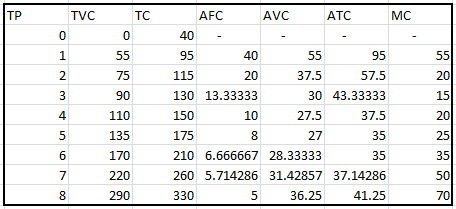
a)
A purely competitive firm produce that quantity at which Price(P) = MC( and If P not equals MC then P must be just greater than MC) and MC is rising. Also in the short run A firm will prefer to shut down If P is lesser than AVC.
Suppose P = 65, then P will be just greater than MC and MC is rising when Q = 7.
Hence Firm will produce 7 units.
Profit = Total Revenue - Total Cost = P*Q - TC = 7*65 - 260 = $195
b)
Suppose P = 18, then P will be just greater than MC , Q = 3. Note that when Q = 3 , AVC = 30
Hence, AVC > P. This implies firm will prefer to shutdown.
Hence Firm will produce 0 units.
Profit = Total Revenue - Total Cost = P*Q - TC = 3*0 - 40 = -$40
Hence. Firm's loss = $40 (or Profit = $-40)
Add Answer to:
8. Assume a single firm in a purely competitive industry has costs as indicated in the...
(43) Assume a single firm in a purely competitive industry has short-run production costs as indi...
 (43) Assume a single firm in a purely competitive industry has short-run production costs as indicated in the following table. Answer questions a through c using the data from this table. TVC-Total variable Costs. TC=Total Costs: AFC=Average Fixed Costs; AVC=Average Variable Costs; ATC-Average Total Costs; MC-Marginal Costs Total Output Total Variable Cost $ TVC TC 0 $5.00 $8.00 $10.00 $11.00 $13.00 $16.00 $20.00 Total Cost $ Average Average Average Total Cost Cost $ MC Marginal Fixed CosVariable $ AFC Cost...
4 Assume that a purely competitive firm has the schedule of the average and marginal costs...
4 Assume that a purely competitive firm has the schedule of the average and marginal costs given in the table below ------------------------------------------------------- OUTPUT AFC AVC ATC MC -------------------------------------------------------- 1 $300 $100 $400 $100 2 150 75 225 50 3 100 70 170 60 4 75 73 148 80 5 60 80 140 110 6 50 90 140 140 7 43 103 146 180 8 38 119 156 230 --------------------------------------------------------- a. At a price of $68, the firm will produce _____...
In the accompanying table, you are given information about a firm that operates in a competitive...
In the accompanying table, you are given information about a firm that operates in a competitive market. Assume that TFC is $20. Q TVC MC AVC 1 $24 2 30 3 38 4 48 5 62 6 82 7 110 Complete the table (solve for MC and AVC). Show sample calculations. What is the lowest P at which the firm will produce in the short run? How many units of output will it produce at that P (referring to b)?...
Help with #8-11 please. For questions 8-11, refer to this diagram for 2 purely competitive producer....
 Help with #8-11 please.
For questions 8-11, refer to this diagram for 2 purely competitive producer. ATC AVC 8. The lowest price at which the firm should produce (as opposed to shutting down) is: A.P. B. P2 C.P. D. P. 9. The firm will produce at a loss at all prices: A. Above P2. B. Above P3. C. Above P. D. Between P2 and Ps. 10. If product price is P3: A. The firm will maximize profit at point d....
Help with #8-11 please.
For questions 8-11, refer to this diagram for 2 purely competitive producer. ATC AVC 8. The lowest price at which the firm should produce (as opposed to shutting down) is: A.P. B. P2 C.P. D. P. 9. The firm will produce at a loss at all prices: A. Above P2. B. Above P3. C. Above P. D. Between P2 and Ps. 10. If product price is P3: A. The firm will maximize profit at point d....
Assume that a purely competitive firm has the following schedule of average and marginal costs: Output...
 Assume that a purely competitive firm has the following schedule of average and marginal costs: Output 1 AFC $300 150 100 No от во 60 50 43 38 33 30 AVC $100 75 70 73 80 90 103 119 138 160 ATC $400 225 170 148 140 140 146 156 171 190 MC $100 50 60 80 110 140 180 230 290 360 9 10 e. At a price of $55, the firm would produce units of output. At a...
Help with #15 please. 15. Suppose a firm ina purely competitive market discovers that the price of its product is ab...
 Help with #15 please.
15. Suppose a firm ina purely competitive market discovers that the price of its product is above its minimum AVc point but everywhere below ATC. Given this, the firm: A. Minimizes losses by producing at the minimum point of its AFC curve. B. Maximizes profits by producing where MR ATC. C. Should close down immediately. D. Should continue producing in the short run.
Help with #15 please.
15. Suppose a firm ina purely competitive market discovers that the price of its product is above its minimum AVc point but everywhere below ATC. Given this, the firm: A. Minimizes losses by producing at the minimum point of its AFC curve. B. Maximizes profits by producing where MR ATC. C. Should close down immediately. D. Should continue producing in the short run.
suppose a competitive firm has the following cost: PART 2 This cost table is related to...
suppose a competitive firm has the following cost: PART 2 This cost table is related to a competitive firm. Q. TFC TVC TC AVC ATC MC 0 30 NA NA NA 1 50 2 66 3 80 4 90 5 100 6 114 7 131.2 8 150 9 190 Using this table above, answer the following questions. 6 Complete the table above. 7 Plot ATC, AVC, and MC in one diagram. 8 What is the shutdown price? 9...
The marginal costs (MC), average variable costs (AVC), and average total costs (ATC) for a firm are shown in the figure to the right. The market price is $10.
 5) Perfect Competition III The marginal costs (MC), average variable costs (AVC), and average total costs (ATC) for a firm are shown in the figure to the right. The market price is $10. a. What is the firm's profit-maximizing output level? b. Will the firm produce in the short-run? Why or why not? c. If the firm is producing in the short-run, is it earning a profit [yes, no, or N/A]? What is the firm's profit or loss per unit? d. What is the firm's...
Assume that the cost data in the following table are for a purely competitive producer:
Assume that the cost data in the following table are for a purely competitive producer: TotalProductAverageFixed CostAverageVariable CostAverageTotal CostMarginal Cost01$60.00$45.00$105.00$45.00230.00 42.50 72.5040.00320.00 40.00 60.0035.00415.00 37.50 52.5030.00512.00 37.00 49.0035.00610.00 37.50 47.5040.0078.57 38.57 47.1445.008 7.50 40.63 48.1355.009 6.67 43.33 50.0065.0010 6.00 46.50 52.5075.00 Instructions: If you are entering any negative numbers be sure to include a negative sign (−) in front of those numbers. Select "Not applicable" and enter a value of "0" for output if the firm does not produce. a. At a product price of $66.00 (i) Will this firm produce in the short run? (Click to select) No Yes (ii) If it is preferable to produce, what...
CHAPTER 8- PERFECT COMPETITION-PRACTICE PROBLEMS 2 Assume the following cost data are for a purely competitive...
 CHAPTER 8- PERFECT COMPETITION-PRACTICE PROBLEMS 2 Assume the following cost data are for a purely competitive producer Total Cost Cost 45 1 $4000 $45.00 $105.00 2 0.00 3 20.00 15.00 12.00 10.00 857 7.50 7250 6000 52.50 49.00 47 50 47.14 48.13 50.00 52.50 30 35 7.50 37.00 7.50 3.33 75 a. At a product price of $56, will this firm produce in the short run? If it is preferable to produce, what will be the profit-maximizing or loss-minimizing output?...
 (43) Assume a single firm in a purely competitive industry has short-run production costs as indicated in the following table. Answer questions a through c using the data from this table. TVC-Total variable Costs. TC=Total Costs: AFC=Average Fixed Costs; AVC=Average Variable Costs; ATC-Average Total Costs; MC-Marginal Costs Total Output Total Variable Cost $ TVC TC 0 $5.00 $8.00 $10.00 $11.00 $13.00 $16.00 $20.00 Total Cost $ Average Average Average Total Cost Cost $ MC Marginal Fixed CosVariable $ AFC Cost...
 Help with #8-11 please.
For questions 8-11, refer to this diagram for 2 purely competitive producer. ATC AVC 8. The lowest price at which the firm should produce (as opposed to shutting down) is: A.P. B. P2 C.P. D. P. 9. The firm will produce at a loss at all prices: A. Above P2. B. Above P3. C. Above P. D. Between P2 and Ps. 10. If product price is P3: A. The firm will maximize profit at point d....
Help with #8-11 please.
For questions 8-11, refer to this diagram for 2 purely competitive producer. ATC AVC 8. The lowest price at which the firm should produce (as opposed to shutting down) is: A.P. B. P2 C.P. D. P. 9. The firm will produce at a loss at all prices: A. Above P2. B. Above P3. C. Above P. D. Between P2 and Ps. 10. If product price is P3: A. The firm will maximize profit at point d....
 Assume that a purely competitive firm has the following schedule of average and marginal costs: Output 1 AFC $300 150 100 No от во 60 50 43 38 33 30 AVC $100 75 70 73 80 90 103 119 138 160 ATC $400 225 170 148 140 140 146 156 171 190 MC $100 50 60 80 110 140 180 230 290 360 9 10 e. At a price of $55, the firm would produce units of output. At a...
 Help with #15 please.
15. Suppose a firm ina purely competitive market discovers that the price of its product is above its minimum AVc point but everywhere below ATC. Given this, the firm: A. Minimizes losses by producing at the minimum point of its AFC curve. B. Maximizes profits by producing where MR ATC. C. Should close down immediately. D. Should continue producing in the short run.
Help with #15 please.
15. Suppose a firm ina purely competitive market discovers that the price of its product is above its minimum AVc point but everywhere below ATC. Given this, the firm: A. Minimizes losses by producing at the minimum point of its AFC curve. B. Maximizes profits by producing where MR ATC. C. Should close down immediately. D. Should continue producing in the short run.
 CHAPTER 8- PERFECT COMPETITION-PRACTICE PROBLEMS 2 Assume the following cost data are for a purely competitive producer Total Cost Cost 45 1 $4000 $45.00 $105.00 2 0.00 3 20.00 15.00 12.00 10.00 857 7.50 7250 6000 52.50 49.00 47 50 47.14 48.13 50.00 52.50 30 35 7.50 37.00 7.50 3.33 75 a. At a product price of $56, will this firm produce in the short run? If it is preferable to produce, what will be the profit-maximizing or loss-minimizing output?...
Most questions answered within 3 hours.
-
Where is the error in this code sequence?
String s1 = "Hello";
String s2 = "ello";...
asked 11 months ago -
Financial data for Joel de Paris, Inc., for last year
follow:
Joel de Paris, Inc.
Balance...
asked 11 months ago -
Consider this reaction:
Al2(SO4)3 (aq)+ BaCl3
(aq) Al2Cl6 (aq)- +
3BaSO4(s) . What is the...
asked 11 months ago -
Suppose that Savneet is considering increasing her
recent random sample from 20 car rentals to 40...
asked 11 months ago -
Trucks arrive at an unloading terminal at an average rate of 120
per hour.
Trucks arrive...
asked 11 months ago -
Why are methanol and ethanol completely soluble in water while
octanol is not very little soluble....
asked 11 months ago -
A facilities manager at a university reads in a research report
that the mean amount of...
asked 11 months ago -
When the CuSO4 is rehydrated by adding water to the anhydrous
compound, is this an endothermic...
asked 11 months ago -
A ray of sunlight is passing from diamond into crown glass; the
angle of incidence is...
asked 11 months ago -
A block of mass 0.249 kg is placed on top of a light, vertical
spring of...
asked 11 months ago -
how do the kidneys compensate in the presences of acidosis
a) trigger hyperventilate
b) reserve acid...
asked 11 months ago -
Question 501 pts
The rental rate of capital to the firm increases. Which of the
following...
asked 11 months ago