
Homework Answers
Trans-Fe complexes of both the compounds are given below.
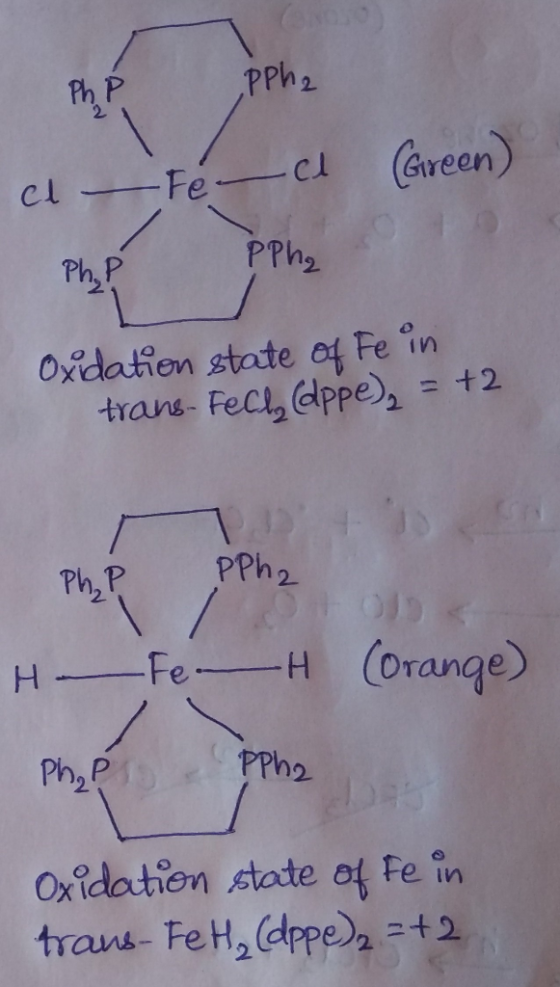
To know the type of splitting we need to calculate the coordination number (CN) of central metal (Fe) for the above mentioned complexes.
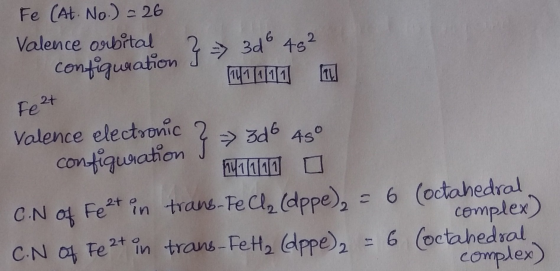
As we can see, the CN of both the complexes is 6. This means octahedral splitting occurs due to crystal field. Both Cl- and H- ions are weak field ligands. but H- is even weaker than Cl- . Hence the splitting and electronic distribution is as follows.
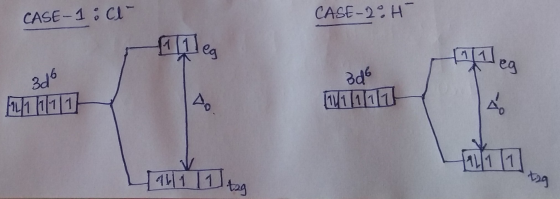
Both the complexes have the same profile as far as oxidation number, coordination number, pattern of splitting and electronic distribution is concerned. But, varies in Crystal Field Splitting Energy(CFSE or ∆o)
In CASE - 1 and CASE - 2 as described above, ∆o > ∆'o
Hence CFSE in the case of Cl2 complex is greater than that of hydridecomplex. This causes the difference in colour as seen in the complexes.
Add Answer to:
inorganic chemistry
1) trans-FeCl2(dppe)2 is a green colored compound. Upon reduction of this coordination compound with...
inorganic chemistry 1) trans-FeCl2(dppe)2 is a green colored compound. Upon reduction of this coordination compound with...
 inorganic chemistry
1) trans-FeCl2(dppe)2 is a green colored compound. Upon reduction of this coordination compound with NaBH4, and orange colored trans-FeH2(dppe)2 results. Explain the origin in the difference of colors by drawing a d-orbital splitting diagram for each complex.
inorganic chemistry
1) trans-FeCl2(dppe)2 is a green colored compound. Upon reduction of this coordination compound with NaBH4, and orange colored trans-FeH2(dppe)2 results. Explain the origin in the difference of colors by drawing a d-orbital splitting diagram for each complex.
Inorganic Chemistry Please help me with #5-#7 5. Draw a d-orbital energy-level diagram, and predict the...
 Inorganic Chemistry
Please help me with #5-#7
5. Draw a d-orbital energy-level diagram, and predict the number of unpaired electrons. a) Fe(CN) b)[Fe(H2O) c) [CoCl2 (tetrahedral) 6. Of the two complexes (a) [CoFeP and (b) [Co(en) one appears yellow and the other appears blue. Match the complex to the color and explain your choice. 7. Three different solutions with orange, green, and violet colors were prepared. Associate each color to the following complexes: [CrCle, (Cr(NHs, and (Cr(H2O
Inorganic Chemistry
Please help me with #5-#7
5. Draw a d-orbital energy-level diagram, and predict the number of unpaired electrons. a) Fe(CN) b)[Fe(H2O) c) [CoCl2 (tetrahedral) 6. Of the two complexes (a) [CoFeP and (b) [Co(en) one appears yellow and the other appears blue. Match the complex to the color and explain your choice. 7. Three different solutions with orange, green, and violet colors were prepared. Associate each color to the following complexes: [CrCle, (Cr(NHs, and (Cr(H2O
Part 1: Tony has been monitoring wildlife around a stream near the Delaware Tech campus for an ongoing Biology proj...
 Part 1: Tony has been monitoring wildlife around a stream near the Delaware Tech campus for an ongoing Biology project. During his last visit to the stream he noticed that there were rusty-red deposits on a number of the rocks. When he scooped up some of the water he saw that it appeared to be cloudy and had a yellowish tint. He thought it smelled slightly metallic. However, he did not observe any signs that wildlife had been harmed At...
What are the instruments that have been utilized for the review article discussions? ` 1. Introduction...
 What are the instruments that have been utilized for the
review article discussions?
`
1. Introduction In recent years, nanoclays have been the object of particular interest for many scientists and researchers in chemistry, physics, engineering and biology due to their excellent properties as well as their sustain- ability [1-3]. For instance, they represent the starting point to the de velopment of smart materials for drug delivery (4-9), food packaging [10-12), environmental remediation and wastewater treatment [13], cultural heritage [14–17and...
What are the instruments that have been utilized for the
review article discussions?
`
1. Introduction In recent years, nanoclays have been the object of particular interest for many scientists and researchers in chemistry, physics, engineering and biology due to their excellent properties as well as their sustain- ability [1-3]. For instance, they represent the starting point to the de velopment of smart materials for drug delivery (4-9), food packaging [10-12), environmental remediation and wastewater treatment [13], cultural heritage [14–17and...
 inorganic chemistry
1) trans-FeCl2(dppe)2 is a green colored compound. Upon reduction of this coordination compound with NaBH4, and orange colored trans-FeH2(dppe)2 results. Explain the origin in the difference of colors by drawing a d-orbital splitting diagram for each complex.
inorganic chemistry
1) trans-FeCl2(dppe)2 is a green colored compound. Upon reduction of this coordination compound with NaBH4, and orange colored trans-FeH2(dppe)2 results. Explain the origin in the difference of colors by drawing a d-orbital splitting diagram for each complex.
 Inorganic Chemistry
Please help me with #5-#7
5. Draw a d-orbital energy-level diagram, and predict the number of unpaired electrons. a) Fe(CN) b)[Fe(H2O) c) [CoCl2 (tetrahedral) 6. Of the two complexes (a) [CoFeP and (b) [Co(en) one appears yellow and the other appears blue. Match the complex to the color and explain your choice. 7. Three different solutions with orange, green, and violet colors were prepared. Associate each color to the following complexes: [CrCle, (Cr(NHs, and (Cr(H2O
Inorganic Chemistry
Please help me with #5-#7
5. Draw a d-orbital energy-level diagram, and predict the number of unpaired electrons. a) Fe(CN) b)[Fe(H2O) c) [CoCl2 (tetrahedral) 6. Of the two complexes (a) [CoFeP and (b) [Co(en) one appears yellow and the other appears blue. Match the complex to the color and explain your choice. 7. Three different solutions with orange, green, and violet colors were prepared. Associate each color to the following complexes: [CrCle, (Cr(NHs, and (Cr(H2O
 Part 1: Tony has been monitoring wildlife around a stream near the Delaware Tech campus for an ongoing Biology project. During his last visit to the stream he noticed that there were rusty-red deposits on a number of the rocks. When he scooped up some of the water he saw that it appeared to be cloudy and had a yellowish tint. He thought it smelled slightly metallic. However, he did not observe any signs that wildlife had been harmed At...
 What are the instruments that have been utilized for the
review article discussions?
`
1. Introduction In recent years, nanoclays have been the object of particular interest for many scientists and researchers in chemistry, physics, engineering and biology due to their excellent properties as well as their sustain- ability [1-3]. For instance, they represent the starting point to the de velopment of smart materials for drug delivery (4-9), food packaging [10-12), environmental remediation and wastewater treatment [13], cultural heritage [14–17and...
What are the instruments that have been utilized for the
review article discussions?
`
1. Introduction In recent years, nanoclays have been the object of particular interest for many scientists and researchers in chemistry, physics, engineering and biology due to their excellent properties as well as their sustain- ability [1-3]. For instance, they represent the starting point to the de velopment of smart materials for drug delivery (4-9), food packaging [10-12), environmental remediation and wastewater treatment [13], cultural heritage [14–17and...
Most questions answered within 3 hours.
-
Where is the error in this code sequence?
String s1 = "Hello";
String s2 = "ello";...
asked 11 months ago -
Financial data for Joel de Paris, Inc., for last year
follow:
Joel de Paris, Inc.
Balance...
asked 11 months ago -
Consider this reaction:
Al2(SO4)3 (aq)+ BaCl3
(aq) Al2Cl6 (aq)- +
3BaSO4(s) . What is the...
asked 11 months ago -
Suppose that Savneet is considering increasing her
recent random sample from 20 car rentals to 40...
asked 11 months ago -
Trucks arrive at an unloading terminal at an average rate of 120
per hour.
Trucks arrive...
asked 11 months ago -
Why are methanol and ethanol completely soluble in water while
octanol is not very little soluble....
asked 11 months ago -
A facilities manager at a university reads in a research report
that the mean amount of...
asked 11 months ago -
When the CuSO4 is rehydrated by adding water to the anhydrous
compound, is this an endothermic...
asked 11 months ago -
A ray of sunlight is passing from diamond into crown glass; the
angle of incidence is...
asked 11 months ago -
A block of mass 0.249 kg is placed on top of a light, vertical
spring of...
asked 11 months ago -
how do the kidneys compensate in the presences of acidosis
a) trigger hyperventilate
b) reserve acid...
asked 11 months ago -
Question 501 pts
The rental rate of capital to the firm increases. Which of the
following...
asked 11 months ago