
Homework Answers
Consider the given problem here the market demand function is given by, “P = 90 - 5*Q”, where “Q = Q1 + Q2”. Now, the cost function of two firms are given by, “C1(Q1) = 10 + 5*Q1” and “C2(Q2) = 5 + 10*Q1”, => the marginal cost functions are given by.
=> MC1 = 5 and MC2 = 10, where “MC1 < MC2”. Now, since marginal cost of “firm1” is less than “firm2”, => under the cooperation only “firm1” will produce and “firm2” will not produce ay output. So, here the “MR” is given by.
=> MR = 90 - 10*Q and “MC1 = 5”, => at the equilibrium “MR = MC1”, => 90 - 10*Q = 5, => Q = 85/10 = 8.5. So, here the profit maximizing total output is given by “Q = 8.5”, where “Q1=8.5” and “Q2=0”.
Combined, the firms will produce “Q=8.5 units” of output of which “firm1” will produce “Q1=8.5 units” and “firm2” will produce “Q2 = 0 units”.
Now, under the Cournot model the profit function of the individual firms are given by.
=> A1 = P*Q1 - C1 = (90 – 5*Q1 – 5*Q2)*Q1 - (10 + 5*Q1) = 90*Q1 – 5*Q1^2 – 5*Q2*Q1 - 10 - 5*Q1.
=> A1 = 85*Q1 – 5*Q1^2 – 5*Q2*Q1 - 10.
Similarly, the profit function of “firm2” is given by.
=> A2 = P*Q2 – C2 = (90 – 5*Q1 – 5*Q2)*Q2 - (5 + 10*Q2) = 90*Q2 – 5*Q1*Q2 – 5*Q2^2 - 5 - 10*Q2.
=> A2 = 80*Q2 – 5*Q1*Q2 – 5*Q2^2 - 5.
So, the FOC require “dA1/dQ1 = dA2/dQ2 = 0”.
=> dA1/dQ1 = 85 - 10*Q1 - 5*Q2 = 0, => 10*Q1 = 85 - 5*Q2, => Q1 = 8.5 - 0.5*Q2, be the reaction function of “firm1”.
Now, “dA2/dQ2 = 0”, => 80 - 5*Q1 - 10*Q2 = 0, => 10*Q2 = 80 - 5*Q1, => Q2 = 8 - 0.5*Q1, be the reaction function of “firm2”.
Now, by simultaneously solving those equations we get the optimum solutions, => “Q1 = 6 units” and “Q2 = 5 units”, => “Q = Q1 + Q2 = 11 units”.
So, if the firms compete, then “firm1” will produce “6 units” of output and “firm2” will produce “5 units” of output.
Add Answer to:
Consider two firms facing the demand curve P=90-SQ. 17 where Q Q1+02. The firms' cost functions...
Joint profit maximizing level of output Consider two firms facing the demand curve 17 P#90-SQ. where...
 Joint profit maximizing level of output
Consider two firms facing the demand curve 17 P#90-SQ. where Q Q1+Q2. The firms' cost functions are C1 (91) -10+50, and c2(Q2)#5+10Q2. Suppose that both firms have entered the industry. What is the joint profit-maximizing level of output? How much will each firm produce? Combined, the firms will produce units of output, of which Firm 1 will produce ] units and Firm 2 will produce □ units. (Enter a numeric response using a real...
Joint profit maximizing level of output
Consider two firms facing the demand curve 17 P#90-SQ. where Q Q1+Q2. The firms' cost functions are C1 (91) -10+50, and c2(Q2)#5+10Q2. Suppose that both firms have entered the industry. What is the joint profit-maximizing level of output? How much will each firm produce? Combined, the firms will produce units of output, of which Firm 1 will produce ] units and Firm 2 will produce □ units. (Enter a numeric response using a real...
Consider two firms facing the demand curve 18 17 16 P=60-5Q where Q Q +Q The...
 Consider two firms facing the demand curve 18 17 16 P=60-5Q where Q Q +Q The firms' cost functions are C1(Q110+15Q1 12 and C2 (°2)-5+3002 Suppose that both firms have entered the industry. What is the joint profit-maximizing level of output? How much will each firm produce? Combined, the firms will produce units of output of which Firm 1 w produce units and Firm 2 will produce units. (Enter a numeric response using a real number rounded to two decimal...
Consider firms facing the demand curve P=90-5Q 17 where Q- Q1 +Q2 The firms' cost functions...
 Consider firms facing the demand curve P=90-5Q 17 where Q- Q1 +Q2 The firms' cost functions are Cl (Q1) = 15 + 5Q1 12 and (2)-+1002 Suppose that both firms have entered the industry. What is the joint profit-maximizing level of output? How much will each firm produce? Combined, the firms will produce units of output, of which Firm 1 will produceunits and Firm 2 will produce units. (Enter a numeric response using a real number rounded to two decimal...
Joint profit maximizing output and Cournot model Consider two firms facing the demand curve P=75-5C, where...
 Joint profit maximizing output and Cournot model
Consider two firms facing the demand curve P=75-5C, where Q Q1 +Q2. The firms' cost functions are Cl (Q1) = 15 +10Q1 and C2 (Q2)-10 + 20Q2. Suppose that both firms have entered the industry. What is the joint profit-maximizing level of output? How much will each firm produce? Combined, the firms will produce units of output, of which Firm 1 will produce units and Firm 2 will produceunits. (Enter a numeric response...
Joint profit maximizing output and Cournot model
Consider two firms facing the demand curve P=75-5C, where Q Q1 +Q2. The firms' cost functions are Cl (Q1) = 15 +10Q1 and C2 (Q2)-10 + 20Q2. Suppose that both firms have entered the industry. What is the joint profit-maximizing level of output? How much will each firm produce? Combined, the firms will produce units of output, of which Firm 1 will produce units and Firm 2 will produceunits. (Enter a numeric response...
PLEASE HELP ON GRAPH AND LAST QUESTION ONLY Consider two firms facing the demand curve P-90-5Q,...
 PLEASE HELP ON GRAPH AND LAST QUESTION ONLY
Consider two firms facing the demand curve P-90-5Q, 17 where Q Q1+Q2. The firms' cost functions are C(Q1) 10+501 and C2 (Q2)" 5 + 10Q2 Suppose that both firms have entered the industry. What is the joint profit-maximizing level of output? How much will each firm produce? Combined, the firms will produce 8.5 units of output, of which Firm 1 will produce 8.5 units and Firm 2 will produce 8 9 10...
PLEASE HELP ON GRAPH AND LAST QUESTION ONLY
Consider two firms facing the demand curve P-90-5Q, 17 where Q Q1+Q2. The firms' cost functions are C(Q1) 10+501 and C2 (Q2)" 5 + 10Q2 Suppose that both firms have entered the industry. What is the joint profit-maximizing level of output? How much will each firm produce? Combined, the firms will produce 8.5 units of output, of which Firm 1 will produce 8.5 units and Firm 2 will produce 8 9 10...
Homework: Assignment 2_w19 Score: 0 of 11 pts 5 of 7 (5 complete) HW Score: 20.69%,...
 Homework: Assignment 2_w19 Score: 0 of 11 pts 5 of 7 (5 complete) HW Score: 20.69%, 6 of 2 Question Help Instructor-created question Consider two firms facing the demand curve P-75-5Q 18 17 where QQ1 +Q2. The firms' cost functions are 1(Q1) -15+ 100, 13 12 and C2 (2) 5+2002 Suppose that both firms have entered the industry. What is the joint profit-maximizing level of output? How much will each firm produce? Combined, the firms will produceunits of output, of...
Homework: Assignment 2 w19 Score: 0 of 11 pts Instructor-created question Save 5 of 7 (5...
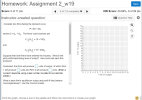 Homework: Assignment 2 w19 Score: 0 of 11 pts Instructor-created question Save 5 of 7 (5 complete) HW Score: 20.69%, 6 of 29 pts Question Help Consider two firms facing the demand curve 17 where Q Q, +Q2. The firms' cost functions are C1 (01 10+15Q1 12 and (2) 15+3002 Suppose that both firms have entered the industry. What is the joint profit-maximizing level of output? How much will each firm produce? Combined, the firms will produce units of output,...
Consider two firms with the same constant average and marginal cost, AC = MC = 5...
Consider two firms with the same constant average and marginal cost, AC = MC = 5 (meaning the cost function is T C1 = 5q1 , T C2 = 5q2 ), facing the market demand curve q1 + q2 = 53 − P . We will use the Stackelberg model to analyze what will happen if one of the firms makes its output decision before the other. What is each firm’s equilibrium output and profit if they behave noncooperatively and...
Consider an (inverse) demand curve P = 30 - Q. And a total cost curve of...
Consider an (inverse) demand curve P = 30 - Q. And a total cost curve of C(Q) = 12Q. (a) Assume a monopolist is operating in this market. (i) Calculate the quantity (qM) chosen by a profit-maximizing monopolist. (ii) At the profit-maximizing quantity, what is the monopolistic market price (pM) of the product. (iii) Calculate the dead-weight loss (allocative inefficiency) associated with this monopoly market. Assume the market for this product is perfectly competitive. (i) Calculate the market-clearing output (qPC)...
Two identical firms face a linear demand curve (written as inverse demand of P = 50...
 Two identical firms face a linear demand curve (written as inverse demand of P = 50 -0.50, The marginal cost for each firm is MC = 0. Assume that both firms compete as Cournot dupolists. Find the equilibrium output for each firm and the market price. o Select one: a. Each firm will produce 66.67 units, and the market price is $33.33 b. Each firm will produce 25 units, and the market price is $25 c. Each firm will produce...
 Joint profit maximizing level of output
Consider two firms facing the demand curve 17 P#90-SQ. where Q Q1+Q2. The firms' cost functions are C1 (91) -10+50, and c2(Q2)#5+10Q2. Suppose that both firms have entered the industry. What is the joint profit-maximizing level of output? How much will each firm produce? Combined, the firms will produce units of output, of which Firm 1 will produce ] units and Firm 2 will produce □ units. (Enter a numeric response using a real...
Joint profit maximizing level of output
Consider two firms facing the demand curve 17 P#90-SQ. where Q Q1+Q2. The firms' cost functions are C1 (91) -10+50, and c2(Q2)#5+10Q2. Suppose that both firms have entered the industry. What is the joint profit-maximizing level of output? How much will each firm produce? Combined, the firms will produce units of output, of which Firm 1 will produce ] units and Firm 2 will produce □ units. (Enter a numeric response using a real...
 Consider two firms facing the demand curve 18 17 16 P=60-5Q where Q Q +Q The firms' cost functions are C1(Q110+15Q1 12 and C2 (°2)-5+3002 Suppose that both firms have entered the industry. What is the joint profit-maximizing level of output? How much will each firm produce? Combined, the firms will produce units of output of which Firm 1 w produce units and Firm 2 will produce units. (Enter a numeric response using a real number rounded to two decimal...
 Consider firms facing the demand curve P=90-5Q 17 where Q- Q1 +Q2 The firms' cost functions are Cl (Q1) = 15 + 5Q1 12 and (2)-+1002 Suppose that both firms have entered the industry. What is the joint profit-maximizing level of output? How much will each firm produce? Combined, the firms will produce units of output, of which Firm 1 will produceunits and Firm 2 will produce units. (Enter a numeric response using a real number rounded to two decimal...
 Joint profit maximizing output and Cournot model
Consider two firms facing the demand curve P=75-5C, where Q Q1 +Q2. The firms' cost functions are Cl (Q1) = 15 +10Q1 and C2 (Q2)-10 + 20Q2. Suppose that both firms have entered the industry. What is the joint profit-maximizing level of output? How much will each firm produce? Combined, the firms will produce units of output, of which Firm 1 will produce units and Firm 2 will produceunits. (Enter a numeric response...
Joint profit maximizing output and Cournot model
Consider two firms facing the demand curve P=75-5C, where Q Q1 +Q2. The firms' cost functions are Cl (Q1) = 15 +10Q1 and C2 (Q2)-10 + 20Q2. Suppose that both firms have entered the industry. What is the joint profit-maximizing level of output? How much will each firm produce? Combined, the firms will produce units of output, of which Firm 1 will produce units and Firm 2 will produceunits. (Enter a numeric response...
 PLEASE HELP ON GRAPH AND LAST QUESTION ONLY
Consider two firms facing the demand curve P-90-5Q, 17 where Q Q1+Q2. The firms' cost functions are C(Q1) 10+501 and C2 (Q2)" 5 + 10Q2 Suppose that both firms have entered the industry. What is the joint profit-maximizing level of output? How much will each firm produce? Combined, the firms will produce 8.5 units of output, of which Firm 1 will produce 8.5 units and Firm 2 will produce 8 9 10...
PLEASE HELP ON GRAPH AND LAST QUESTION ONLY
Consider two firms facing the demand curve P-90-5Q, 17 where Q Q1+Q2. The firms' cost functions are C(Q1) 10+501 and C2 (Q2)" 5 + 10Q2 Suppose that both firms have entered the industry. What is the joint profit-maximizing level of output? How much will each firm produce? Combined, the firms will produce 8.5 units of output, of which Firm 1 will produce 8.5 units and Firm 2 will produce 8 9 10...
 Homework: Assignment 2_w19 Score: 0 of 11 pts 5 of 7 (5 complete) HW Score: 20.69%, 6 of 2 Question Help Instructor-created question Consider two firms facing the demand curve P-75-5Q 18 17 where QQ1 +Q2. The firms' cost functions are 1(Q1) -15+ 100, 13 12 and C2 (2) 5+2002 Suppose that both firms have entered the industry. What is the joint profit-maximizing level of output? How much will each firm produce? Combined, the firms will produceunits of output, of...
 Homework: Assignment 2 w19 Score: 0 of 11 pts Instructor-created question Save 5 of 7 (5 complete) HW Score: 20.69%, 6 of 29 pts Question Help Consider two firms facing the demand curve 17 where Q Q, +Q2. The firms' cost functions are C1 (01 10+15Q1 12 and (2) 15+3002 Suppose that both firms have entered the industry. What is the joint profit-maximizing level of output? How much will each firm produce? Combined, the firms will produce units of output,...
 Two identical firms face a linear demand curve (written as inverse demand of P = 50 -0.50, The marginal cost for each firm is MC = 0. Assume that both firms compete as Cournot dupolists. Find the equilibrium output for each firm and the market price. o Select one: a. Each firm will produce 66.67 units, and the market price is $33.33 b. Each firm will produce 25 units, and the market price is $25 c. Each firm will produce...
Most questions answered within 3 hours.
-
Where is the error in this code sequence?
String s1 = "Hello";
String s2 = "ello";...
asked 10 months ago -
Financial data for Joel de Paris, Inc., for last year
follow:
Joel de Paris, Inc.
Balance...
asked 10 months ago -
Consider this reaction:
Al2(SO4)3 (aq)+ BaCl3
(aq) Al2Cl6 (aq)- +
3BaSO4(s) . What is the...
asked 10 months ago -
Suppose that Savneet is considering increasing her
recent random sample from 20 car rentals to 40...
asked 10 months ago -
Trucks arrive at an unloading terminal at an average rate of 120
per hour.
Trucks arrive...
asked 10 months ago -
Why are methanol and ethanol completely soluble in water while
octanol is not very little soluble....
asked 10 months ago -
A facilities manager at a university reads in a research report
that the mean amount of...
asked 10 months ago -
When the CuSO4 is rehydrated by adding water to the anhydrous
compound, is this an endothermic...
asked 10 months ago -
A ray of sunlight is passing from diamond into crown glass; the
angle of incidence is...
asked 10 months ago -
A block of mass 0.249 kg is placed on top of a light, vertical
spring of...
asked 10 months ago -
how do the kidneys compensate in the presences of acidosis
a) trigger hyperventilate
b) reserve acid...
asked 10 months ago -
Question 501 pts
The rental rate of capital to the firm increases. Which of the
following...
asked 10 months ago