if one of my research variables is exercise (explanatory) can my response variable be BMI? if...
if one of my research variables is exercise (explanatory) can my response variable be BMI? if not, what can be my response variable?
Homework Answers
Yes, When explanatory or independent variable is exercise, then we assume BMI to be dependent or response variable. This is because we know that Body mass index or BMI is the equal to body weight divided by square of height of a person.
Body weight depends upon the exercise. So, BMI or body mass index also depend upon exercise becaue height of a person is fixed after a certain age limit, but body weight always keep changing depending upon the amount of exercise performed.
So, we can say that when explanatory variable is exercise, we can
say response variable to BMI.
Add Answer to:
if one of my research variables is exercise
(explanatory) can my response variable be BMI? if...
my dependent variable is revenue and my variables for this research are whether they order off...
my dependent variable is revenue and my variables for this research are whether they order off an app, use take out, and or delivery. If I were to add one new explanatory variable to your data, do you think you will find statistical significance? Why and why not?
4. The following table lists the explanatory variables used to explain the response variable breastfeeding. The...
 4. The following table lists the explanatory variables used to explain the response variable breastfeeding. The response variable was binary (Y/N), did the mother breastfeed or not. All possible categories for the explanatory variables are listed below as well. Variable Education Categories High school or lower Some college Undergraduate degree Graduate Degree Full Time Part Time Cesarean Natural Work Status Method of delivery The following 95% confidence intervals of the odds ratios were generated once the logistic regression model was...
Exercise 17-27 Algo Consider a binary response variable y and an explanatory variable x that varies...
Exercise 17-27 Algo Consider a binary response variable y and an explanatory variable x that varies between 0 and 4. The linear model is estimated as yˆy^ = −1.18 + 0.63x. a. Compute the estimated probability for x = 2 and x = 3. (Negative values should be indicated by a minus sign. Round your answers to 2 decimal places.) b. For what values of x is the estimated probability negative or greater than one? (Round your answers to 2...
Take this form of linear model: Find a transformation of the explanatory variables and/or the response...
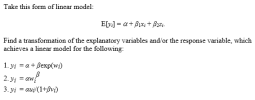 Take this form of linear model: Find a transformation of the explanatory variables and/or the response variable, which achieves a linear model for the following:
1. In general, how can someone discern the difference between a response variable and an explanatory...
1. In general, how can someone discern the difference between a response variable and an explanatory variable?
What is/are constant(s) within an experiment? Select one: a. Response (dependent) variables which must be kept...
What is/are constant(s) within an experiment? Select one: a. Response (dependent) variables which must be kept the same throughout the experiment. b. Any variable, other than the explanatory (independent) variable, which is/are kept the same between treatments. c. Variables, other than the response (dependent variable), which are varied throughout the experiment. d. Explanatory (independent) variables which require controls.
Use the following linear regression equation to answer the questions. x1 = 1.5 + 3.4x2 – 8.3x3 + 2.3x4 (a) Which variable is the response variable? Which variables are the explanatory variables? (b...
Use the following linear regression equation to answer the questions. x1 = 1.5 + 3.4x2 – 8.3x3 + 2.3x4 (a) Which variable is the response variable? Which variables are the explanatory variables? (b) Which number is the constant term? List the coefficients with their corresponding explanatory variables. constant? x2 coefficient? x3 coefficient? x4 coefficient? (c) If x2 = 1, x3 = 8, and x4 = 6, what is the predicted value for x1? (Use 1 decimal place.) (d) Explain how...
When two explanatory variables are highly correlated, should you remove one of the correlated explanatory variables...
When two explanatory variables are highly correlated, should you remove one of the correlated explanatory variables to reduce the multicollinearity problem. A. Yes, it will reduce the standard errors on the coefficients and increase the t statistics. B. No, it will not affect the t statistics on the coefficients. C. No, it will cause the coefficient on the remaining variable to be biased. D. Yes, it will improve the fit of the regression model.
In regression, we call Y the response or dependent variable, which is modeled in terms of...
In regression, we call Y the response or dependent variable, which is modeled in terms of one or more "independent" variables. The independent variables are further classified as explanatory/causal variables or as predictor variables. Discuss and elaborate on whether or not time can be a legitimate explanatory/causal variable, whether time can be a legitimate predictor variable whether a predictor variable must also be a causal/explanatory variable. Provide examples to support your arguments.
Consider a binary response variable y and two explanatory variables x1 and x2. The following table...
Consider a binary response variable y and two explanatory variables x1 and x2. The following table contains the parameter estimates of the linear probability model (LPM) and the logit model, with the associated p-values shown in parentheses. Variable LPM Logit Constant −0.60 −2.50 0.02 (0.03 ) x1 0.28 0.99 (0.06 ) (0.06 ) x2 −0.06 −0.30 (0.03 ) (0.06 ) a. At the 5% significance level, comment on the significance of the variables for both models. Variable LPM Logit x1...
 4. The following table lists the explanatory variables used to explain the response variable breastfeeding. The response variable was binary (Y/N), did the mother breastfeed or not. All possible categories for the explanatory variables are listed below as well. Variable Education Categories High school or lower Some college Undergraduate degree Graduate Degree Full Time Part Time Cesarean Natural Work Status Method of delivery The following 95% confidence intervals of the odds ratios were generated once the logistic regression model was...
 Take this form of linear model: Find a transformation of the explanatory variables and/or the response variable, which achieves a linear model for the following:
Most questions answered within 3 hours.
-
Where is the error in this code sequence?
String s1 = "Hello";
String s2 = "ello";...
asked 10 months ago -
Financial data for Joel de Paris, Inc., for last year
follow:
Joel de Paris, Inc.
Balance...
asked 10 months ago -
Consider this reaction:
Al2(SO4)3 (aq)+ BaCl3
(aq) Al2Cl6 (aq)- +
3BaSO4(s) . What is the...
asked 10 months ago -
Suppose that Savneet is considering increasing her
recent random sample from 20 car rentals to 40...
asked 10 months ago -
Trucks arrive at an unloading terminal at an average rate of 120
per hour.
Trucks arrive...
asked 10 months ago -
Why are methanol and ethanol completely soluble in water while
octanol is not very little soluble....
asked 10 months ago -
A facilities manager at a university reads in a research report
that the mean amount of...
asked 10 months ago -
When the CuSO4 is rehydrated by adding water to the anhydrous
compound, is this an endothermic...
asked 10 months ago -
A ray of sunlight is passing from diamond into crown glass; the
angle of incidence is...
asked 10 months ago -
A block of mass 0.249 kg is placed on top of a light, vertical
spring of...
asked 10 months ago -
how do the kidneys compensate in the presences of acidosis
a) trigger hyperventilate
b) reserve acid...
asked 10 months ago -
Question 501 pts
The rental rate of capital to the firm increases. Which of the
following...
asked 10 months ago