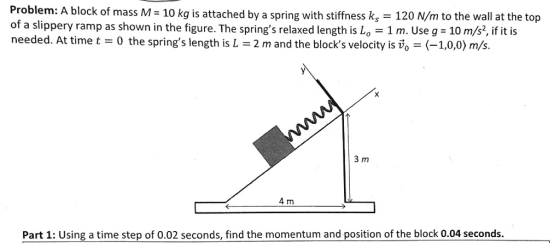
Using a time step of 0.02 seconds, find the momentum and position of the block 0.04 seconds. Show all your work!
Homework Answers
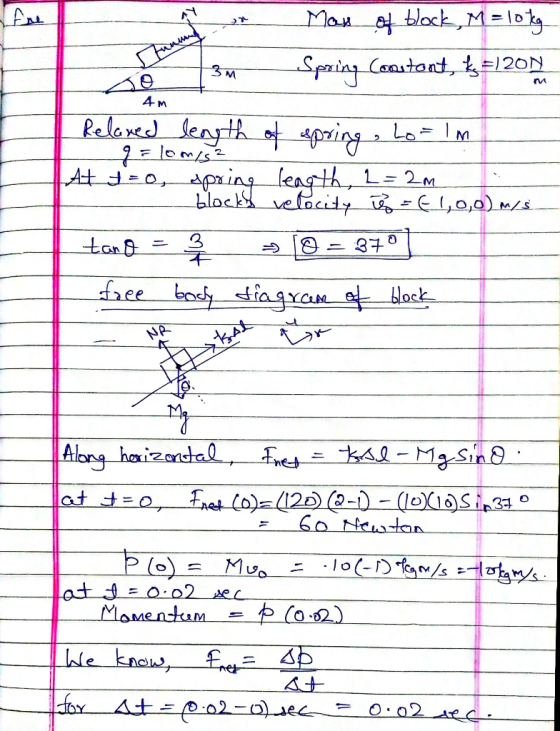
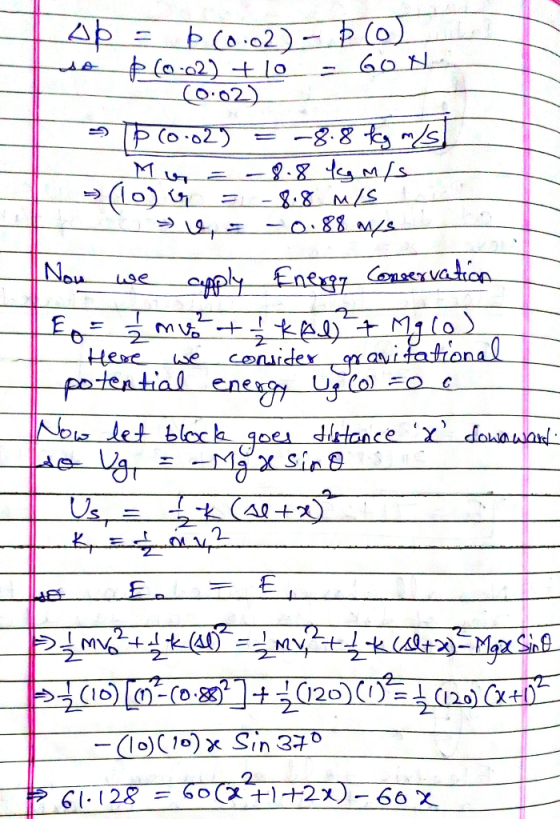
Here we apply Newton's laws of motion and mechanical energy conservation. Also we apply impulse momentum concept.
Add Answer to:
Using a time step of 0.02 seconds, find the momentum and
position of the block 0.04...
Use the approximation that for each time step. A spring with a relaxed length of 25...
Use the approximation that for each time step. A spring with a relaxed length of 25 cm and a stiffness of 16 N/m stands vertically on a table. A block of mass 78 g is attached to the top of the spring. You pull the block upward, stretching the spring until its length is now 29.5 cm, hold the block at rest for a moment, and then release it. Using a time step of 0.1 s, predict the position and...
Use the approximation that v→avg=p→f/m for each time step. A spring with a relaxed length of...
Use the approximation that v→avg=p→f/m for each time step. A spring with a relaxed length of 25 cm and a stiffness of 17 N/m stands vertically on a table. A block of mass 75 g is attached to the top of the spring. You pull the block upward, stretching the spring until its length is now 30.9 cm, hold the block at rest for a moment, and then release it. Using a time step of 0.1 s, predict the position...
Use the approximation that Vavg lm for each time step A spring with a relaxed length...
 Use the approximation that Vavg lm for each time step A spring with a relaxed length of 25 cm and a stiffness of 20 N/m stands vertically on a table. A block of mass 69 g is attached to the top of the spring. You pull the block upward, stretching the spring until its length is now 29.7 cm, hold the block at rest for a moment, and then release it. Using a time step of 0.1 s, predict the...
Use the approximation that v→avg=p→f/m for each time step. A spring with a relaxed length of...
Use the approximation that v→avg=p→f/m for each time step. A spring with a relaxed length of 25 cm and a stiffness of 16 N/m stands vertically on a table. A block of mass 89 g is attached to the top of the spring. You pull the block upward, stretching the spring until its length is now 30.3 cm, hold the block at rest for a moment, and then release it. Using a time step of 0.1 s, predict the position...
Use the approximation that v→avg=p→f/m for each time step. A spring with a relaxed length of...
Use the approximation that v→avg=p→f/m for each time step. A spring with a relaxed length of 25 cm and a stiffness of 16 N/m stands vertically on a table. A block of mass 89 g is attached to the top of the spring. You pull the block upward, stretching the spring until its length is now 30.3 cm, hold the block at rest for a moment, and then release it. Using a time step of 0.1 s, predict the position...
A block is attached to the top of a spring that stands vertically on a table....
 A block is attached to the top of a spring that stands
vertically on a table. The spring stiffness is 57 N/m, its relaxed
length is 31 cm, and the mass of the block is 305 g. The block is
oscillating up and down as the spring stretches and compresses. At
a particular time you observe that the velocity of the block is
<0, 0.0877, 0> m/s and the position of the block is <0,
0.0798, 0> m relative to...
A block is attached to the top of a spring that stands
vertically on a table. The spring stiffness is 57 N/m, its relaxed
length is 31 cm, and the mass of the block is 305 g. The block is
oscillating up and down as the spring stretches and compresses. At
a particular time you observe that the velocity of the block is
<0, 0.0877, 0> m/s and the position of the block is <0,
0.0798, 0> m relative to...
STEP 1 Force: Just after releasing the block, calculate the force exerted on the block by...
 STEP 1 Force: Just after releasing the block, calculate the force exerted on the block by the spring, the force exerted on the block by the Earth, and the net force: spring,r# 2.64 Earthy-6769 net.y - 1.96 0.676N 1.96 N Momentum update: Just after releasing the block, the momentum of the block is zero. Approximate the average net force during the next timel by the force you just calculated. At t0.07 seconds, what will the new momentum and velocity of...
Use the approximation that →avg-pfhn for each time step. A spring with a relaxed length of...
 Use the approximation that →avg-pfhn for each time step. A spring with a relaxed length of 25 cm and a stiffness of 20 N/m stands vertically on a table. A block of mass 63 g is attached to the top of the spring. You pull the block upward, stretching the spring until its length is now 31.6 cm, hold the block at rest for a moment, and then release it. Using a time step of 0.1 s, predict the position...
Problem 2.42 Use the approximation that V avg Pm for each time step A spring with...
 Problem 2.42 Use the approximation that V avg Pm for each time step A spring with a relaxed length of 25 cm and a stiffness of 17 N/m stands vertically on a table. A block of mass 72 g is attached to the top of the spring. You pull the block upward, stretching the spring until its length is now 28.9 cm, hold the block at rest for a moment, and then release it. Using a time step of 0.1...
A spring with a relaxed length of 25 cm and a stiffness of 13 N/m stands...
A spring with a relaxed length of 25 cm and a stiffness of 13 N/m stands vertically on a table. A block of mass 73 g is attached to the top of the spring. You pull the block upward, stretching the spring until its length is now 31.7 cm, hold the block at rest for a moment, and then release it. Using a time step of 0.1 s, predict the position and momentum of the block at a time 0.2...
 Use the approximation that Vavg lm for each time step A spring with a relaxed length of 25 cm and a stiffness of 20 N/m stands vertically on a table. A block of mass 69 g is attached to the top of the spring. You pull the block upward, stretching the spring until its length is now 29.7 cm, hold the block at rest for a moment, and then release it. Using a time step of 0.1 s, predict the...
 A block is attached to the top of a spring that stands
vertically on a table. The spring stiffness is 57 N/m, its relaxed
length is 31 cm, and the mass of the block is 305 g. The block is
oscillating up and down as the spring stretches and compresses. At
a particular time you observe that the velocity of the block is
<0, 0.0877, 0> m/s and the position of the block is <0,
0.0798, 0> m relative to...
A block is attached to the top of a spring that stands
vertically on a table. The spring stiffness is 57 N/m, its relaxed
length is 31 cm, and the mass of the block is 305 g. The block is
oscillating up and down as the spring stretches and compresses. At
a particular time you observe that the velocity of the block is
<0, 0.0877, 0> m/s and the position of the block is <0,
0.0798, 0> m relative to...
 STEP 1 Force: Just after releasing the block, calculate the force exerted on the block by the spring, the force exerted on the block by the Earth, and the net force: spring,r# 2.64 Earthy-6769 net.y - 1.96 0.676N 1.96 N Momentum update: Just after releasing the block, the momentum of the block is zero. Approximate the average net force during the next timel by the force you just calculated. At t0.07 seconds, what will the new momentum and velocity of...
 Use the approximation that →avg-pfhn for each time step. A spring with a relaxed length of 25 cm and a stiffness of 20 N/m stands vertically on a table. A block of mass 63 g is attached to the top of the spring. You pull the block upward, stretching the spring until its length is now 31.6 cm, hold the block at rest for a moment, and then release it. Using a time step of 0.1 s, predict the position...
 Problem 2.42 Use the approximation that V avg Pm for each time step A spring with a relaxed length of 25 cm and a stiffness of 17 N/m stands vertically on a table. A block of mass 72 g is attached to the top of the spring. You pull the block upward, stretching the spring until its length is now 28.9 cm, hold the block at rest for a moment, and then release it. Using a time step of 0.1...
Most questions answered within 3 hours.
-
Where is the error in this code sequence?
String s1 = "Hello";
String s2 = "ello";...
asked 10 months ago -
Financial data for Joel de Paris, Inc., for last year
follow:
Joel de Paris, Inc.
Balance...
asked 10 months ago -
Consider this reaction:
Al2(SO4)3 (aq)+ BaCl3
(aq) Al2Cl6 (aq)- +
3BaSO4(s) . What is the...
asked 10 months ago -
Suppose that Savneet is considering increasing her
recent random sample from 20 car rentals to 40...
asked 10 months ago -
Trucks arrive at an unloading terminal at an average rate of 120
per hour.
Trucks arrive...
asked 10 months ago -
Why are methanol and ethanol completely soluble in water while
octanol is not very little soluble....
asked 10 months ago -
A facilities manager at a university reads in a research report
that the mean amount of...
asked 10 months ago -
When the CuSO4 is rehydrated by adding water to the anhydrous
compound, is this an endothermic...
asked 10 months ago -
A ray of sunlight is passing from diamond into crown glass; the
angle of incidence is...
asked 10 months ago -
A block of mass 0.249 kg is placed on top of a light, vertical
spring of...
asked 10 months ago -
how do the kidneys compensate in the presences of acidosis
a) trigger hyperventilate
b) reserve acid...
asked 10 months ago -
Question 501 pts
The rental rate of capital to the firm increases. Which of the
following...
asked 10 months ago