The United States is suffering from a high rate of unemployment. a) Identify two fiscal policy...
The United States is suffering from a high rate of unemployment.
a) Identify two fiscal policy actions that Congress might initiate to solve the problem.
b) Using a correctly labeled AD/AS graph, show and explain how the policies you identified in (a) will affect each of the following in the short-run
aggregate demand
output and employment
price level
c) Explain how the policies you identified in part (a) will impact real interest rates in the short-run.
d) If the interest rate effect you identified in part(b) continues in the long run, explain how economic growth will be impacted.
Homework Answers
Answer (a): The rate of fast rising Unemployment in the United States is the fastest growing social concern for the Government and for the economy as a whole. This rapid growth of unemployment has to be stopped at any cost to stop the negative impacts of it in the economy. The Government can introduce various measure to curb unemployment, one of the types of measures being the Fiscal Policy. Fiscal policy can lead to an increase the economic growth and the aggregate demand in the economy, thereby resulting in decrease of the rate of unemployment. Two of the most critical fiscal policies that the Government can take include the reduction of tax rate in the economy and the increase of the Government funding o the State investment in to the economy. Tax reduction will directly result in an increase in the net savings of the poorer section of the society, and the government investment will pour in fresh money in the economy which will infuse more economic power in the hands of the poorer people and will directly help in the reduction of unemployment from the economy.
Answer (b):
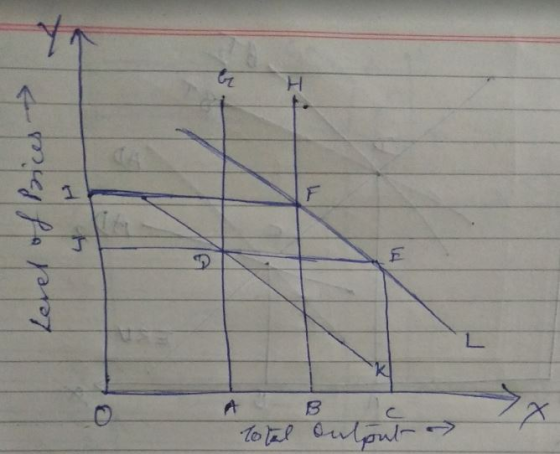
As shown in the above diagram, The curve K represents the Aggregate demand (AD) curve before the tax rate reduction and before the Government investment in the economy , and the GH curve represents the rate of the Average supply before the tax rate reduction and before the Government investment in the economy. Now, once the Government reduces the rate of taxation in the economy and also infuses more investment in the economy, the money in the hands of the poorer section of the society increases and they now have more purchasing power, therefore the aggregate supply in the economy has to rise to meet the rise in demand. This pushes up the purchasing power of the poorer section of the society and the Demand as well as the supply curve both increase, as shown in the diagram by the L curve denoting the increase in the demand curve and the HB curve denoting the increase in the supply curve.
Answer (c) : In the shorter run , the influx of huge investment from the government in to the economy and a subsequent reduction in the tax rate will directly lead to more purchasing power in the hands of the poor people of the country , and it will increase the power of the financial institutions to lend more money, the circulating of the money being more flexible now. Since the availability of money has now risen considerably, the interest rate in the economy will drastically reduce to a level where, the common people can easily afford to borrow money from the Government or private lending institutions at cheaper interest rates.
Answer (d) : If the rate of interest remains very low in the longer run, it may affect economy in two contrasting ways. First, being the rise of many new firms, which will push up the development level of the economy. When interest rate in the economy is low, more and more investment would be done in the economy, which will bring up many new firms and thereby reduce the existing prices of the products in the market. This will lead to the economy getting richer as the days go by, However, a negative affect of this would be the loss of the lending firms and the government institutions in the longer run. The Government cannot earn profits from the reduces rate of taxation in the economy, which will reduce the ash reserve in the Government accounts, also , if the Government needs to influx more and more in the economy, this will huge loss to the State accounts, thereby negatively affecting the economic and political stability of the government institutions. In te longer run, therefore, these steps may not be too conducive for the economy.
Add Answer to:
The United States is suffering from a high rate of
unemployment.
a) Identify two fiscal policy...
Assume unemployment is high and is a major problem in the United States. In an effort...
Assume unemployment is high and is a major problem in the United States. In an effort to get unemployment back to its natural rate, the Federal Reserve enacts an expansionary monetary policy by purchasing $10 million in U.S. Treasury bonds. If the reserve ratio is 10 percent, what is the maximum increase in money supply that may occur as a result of the Fed’s open market operation? Give one reason why money supply may not increase by the amount given...
1. Assume unemployment is high and is a major problem in the United States. (a) In...
 1. Assume unemployment is high and is a major problem in the United States. (a) In an effort to get unemployment back to its natural rate, the Federal Reserve enacts an expansionary monetary policy by purchasing $10 million in U.S. Treasury bonds. i. If the reserve ratio is 10 percent, what is the maximum increase in money supply that may occur as a result of the Fed's open market operation? Answer: ii. Give one reason why money supply may not...
In 2019, the united states is experiencing an unemployment rate that is below its natural ......
In 2019, the united states is experiencing an unemployment rate that is below its natural ... Your question has been answered Let us know if you got a helpful answer. Rate this answer Question: 1. In 2019, the United States is experiencing an unemployment rate that is below its natural rate... 1. In 2019, the United States is experiencing an unemployment rate that is below its natural rate of unemployment. That is, its labor force is more than fully employed....
In 2019, the United States is experiencing an unemployment rate that is below its natural rate...
In 2019, the United States is experiencing an unemployment rate that is below its natural rate of unemployment. That is, its labor force is more than fully employed. However, the country is suffering from a rising fiscal deficit, a rising government debt/GDP ratio, and an expanding current account deficit. In addition, after years of quantitative easing in the wake of the 2008-09 financial crisis and economic recession, the Federal Reserve must now roll back its quantitative easing and shrink its...
I. The economy of Zarland is operating below the full-employment level of output with a balanced budget. (a) Draw a correctly labeled graph of short-run aggregate supply, long-run aggregate supply, a...
 I. The economy of Zarland is operating below the full-employment level of output with a balanced budget. (a) Draw a correctly labeled graph of short-run aggregate supply, long-run aggregate supply, and aggregate demand, and show each of the following. (Gi) The country's current equilibrium output and price level, labeled Yj and PL1. respectively (ii) The full-employment output, labeled Yf (b) Ir Zarland increases government expenditures and taxes by equal amounts, can aggregate demand increase? Explain. (c) If Zarland decides to...
Assume an economy operating below full employment. Draw a correctly labeled AD/AS graph showing: the problem...
Assume an economy operating below full employment. Draw a correctly labeled AD/AS graph showing: the problem in the economy current price level and output full employment output Identify an open market operation that the Fed could implement to resolve the problem. Using a correctly labeled money market graph with a side-by-side investment demand graph, show the effect of the policy you identified in part B on each of the following: nominal interest rates quantity of investment demanded On your graph...
If the government plans to boost employment through expansionary fiscal policy beyond the natural rate of...
If the government plans to boost employment through expansionary fiscal policy beyond the natural rate of unemployment, show this effort in an AD-AS diagram. What is the short-run equilibrium under the assumption of rational expectations?
AP Macroeconomics Test Booklet Unit 3 Progress Check: FRQ Name 1. Include correctly labeled diagrams,...
AP Macroeconomics Test Booklet Unit 3 Progress Check: FRQ Name 1. Include correctly labeled diagrams, if useful or required, in explaining your answers. A correctly labeled diagram must have all axes and curves clearly labeled and must show directional changes. If the question prompts you to “Calculate,” you must show how you arrived at your final answer. The economy of Country X is at full employment. (a) Draw a correctly labeled graph of the long-run aggregate supply, short-run aggregate...
Should policymakers use monetary policy, fiscal policy, or both in an effort to stabilize the economy?
 Use of discretionary policy to stabilize the economy Should policymakers use monetary policy, fiscal policy, or both in an effort to stabilize the economy? The following questions address the issue of how monetary and fiscal policies affect the economy and the pros and cons of using these tools to lessen economic fluctuations. The following graph shows a hypothetical aggregate demand curve (AD), short-run aggregate supply curve (AS), and long-run aggregate supply curve (LRAS) For the economy in May 2020. According to the...
The United States is currently experiencing a 2% unemployment rate, a 11% inflation rate and real...
The United States is currently experiencing a 2% unemployment rate, a 11% inflation rate and real GDP is rising rapidly. Answer the following questions in detail and use complete sentences: Who is in charge of monetary policy in the United States? What type of monetary policy does this economy need and why? What are the tools of the prescribed monetary policy and how would they change in response to this economic situation? How would this policy affect interest rates and...
 1. Assume unemployment is high and is a major problem in the United States. (a) In an effort to get unemployment back to its natural rate, the Federal Reserve enacts an expansionary monetary policy by purchasing $10 million in U.S. Treasury bonds. i. If the reserve ratio is 10 percent, what is the maximum increase in money supply that may occur as a result of the Fed's open market operation? Answer: ii. Give one reason why money supply may not...
 I. The economy of Zarland is operating below the full-employment level of output with a balanced budget. (a) Draw a correctly labeled graph of short-run aggregate supply, long-run aggregate supply, and aggregate demand, and show each of the following. (Gi) The country's current equilibrium output and price level, labeled Yj and PL1. respectively (ii) The full-employment output, labeled Yf (b) Ir Zarland increases government expenditures and taxes by equal amounts, can aggregate demand increase? Explain. (c) If Zarland decides to...
 Use of discretionary policy to stabilize the economy Should policymakers use monetary policy, fiscal policy, or both in an effort to stabilize the economy? The following questions address the issue of how monetary and fiscal policies affect the economy and the pros and cons of using these tools to lessen economic fluctuations. The following graph shows a hypothetical aggregate demand curve (AD), short-run aggregate supply curve (AS), and long-run aggregate supply curve (LRAS) For the economy in May 2020. According to the...
Most questions answered within 3 hours.
-
Where is the error in this code sequence?
String s1 = "Hello";
String s2 = "ello";...
asked 10 months ago -
Financial data for Joel de Paris, Inc., for last year
follow:
Joel de Paris, Inc.
Balance...
asked 10 months ago -
Consider this reaction:
Al2(SO4)3 (aq)+ BaCl3
(aq) Al2Cl6 (aq)- +
3BaSO4(s) . What is the...
asked 10 months ago -
Suppose that Savneet is considering increasing her
recent random sample from 20 car rentals to 40...
asked 10 months ago -
Trucks arrive at an unloading terminal at an average rate of 120
per hour.
Trucks arrive...
asked 10 months ago -
Why are methanol and ethanol completely soluble in water while
octanol is not very little soluble....
asked 10 months ago -
A facilities manager at a university reads in a research report
that the mean amount of...
asked 10 months ago -
When the CuSO4 is rehydrated by adding water to the anhydrous
compound, is this an endothermic...
asked 10 months ago -
A ray of sunlight is passing from diamond into crown glass; the
angle of incidence is...
asked 10 months ago -
A block of mass 0.249 kg is placed on top of a light, vertical
spring of...
asked 10 months ago -
how do the kidneys compensate in the presences of acidosis
a) trigger hyperventilate
b) reserve acid...
asked 10 months ago -
Question 501 pts
The rental rate of capital to the firm increases. Which of the
following...
asked 10 months ago