
Homework Answers
Add Answer to:
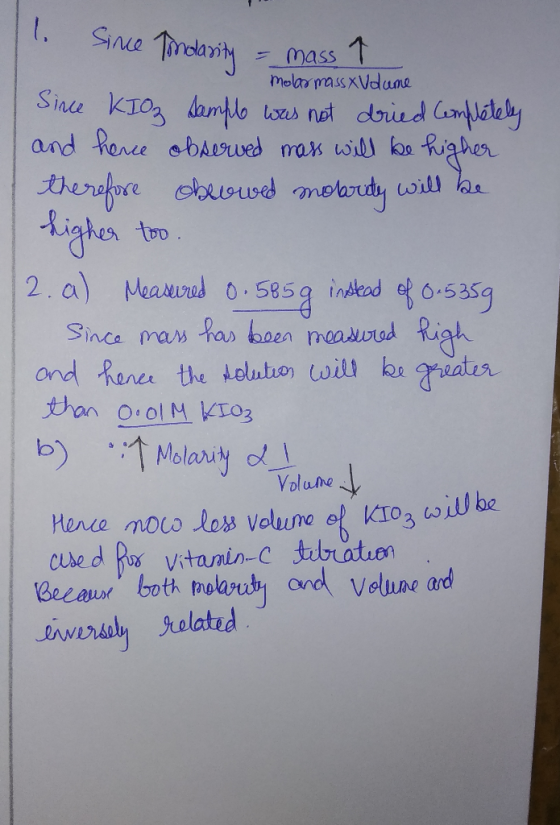
Laboratory Questions Circle the questions that have been assigned. 1. Part A.1. The KIO, sample was...
=4.31% 17:369 Laboratory Questions Circle the questions that have been assigned. 1. Part A.2. A 20-ml...
 =4.31% 17:369 Laboratory Questions Circle the questions that have been assigned. 1. Part A.2. A 20-ml volume of previously boiled, deionized water is added to the Erlenmeyer flask to prepare the sample for titration. Explain why this volume is not critical to the analysis. 2. Part A.2. Previously boiled, deionized water is unavailable. In a hurry to pursue the analysis, deionized water (not boiled) is added. How does this attempt to expedite the analysis affect the reported percent acetic acid...
Experimental Procedure, Part B.1. What is the purpose of adding NaHCO, to the reaction mixture? Explain....
 Experimental Procedure, Part B.1. What is the purpose of adding NaHCO, to the reaction mixture? Explain. Write a balanced equation for its reaction. a. Experimental Procedure, Part C. What is the oxidizing agent in the titration? b. What is the color change of the starch indicator that signals the stoichiometric point in Part C? (1. Vitamin C is a reducing agent and antioxidant. What ion does it reduce in this experiment? Explain. Desk No. IOS- Experimental Procedure, Part A.1. Determine...
Q3 & Q4 Q3. Part B.1. Some of the solid solute adheres to the side of...
 Q3 & Q4
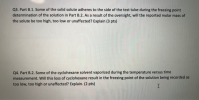
Q3. Part B.1. Some of the solid solute adheres to the side of the test tube during the freezing point determination of the solution in Part B.2. As a result of the oversight, will the reported molar mass of the solute be too high, too low or unaffected? Explain (3 pts) Q4. Part B.2. Some of the cyclohexane solvent vaporized during the temperature versus time measurement. Will this loss of cyclohexane result in the freezing point of...
Q3 & Q4
Q3. Part B.1. Some of the solid solute adheres to the side of the test tube during the freezing point determination of the solution in Part B.2. As a result of the oversight, will the reported molar mass of the solute be too high, too low or unaffected? Explain (3 pts) Q4. Part B.2. Some of the cyclohexane solvent vaporized during the temperature versus time measurement. Will this loss of cyclohexane result in the freezing point of...
Circle the questions that are to be answered 1. Part A.2 Suppose some of the solid...
 Circle the questions that are to be answered 1. Part A.2 Suppose some of the solid calcium hydroxide is inadvertently transferred along with the supernatant liquid for analysis Will more, less, or the same amount of hydrochloric acid titrant be used for the analysis in Part A.6? Explain b Will this inadvertent transfer increase, decrease, or have no effect on the cakculated solubility product for calcium hydroxide? Explain c Will this inadvertent transfer increase, decrease, or have no effect on...
Post Lab Questions 1. in a hurry to complete the experiment, the student failed to calibrate...
 Post Lab Questions 1. in a hurry to complete the experiment, the student failed to calibrate the Spectrophotometer. As a result, all absorbance values for the standard solutions that are measured and recorded are too high. How will this affect the following calculations in Part B? a. Will the calculated equilibrium concentrations of FeSCN** be too high, too low, or unaffected? Explain. b. Will the calculated equilibrium constants be too high, too low, or unaffected? Explain. 2. In Part A,...
QUESTIONS (Submit your answers on a separate sheer if necessary Circle the questions that have been...
 QUESTIONS (Submit your answers on a separate sheer if necessary Circle the questions that have been assigned 1. The aluminum sample is not cut into small pieces but rather left as one large piece. a. How will this oversight affect the progress of completing the experimental procedure? Explain. b. Will the percent yield of the alum be too high, too low, or unaffected by the oversight? Explain. 2. Aluminum pieces inadvertently collect on the filter a. If left on the...
3) Use the mole ratios contained in both equation 3 and equation 4 to calculate the...
 3) Use the mole ratios contained in both equation 3 and
equation 4 to calculate the
volume (in mL) of 0.0100 M potassium iodate solution needed to
completely oxidize all
of the ascorbic acid contained in 20.00 mL of 0.0200 M
ascorbic acid solution.
concentration of the titrant can be used along with the mole ratios from the reaction equations to determine the amount of ascorbic acid in the solution Chemical Reactions involved with the redox titration: Equation 1 shows...
3) Use the mole ratios contained in both equation 3 and
equation 4 to calculate the
volume (in mL) of 0.0100 M potassium iodate solution needed to
completely oxidize all
of the ascorbic acid contained in 20.00 mL of 0.0200 M
ascorbic acid solution.
concentration of the titrant can be used along with the mole ratios from the reaction equations to determine the amount of ascorbic acid in the solution Chemical Reactions involved with the redox titration: Equation 1 shows...
Part A and Part B. Also question #3-post lab. (its circled) A. Molar Solubility and Solubility Product of Calcium Hydroxide Trial I Trial 3 Trial 2 25.0 1. Volume of saturated Ca(OH), solution (m...
 Part A and Part B.
Also question #3-post lab. (its circled)
A. Molar Solubility and Solubility Product of Calcium Hydroxide Trial I Trial 3 Trial 2 25.0 1. Volume of saturated Ca(OH), solution (mL) 2. Concentration of standardized HCl solution (molU/L) 3. Buret reading, initial (mL 4. Buret reading, final (mL) 5. Volume of HCI added (mL) 6. Moles of HCI added (mol) 7. Moles of OH" in saturated solution (mol) 8. (OH1, equilibrium (mol/L) 9. (Ca2 ], equilibrium (mol/L)...
Part A and Part B.
Also question #3-post lab. (its circled)
A. Molar Solubility and Solubility Product of Calcium Hydroxide Trial I Trial 3 Trial 2 25.0 1. Volume of saturated Ca(OH), solution (mL) 2. Concentration of standardized HCl solution (molU/L) 3. Buret reading, initial (mL 4. Buret reading, final (mL) 5. Volume of HCI added (mL) 6. Moles of HCI added (mol) 7. Moles of OH" in saturated solution (mol) 8. (OH1, equilibrium (mol/L) 9. (Ca2 ], equilibrium (mol/L)...
5. Part B.3. Jacob carelessly added only 40.0 mL (instead of the recommended 50.0 mL) of 1.1 M HC...
 number 5 and 6 only
actually only #6 please
5. Part B.3. Jacob carelessly added only 40.0 mL (instead of the recommended 50.0 mL) of 1.1 M HCl to the 50.0 mL of 0 M NaOH. Explain the consequence of the error this factory error cause the reported energy of neutralization, AH, to be higher, lower, or unaffected? Explain. will the enthalpy of solution for the salt be reported too high or too low? Explain not a perfect insulator, will...
number 5 and 6 only
actually only #6 please
5. Part B.3. Jacob carelessly added only 40.0 mL (instead of the recommended 50.0 mL) of 1.1 M HCl to the 50.0 mL of 0 M NaOH. Explain the consequence of the error this factory error cause the reported energy of neutralization, AH, to be higher, lower, or unaffected? Explain. will the enthalpy of solution for the salt be reported too high or too low? Explain not a perfect insulator, will...
i need all answers Data Table 1: Titration of Vinegar with Sodium Hydroxide Vinegar Sample 1...
 i
need all answers
Data Table 1: Titration of Vinegar with Sodium Hydroxide Vinegar Sample 1 Vinegar Sample 2 Vinegar Sample 3 Mass of Vinegar (6) Volume of Vinegar (ml) Density - 1.005 g/ml Initial NaOH volume in syringe (ml) Final NaOH volume in syringe (ml) Volume of NaOH delivered (mL) Volume of NaOH delivered (L) Molarity of NaOH Moles of NaOH delivered Reaction of NaOH with Acetic Acid Moles of Acetic Acid in vinegar sample Molar mass of Acetic...
i
need all answers
Data Table 1: Titration of Vinegar with Sodium Hydroxide Vinegar Sample 1 Vinegar Sample 2 Vinegar Sample 3 Mass of Vinegar (6) Volume of Vinegar (ml) Density - 1.005 g/ml Initial NaOH volume in syringe (ml) Final NaOH volume in syringe (ml) Volume of NaOH delivered (mL) Volume of NaOH delivered (L) Molarity of NaOH Moles of NaOH delivered Reaction of NaOH with Acetic Acid Moles of Acetic Acid in vinegar sample Molar mass of Acetic...
 =4.31% 17:369 Laboratory Questions Circle the questions that have been assigned. 1. Part A.2. A 20-ml volume of previously boiled, deionized water is added to the Erlenmeyer flask to prepare the sample for titration. Explain why this volume is not critical to the analysis. 2. Part A.2. Previously boiled, deionized water is unavailable. In a hurry to pursue the analysis, deionized water (not boiled) is added. How does this attempt to expedite the analysis affect the reported percent acetic acid...
 Experimental Procedure, Part B.1. What is the purpose of adding NaHCO, to the reaction mixture? Explain. Write a balanced equation for its reaction. a. Experimental Procedure, Part C. What is the oxidizing agent in the titration? b. What is the color change of the starch indicator that signals the stoichiometric point in Part C? (1. Vitamin C is a reducing agent and antioxidant. What ion does it reduce in this experiment? Explain. Desk No. IOS- Experimental Procedure, Part A.1. Determine...
 Q3 & Q4
Q3. Part B.1. Some of the solid solute adheres to the side of the test tube during the freezing point determination of the solution in Part B.2. As a result of the oversight, will the reported molar mass of the solute be too high, too low or unaffected? Explain (3 pts) Q4. Part B.2. Some of the cyclohexane solvent vaporized during the temperature versus time measurement. Will this loss of cyclohexane result in the freezing point of...
Q3 & Q4
Q3. Part B.1. Some of the solid solute adheres to the side of the test tube during the freezing point determination of the solution in Part B.2. As a result of the oversight, will the reported molar mass of the solute be too high, too low or unaffected? Explain (3 pts) Q4. Part B.2. Some of the cyclohexane solvent vaporized during the temperature versus time measurement. Will this loss of cyclohexane result in the freezing point of...
 Circle the questions that are to be answered 1. Part A.2 Suppose some of the solid calcium hydroxide is inadvertently transferred along with the supernatant liquid for analysis Will more, less, or the same amount of hydrochloric acid titrant be used for the analysis in Part A.6? Explain b Will this inadvertent transfer increase, decrease, or have no effect on the cakculated solubility product for calcium hydroxide? Explain c Will this inadvertent transfer increase, decrease, or have no effect on...
 Post Lab Questions 1. in a hurry to complete the experiment, the student failed to calibrate the Spectrophotometer. As a result, all absorbance values for the standard solutions that are measured and recorded are too high. How will this affect the following calculations in Part B? a. Will the calculated equilibrium concentrations of FeSCN** be too high, too low, or unaffected? Explain. b. Will the calculated equilibrium constants be too high, too low, or unaffected? Explain. 2. In Part A,...
 QUESTIONS (Submit your answers on a separate sheer if necessary Circle the questions that have been assigned 1. The aluminum sample is not cut into small pieces but rather left as one large piece. a. How will this oversight affect the progress of completing the experimental procedure? Explain. b. Will the percent yield of the alum be too high, too low, or unaffected by the oversight? Explain. 2. Aluminum pieces inadvertently collect on the filter a. If left on the...
 3) Use the mole ratios contained in both equation 3 and
equation 4 to calculate the
volume (in mL) of 0.0100 M potassium iodate solution needed to
completely oxidize all
of the ascorbic acid contained in 20.00 mL of 0.0200 M
ascorbic acid solution.
concentration of the titrant can be used along with the mole ratios from the reaction equations to determine the amount of ascorbic acid in the solution Chemical Reactions involved with the redox titration: Equation 1 shows...
3) Use the mole ratios contained in both equation 3 and
equation 4 to calculate the
volume (in mL) of 0.0100 M potassium iodate solution needed to
completely oxidize all
of the ascorbic acid contained in 20.00 mL of 0.0200 M
ascorbic acid solution.
concentration of the titrant can be used along with the mole ratios from the reaction equations to determine the amount of ascorbic acid in the solution Chemical Reactions involved with the redox titration: Equation 1 shows...
 Part A and Part B.
Also question #3-post lab. (its circled)
A. Molar Solubility and Solubility Product of Calcium Hydroxide Trial I Trial 3 Trial 2 25.0 1. Volume of saturated Ca(OH), solution (mL) 2. Concentration of standardized HCl solution (molU/L) 3. Buret reading, initial (mL 4. Buret reading, final (mL) 5. Volume of HCI added (mL) 6. Moles of HCI added (mol) 7. Moles of OH" in saturated solution (mol) 8. (OH1, equilibrium (mol/L) 9. (Ca2 ], equilibrium (mol/L)...
Part A and Part B.
Also question #3-post lab. (its circled)
A. Molar Solubility and Solubility Product of Calcium Hydroxide Trial I Trial 3 Trial 2 25.0 1. Volume of saturated Ca(OH), solution (mL) 2. Concentration of standardized HCl solution (molU/L) 3. Buret reading, initial (mL 4. Buret reading, final (mL) 5. Volume of HCI added (mL) 6. Moles of HCI added (mol) 7. Moles of OH" in saturated solution (mol) 8. (OH1, equilibrium (mol/L) 9. (Ca2 ], equilibrium (mol/L)...
 number 5 and 6 only
actually only #6 please
5. Part B.3. Jacob carelessly added only 40.0 mL (instead of the recommended 50.0 mL) of 1.1 M HCl to the 50.0 mL of 0 M NaOH. Explain the consequence of the error this factory error cause the reported energy of neutralization, AH, to be higher, lower, or unaffected? Explain. will the enthalpy of solution for the salt be reported too high or too low? Explain not a perfect insulator, will...
number 5 and 6 only
actually only #6 please
5. Part B.3. Jacob carelessly added only 40.0 mL (instead of the recommended 50.0 mL) of 1.1 M HCl to the 50.0 mL of 0 M NaOH. Explain the consequence of the error this factory error cause the reported energy of neutralization, AH, to be higher, lower, or unaffected? Explain. will the enthalpy of solution for the salt be reported too high or too low? Explain not a perfect insulator, will...
 i
need all answers
Data Table 1: Titration of Vinegar with Sodium Hydroxide Vinegar Sample 1 Vinegar Sample 2 Vinegar Sample 3 Mass of Vinegar (6) Volume of Vinegar (ml) Density - 1.005 g/ml Initial NaOH volume in syringe (ml) Final NaOH volume in syringe (ml) Volume of NaOH delivered (mL) Volume of NaOH delivered (L) Molarity of NaOH Moles of NaOH delivered Reaction of NaOH with Acetic Acid Moles of Acetic Acid in vinegar sample Molar mass of Acetic...
i
need all answers
Data Table 1: Titration of Vinegar with Sodium Hydroxide Vinegar Sample 1 Vinegar Sample 2 Vinegar Sample 3 Mass of Vinegar (6) Volume of Vinegar (ml) Density - 1.005 g/ml Initial NaOH volume in syringe (ml) Final NaOH volume in syringe (ml) Volume of NaOH delivered (mL) Volume of NaOH delivered (L) Molarity of NaOH Moles of NaOH delivered Reaction of NaOH with Acetic Acid Moles of Acetic Acid in vinegar sample Molar mass of Acetic...
Most questions answered within 3 hours.
-
Where is the error in this code sequence?
String s1 = "Hello";
String s2 = "ello";...
asked 10 months ago -
Financial data for Joel de Paris, Inc., for last year
follow:
Joel de Paris, Inc.
Balance...
asked 10 months ago -
Consider this reaction:
Al2(SO4)3 (aq)+ BaCl3
(aq) Al2Cl6 (aq)- +
3BaSO4(s) . What is the...
asked 10 months ago -
Suppose that Savneet is considering increasing her
recent random sample from 20 car rentals to 40...
asked 10 months ago -
Trucks arrive at an unloading terminal at an average rate of 120
per hour.
Trucks arrive...
asked 10 months ago -
Why are methanol and ethanol completely soluble in water while
octanol is not very little soluble....
asked 10 months ago -
A facilities manager at a university reads in a research report
that the mean amount of...
asked 10 months ago -
When the CuSO4 is rehydrated by adding water to the anhydrous
compound, is this an endothermic...
asked 10 months ago -
A ray of sunlight is passing from diamond into crown glass; the
angle of incidence is...
asked 10 months ago -
A block of mass 0.249 kg is placed on top of a light, vertical
spring of...
asked 10 months ago -
how do the kidneys compensate in the presences of acidosis
a) trigger hyperventilate
b) reserve acid...
asked 10 months ago -
Question 501 pts
The rental rate of capital to the firm increases. Which of the
following...
asked 10 months ago