
Homework Answers
IF YOU HAVE ANY DOUBTS COMMENT BELOW I WILL BE TTHERE TO HELP YOU..ALL THE BEST..
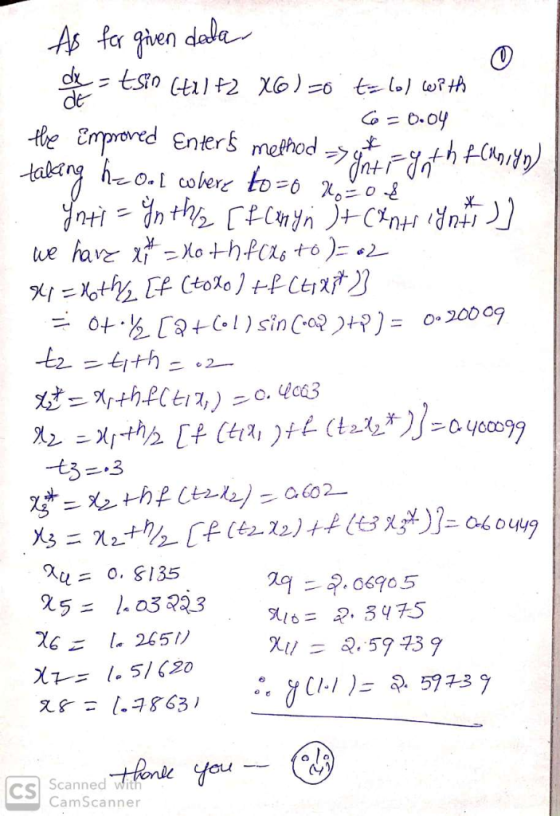
I HOPE YOU UNDERSTAND..
PLS RATE THUMBS UP..ITS HELPS ME ALOT..
THANK YOU...!!
Add Answer to:
Consider the initial value problem given below dx -2 +t sin (x), dt x(0) 0 Use...
Consider the initial value problem given below dy y =xy y(1.4)3 dx X The solution to...
 Consider the initial value problem given below dy y =xy y(1.4)3 dx X The solution to this initial value problem has a vertical asymptote at some point in the interval [1.4,2.11. By experimenting with the improved Euler's method subroutin determine this point to two decimal places. The solution has a vertical asymptote at x
Consider the initial value problem given below dy y =xy y(1.4)3 dx X The solution to this initial value problem has a vertical asymptote at some...
Consider the initial value problem given below dy y =xy y(1.4)3 dx X The solution to this initial value problem has a vertical asymptote at some point in the interval [1.4,2.11. By experimenting with the improved Euler's method subroutin determine this point to two decimal places. The solution has a vertical asymptote at x
Consider the initial value problem given below dy y =xy y(1.4)3 dx X The solution to this initial value problem has a vertical asymptote at some...
Solve the given initial value problem. dx = 3x + y - e 3t. dt x(0)...
 Solve the given initial value problem. dx = 3x + y - e 3t. dt x(0) = 2 dy = x + 3y; dt y(0) = - 3 The solution is x(t) = and y(t) = 0
Consider the following initial value problem dy dt = (1 – t)y + sin y with...
 Consider the following initial value problem dy dt = (1 – t)y + sin y with y(-1) = 0.5 We want to find y(2) with an absolute error below 10-8.
Solve the given initial value problem. x(0) = 1 dx = 4x +y- e 3t, dt...
 Solve the given initial value problem. x(0) = 1 dx = 4x +y- e 3t, dt dy = 2x + 3y; dt y(0) = -3 The solution is X(t) = and y(t) =
YOUR TEACHER Consider the initial-value problem y = (x + y - 1)?.Y(0) - 2. Use...
 YOUR TEACHER Consider the initial-value problem y = (x + y - 1)?.Y(0) - 2. Use the improved Euler's method with h = 0.1 and h = 0.05 to obtain approximate values of the solution at x = 0.5. At each step compare the approximate value with the actual value of the analytic solution. (Round your answers to four decimal places.) 0.1 y(0.5) h 0.05 (0.5) actual value Y(0.5) - Need Help? Tuto Tutor
YOUR TEACHER Consider the initial-value problem y = (x + y - 1)?.Y(0) - 2. Use...
 YOUR TEACHER Consider the initial-value problem y = (x + y - 1)?.Y(0) - 2. Use the improved Euler's method with h = 0.1 and h = 0.05 to obtain approximate values of the solution at x = 0.5. At each step compare the approximate value with the actual value of the analytic solution (Round your answers to four decimal places.) h 0.1 Y(0.5) h 0.05 Y(0.5) actual value Y(0.5) = Need Help? Tuto Tutor
Consider the value problem given below y=x+3 cos (xy). (O)=0 Use the improved Euler's method subroutine...
 Consider the value problem given below y=x+3 cos (xy). (O)=0 Use the improved Euler's method subroutine with step size 0.5 to approximate the solution to the initial value problem at points x=0.0.0.5, 1.0,..., 5.0. Use your answers to make a rough sketch of the solution on 0,5 Fill in the approximation table below. (Do not round unt the fral answers. The round to three decimal places as needed) Y 00 0.5 1.0 15 2.0 25 30 3.5 4.0 4.5 50...
Please solve this problem by hand calculation. Thanks Consider the following system of two ODES: dx = x-yt dt dy = t+ y...
 Please solve this problem by hand calculation. Thanks
Consider the following system of two ODES: dx = x-yt dt dy = t+ y from t=0 to t = 1.2 with x(0) = 1, and y(0) = 1 dt (a) Solve with Euler's explicit method using h = 0.4 (b) Solve with the classical fourth-order Runge-Kutta method using h = 0.4. The a solution of the system is x = 4et- 12et- t2 - 3t - 3, y= 2et- t-1. In...
Please solve this problem by hand calculation. Thanks
Consider the following system of two ODES: dx = x-yt dt dy = t+ y from t=0 to t = 1.2 with x(0) = 1, and y(0) = 1 dt (a) Solve with Euler's explicit method using h = 0.4 (b) Solve with the classical fourth-order Runge-Kutta method using h = 0.4. The a solution of the system is x = 4et- 12et- t2 - 3t - 3, y= 2et- t-1. In...
Problem 1 Use Euler's method with step size h = 0.5 to approximate the solution of the IVP. 2 dy ...
 Problem 1 Use Euler's method with step size h = 0.5 to approximate the solution of the IVP. 2 dy ev dt t 1-t-2, y(1) = 0. Problem 2 Consider the IVP: dy dt (a) Use Euler's method with step size h0.25 to approximate y(0.5) b) Find the exact solution of the IV P c) Find the maximum error in approximating y(0.5) by y2 (d) Calculate the actual absolute error in approximating y(0.5) by /2.
Problem 1 Use Euler's method...
Problem 1 Use Euler's method with step size h = 0.5 to approximate the solution of the IVP. 2 dy ev dt t 1-t-2, y(1) = 0. Problem 2 Consider the IVP: dy dt (a) Use Euler's method with step size h0.25 to approximate y(0.5) b) Find the exact solution of the IV P c) Find the maximum error in approximating y(0.5) by y2 (d) Calculate the actual absolute error in approximating y(0.5) by /2.
Problem 1 Use Euler's method...
(1 point) Consider the Initial Value Problem -5 dx dt X x(0) (a) Find the eigenvalues...
 (1 point) Consider the Initial Value Problem -5 dx dt X x(0) (a) Find the eigenvalues and eigenvectors for the coefficient matrix A = and 2 -- 1 333 (b) Find the solution to the initial value problem. Give your solution in real form Use the phase plotter pplane9.m in MATLAB to help you describe the trajectory Spiral, spiraling inward in the counterclockwise direction 1. Describe the trajectory
 Consider the initial value problem given below dy y =xy y(1.4)3 dx X The solution to this initial value problem has a vertical asymptote at some point in the interval [1.4,2.11. By experimenting with the improved Euler's method subroutin determine this point to two decimal places. The solution has a vertical asymptote at x
Consider the initial value problem given below dy y =xy y(1.4)3 dx X The solution to this initial value problem has a vertical asymptote at some...
Consider the initial value problem given below dy y =xy y(1.4)3 dx X The solution to this initial value problem has a vertical asymptote at some point in the interval [1.4,2.11. By experimenting with the improved Euler's method subroutin determine this point to two decimal places. The solution has a vertical asymptote at x
Consider the initial value problem given below dy y =xy y(1.4)3 dx X The solution to this initial value problem has a vertical asymptote at some...
 Solve the given initial value problem. dx = 3x + y - e 3t. dt x(0) = 2 dy = x + 3y; dt y(0) = - 3 The solution is x(t) = and y(t) = 0
 Consider the following initial value problem dy dt = (1 – t)y + sin y with y(-1) = 0.5 We want to find y(2) with an absolute error below 10-8.
 Solve the given initial value problem. x(0) = 1 dx = 4x +y- e 3t, dt dy = 2x + 3y; dt y(0) = -3 The solution is X(t) = and y(t) =
 YOUR TEACHER Consider the initial-value problem y = (x + y - 1)?.Y(0) - 2. Use the improved Euler's method with h = 0.1 and h = 0.05 to obtain approximate values of the solution at x = 0.5. At each step compare the approximate value with the actual value of the analytic solution. (Round your answers to four decimal places.) 0.1 y(0.5) h 0.05 (0.5) actual value Y(0.5) - Need Help? Tuto Tutor
 YOUR TEACHER Consider the initial-value problem y = (x + y - 1)?.Y(0) - 2. Use the improved Euler's method with h = 0.1 and h = 0.05 to obtain approximate values of the solution at x = 0.5. At each step compare the approximate value with the actual value of the analytic solution (Round your answers to four decimal places.) h 0.1 Y(0.5) h 0.05 Y(0.5) actual value Y(0.5) = Need Help? Tuto Tutor
 Consider the value problem given below y=x+3 cos (xy). (O)=0 Use the improved Euler's method subroutine with step size 0.5 to approximate the solution to the initial value problem at points x=0.0.0.5, 1.0,..., 5.0. Use your answers to make a rough sketch of the solution on 0,5 Fill in the approximation table below. (Do not round unt the fral answers. The round to three decimal places as needed) Y 00 0.5 1.0 15 2.0 25 30 3.5 4.0 4.5 50...
 Please solve this problem by hand calculation. Thanks
Consider the following system of two ODES: dx = x-yt dt dy = t+ y from t=0 to t = 1.2 with x(0) = 1, and y(0) = 1 dt (a) Solve with Euler's explicit method using h = 0.4 (b) Solve with the classical fourth-order Runge-Kutta method using h = 0.4. The a solution of the system is x = 4et- 12et- t2 - 3t - 3, y= 2et- t-1. In...
Please solve this problem by hand calculation. Thanks
Consider the following system of two ODES: dx = x-yt dt dy = t+ y from t=0 to t = 1.2 with x(0) = 1, and y(0) = 1 dt (a) Solve with Euler's explicit method using h = 0.4 (b) Solve with the classical fourth-order Runge-Kutta method using h = 0.4. The a solution of the system is x = 4et- 12et- t2 - 3t - 3, y= 2et- t-1. In...
 Problem 1 Use Euler's method with step size h = 0.5 to approximate the solution of the IVP. 2 dy ev dt t 1-t-2, y(1) = 0. Problem 2 Consider the IVP: dy dt (a) Use Euler's method with step size h0.25 to approximate y(0.5) b) Find the exact solution of the IV P c) Find the maximum error in approximating y(0.5) by y2 (d) Calculate the actual absolute error in approximating y(0.5) by /2.
Problem 1 Use Euler's method...
Problem 1 Use Euler's method with step size h = 0.5 to approximate the solution of the IVP. 2 dy ev dt t 1-t-2, y(1) = 0. Problem 2 Consider the IVP: dy dt (a) Use Euler's method with step size h0.25 to approximate y(0.5) b) Find the exact solution of the IV P c) Find the maximum error in approximating y(0.5) by y2 (d) Calculate the actual absolute error in approximating y(0.5) by /2.
Problem 1 Use Euler's method...
 (1 point) Consider the Initial Value Problem -5 dx dt X x(0) (a) Find the eigenvalues and eigenvectors for the coefficient matrix A = and 2 -- 1 333 (b) Find the solution to the initial value problem. Give your solution in real form Use the phase plotter pplane9.m in MATLAB to help you describe the trajectory Spiral, spiraling inward in the counterclockwise direction 1. Describe the trajectory
Most questions answered within 3 hours.
-
Where is the error in this code sequence?
String s1 = "Hello";
String s2 = "ello";...
asked 11 months ago -
Financial data for Joel de Paris, Inc., for last year
follow:
Joel de Paris, Inc.
Balance...
asked 11 months ago -
Consider this reaction:
Al2(SO4)3 (aq)+ BaCl3
(aq) Al2Cl6 (aq)- +
3BaSO4(s) . What is the...
asked 11 months ago -
Suppose that Savneet is considering increasing her
recent random sample from 20 car rentals to 40...
asked 11 months ago -
Trucks arrive at an unloading terminal at an average rate of 120
per hour.
Trucks arrive...
asked 11 months ago -
Why are methanol and ethanol completely soluble in water while
octanol is not very little soluble....
asked 11 months ago -
A facilities manager at a university reads in a research report
that the mean amount of...
asked 11 months ago -
When the CuSO4 is rehydrated by adding water to the anhydrous
compound, is this an endothermic...
asked 11 months ago -
A ray of sunlight is passing from diamond into crown glass; the
angle of incidence is...
asked 11 months ago -
A block of mass 0.249 kg is placed on top of a light, vertical
spring of...
asked 11 months ago -
how do the kidneys compensate in the presences of acidosis
a) trigger hyperventilate
b) reserve acid...
asked 11 months ago -
Question 501 pts
The rental rate of capital to the firm increases. Which of the
following...
asked 11 months ago