
Homework Answers

Add Answer to:
Shown below is the synthesis of N, N-dimethyl-2-methylhexanamide from diethyl malonate. Fill in the best reagents...
Shown below is the synthesis of N,N-dimethyl-2-methylhexanamide from diethyl malonate. Fill in the best reagents to...
 Shown below is the synthesis of N,N-dimethyl-2-methylhexanamide
from diethyl malonate. Fill in the best reagents to achieve this
synthetic transformation. Note: If one or more reagents are
incorrectly placed, a single red X will appear on the top left.
Shown below is the synthesis of N,N-dimethyl-2-methylhexanamide
from diethyl malonate. Fill in the best reagents to achieve this
synthetic transformation. Note: If one or more reagents are
incorrectly placed, a single red X will appear on the top left.
A. Propose a synthesis of compound A starting from dimethyl malonate. When choosing your synthetic steps,...
 A. Propose a synthesis of compound A starting from dimethyl malonate. When choosing your synthetic steps, you can use any hydrocarbon with three or fewer carbon atoms, any solvents or inorganic reagents, and any organic reagents that do not contribute carbon atoms to the carbon skeleton in the product. Clearly show the required reagents and the product of each step. You do not need to show mechanistic (curved) arrows. [6 marks) سوني Dimethyl malonate А
Propose a synthesis of the following derivative of diethyl malonate using reagents from the choices provided...
 Propose a synthesis of the following derivative of diethyl malonate using reagents from the choices provided below. (From the choices provided, list the reagent(s) in order that will accomplish this transformation. No more than 4 steps are required. List your answer as a single letter (single-step transformation) or a series of letters (multi-step transformation) with no commas separating them.) Reagents available a. Eto Na g. CH2=CHCH=CHCH,Br b. CH3 CH2Br c. CH3 CH, CH, CH(CH3)Br d. (CH3)2 CHCH, CH,Br e. CH3...
8. Give a synthesis of the compound shown starting from either diethyl malonate (DEM) or ethyl...
 8. Give a synthesis of the compound shown starting from either diethyl malonate (DEM) or ethyl acetoacetate (EAA) shown in the box below. Give all reagents necessary. State clearly whether your starting compound is DEM or EAA. You do not need to draw the intermediate steps. 17 pts] Eto Et Hoce DEM ΕΑΑ. 9. Draw the uncharged product of this synthetic sequence. [4 pts] 1. KOH OCH 3. NaOH(aq) excess 10. By how much will the mass of this compound...
Fill in the appropriate reagents to achieve the synthetic transformation shown below. Note: If one or more reagents are...
 Fill in the appropriate reagents to achieve the synthetic
transformation shown below. Note: If one or more reagents are
incorrectly placed, a single red X will appear on the top left.
Map Sapling Learning macmilan learning Fill in the appropriate reaets to achieve the synthetic transformation shown below. Note: If one or more reagents are incorrectly placed, a single re X appear on the top left 2. 3. 4. 5. Mg, ether NaH Br(CH2)2CH3 CH3(CH2ho NaOH CH3(CH2MgBr acetone H30*
Fill in the appropriate reagents to achieve the synthetic
transformation shown below. Note: If one or more reagents are
incorrectly placed, a single red X will appear on the top left.
Map Sapling Learning macmilan learning Fill in the appropriate reaets to achieve the synthetic transformation shown below. Note: If one or more reagents are incorrectly placed, a single re X appear on the top left 2. 3. 4. 5. Mg, ether NaH Br(CH2)2CH3 CH3(CH2ho NaOH CH3(CH2MgBr acetone H30*
Part IV - Multistep Synthesis [14 marks] A. Propose a synthesis of compound A starting from...
 Part IV - Multistep Synthesis [14 marks] A. Propose a synthesis of compound A starting from dimethyl malonate. When choosing your synthetic steps, you can use any hydrocarbon with three or fewer carbon atoms, any solvents or inorganic reagents, and any organic reagents that do not contribute carbon atoms to the carbon skeleton in the product. Clearly show the required reagents and the product of each step. You do not need to show mechanistic (curved) arrows. [6 marks] Dimethyl malonate...
synthesis questions, please explain! 13. (10 pts.) Fill in the missing reagents or product in the...
 synthesis questions, please explain!
13. (10 pts.) Fill in the missing reagents or product in the following synthesis HO H2SO4 PCC CH2CH2 Diethyl ether 2. H30* 14. (10 pts.) Fill in the missing products. MOBI Diethyl ether n mCPBA mCPBA NaH
synthesis questions, please explain!
13. (10 pts.) Fill in the missing reagents or product in the following synthesis HO H2SO4 PCC CH2CH2 Diethyl ether 2. H30* 14. (10 pts.) Fill in the missing products. MOBI Diethyl ether n mCPBA mCPBA NaH
12. Propose a multi-step synthesis to achieve the transformation shown below. Show all necessary reagents and...
 12. Propose a multi-step synthesis to achieve the transformation shown below. Show all necessary reagents and conditions. LOH ó-6
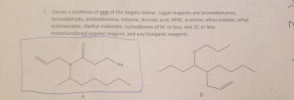
Please help with A. 7. Devise a synthesis of one of the targets below. Legal reagents...
 Please help with A.
7. Devise a synthesis of one of the targets below. Legal reagents are bromobenzene, benzaldehyde, acetophenone, toluene, benzoic acid, MVK, acetone, ethyl acetate, ethyl acetoacetate, diethyl malonate, cycloalkanes of 6C or less, any 2C or less monofunctional organic reagent, and any inorganic reagents.
Please help with A.
7. Devise a synthesis of one of the targets below. Legal reagents are bromobenzene, benzaldehyde, acetophenone, toluene, benzoic acid, MVK, acetone, ethyl acetate, ethyl acetoacetate, diethyl malonate, cycloalkanes of 6C or less, any 2C or less monofunctional organic reagent, and any inorganic reagents.
5. Synthesis: Show how the amine could be prepared from benzene, propanoic acid and dimethyl amine....
 5. Synthesis: Show how the amine could be prepared from benzene, propanoic acid and dimethyl amine. More than one synthetic transformation will be necessary. You have unlimited access to any inorganic reagent. Он and and 6. Give all possible structures of the product (C20H1203) formed by intramolecular Claisen condensation of the keto-ester shown below. 1. NaOH 2. H30 Page 3 of 4
 Shown below is the synthesis of N,N-dimethyl-2-methylhexanamide
from diethyl malonate. Fill in the best reagents to achieve this
synthetic transformation. Note: If one or more reagents are
incorrectly placed, a single red X will appear on the top left.
Shown below is the synthesis of N,N-dimethyl-2-methylhexanamide
from diethyl malonate. Fill in the best reagents to achieve this
synthetic transformation. Note: If one or more reagents are
incorrectly placed, a single red X will appear on the top left.
 A. Propose a synthesis of compound A starting from dimethyl malonate. When choosing your synthetic steps, you can use any hydrocarbon with three or fewer carbon atoms, any solvents or inorganic reagents, and any organic reagents that do not contribute carbon atoms to the carbon skeleton in the product. Clearly show the required reagents and the product of each step. You do not need to show mechanistic (curved) arrows. [6 marks) سوني Dimethyl malonate А
 Propose a synthesis of the following derivative of diethyl malonate using reagents from the choices provided below. (From the choices provided, list the reagent(s) in order that will accomplish this transformation. No more than 4 steps are required. List your answer as a single letter (single-step transformation) or a series of letters (multi-step transformation) with no commas separating them.) Reagents available a. Eto Na g. CH2=CHCH=CHCH,Br b. CH3 CH2Br c. CH3 CH, CH, CH(CH3)Br d. (CH3)2 CHCH, CH,Br e. CH3...
 8. Give a synthesis of the compound shown starting from either diethyl malonate (DEM) or ethyl acetoacetate (EAA) shown in the box below. Give all reagents necessary. State clearly whether your starting compound is DEM or EAA. You do not need to draw the intermediate steps. 17 pts] Eto Et Hoce DEM ΕΑΑ. 9. Draw the uncharged product of this synthetic sequence. [4 pts] 1. KOH OCH 3. NaOH(aq) excess 10. By how much will the mass of this compound...
 Fill in the appropriate reagents to achieve the synthetic
transformation shown below. Note: If one or more reagents are
incorrectly placed, a single red X will appear on the top left.
Map Sapling Learning macmilan learning Fill in the appropriate reaets to achieve the synthetic transformation shown below. Note: If one or more reagents are incorrectly placed, a single re X appear on the top left 2. 3. 4. 5. Mg, ether NaH Br(CH2)2CH3 CH3(CH2ho NaOH CH3(CH2MgBr acetone H30*
Fill in the appropriate reagents to achieve the synthetic
transformation shown below. Note: If one or more reagents are
incorrectly placed, a single red X will appear on the top left.
Map Sapling Learning macmilan learning Fill in the appropriate reaets to achieve the synthetic transformation shown below. Note: If one or more reagents are incorrectly placed, a single re X appear on the top left 2. 3. 4. 5. Mg, ether NaH Br(CH2)2CH3 CH3(CH2ho NaOH CH3(CH2MgBr acetone H30*
 Part IV - Multistep Synthesis [14 marks] A. Propose a synthesis of compound A starting from dimethyl malonate. When choosing your synthetic steps, you can use any hydrocarbon with three or fewer carbon atoms, any solvents or inorganic reagents, and any organic reagents that do not contribute carbon atoms to the carbon skeleton in the product. Clearly show the required reagents and the product of each step. You do not need to show mechanistic (curved) arrows. [6 marks] Dimethyl malonate...
 synthesis questions, please explain!
13. (10 pts.) Fill in the missing reagents or product in the following synthesis HO H2SO4 PCC CH2CH2 Diethyl ether 2. H30* 14. (10 pts.) Fill in the missing products. MOBI Diethyl ether n mCPBA mCPBA NaH
synthesis questions, please explain!
13. (10 pts.) Fill in the missing reagents or product in the following synthesis HO H2SO4 PCC CH2CH2 Diethyl ether 2. H30* 14. (10 pts.) Fill in the missing products. MOBI Diethyl ether n mCPBA mCPBA NaH
 12. Propose a multi-step synthesis to achieve the transformation shown below. Show all necessary reagents and conditions. LOH ó-6
 Please help with A.
7. Devise a synthesis of one of the targets below. Legal reagents are bromobenzene, benzaldehyde, acetophenone, toluene, benzoic acid, MVK, acetone, ethyl acetate, ethyl acetoacetate, diethyl malonate, cycloalkanes of 6C or less, any 2C or less monofunctional organic reagent, and any inorganic reagents.
Please help with A.
7. Devise a synthesis of one of the targets below. Legal reagents are bromobenzene, benzaldehyde, acetophenone, toluene, benzoic acid, MVK, acetone, ethyl acetate, ethyl acetoacetate, diethyl malonate, cycloalkanes of 6C or less, any 2C or less monofunctional organic reagent, and any inorganic reagents.
 5. Synthesis: Show how the amine could be prepared from benzene, propanoic acid and dimethyl amine. More than one synthetic transformation will be necessary. You have unlimited access to any inorganic reagent. Он and and 6. Give all possible structures of the product (C20H1203) formed by intramolecular Claisen condensation of the keto-ester shown below. 1. NaOH 2. H30 Page 3 of 4
Most questions answered within 3 hours.
-
Where is the error in this code sequence?
String s1 = "Hello";
String s2 = "ello";...
asked 11 months ago -
Financial data for Joel de Paris, Inc., for last year
follow:
Joel de Paris, Inc.
Balance...
asked 11 months ago -
Consider this reaction:
Al2(SO4)3 (aq)+ BaCl3
(aq) Al2Cl6 (aq)- +
3BaSO4(s) . What is the...
asked 11 months ago -
Suppose that Savneet is considering increasing her
recent random sample from 20 car rentals to 40...
asked 11 months ago -
Trucks arrive at an unloading terminal at an average rate of 120
per hour.
Trucks arrive...
asked 11 months ago -
Why are methanol and ethanol completely soluble in water while
octanol is not very little soluble....
asked 11 months ago -
A facilities manager at a university reads in a research report
that the mean amount of...
asked 11 months ago -
When the CuSO4 is rehydrated by adding water to the anhydrous
compound, is this an endothermic...
asked 11 months ago -
A ray of sunlight is passing from diamond into crown glass; the
angle of incidence is...
asked 11 months ago -
A block of mass 0.249 kg is placed on top of a light, vertical
spring of...
asked 11 months ago -
how do the kidneys compensate in the presences of acidosis
a) trigger hyperventilate
b) reserve acid...
asked 11 months ago -
Question 501 pts
The rental rate of capital to the firm increases. Which of the
following...
asked 11 months ago