1) What is the correct net ionic equation, including all coefficients, charges, and phases, for the...
Ba(OH)2(aq)+H2SO4(aq) --->
Express your answer as a chemical equation.
2) In an ion, the sum of the oxidation states is equal to the overall ionic charge. Note that the sign of the oxidation states and the number of atoms associated with each oxidation state must be considered. In OH-, for example, the oxygen atom has an oxidation state of 2 and the hydrogen atom has an oxidation state of +1, for a total of ( -2 ) + ( +1 ) = -1
(i) What is the oxidation state of each individual carbon atom in C2O4 2^-
Express the oxidation state numerically (e.g., +1).
(ii) Which element is reduced in this reaction?
2HCl+ 2KMnO4 + 3H2C2O4 ? 6CO2 +2MnO2 + 2KCl + 4H2O
Enter the elemental symbol.
Homework Answers
This problem is based on writing ionic equations and determining oxidation states of elements.
In order to write the complete ionic equation, first write the balanced molecular equation. Then show the aqueous compounds dissociated into ions. Insoluble salts, weak acids and bases are written in form of their molecular formula.
Then cancel out the ions that are common on both the sides to get the net ionic equation.
Ionic equations are chemical equations in which the electrolytes that dissociate completely in aqueous solution are written as dissociated ions. The symbol aq is written in front of the ions to show that they are in aqueous solutions.
The oxidation state or the oxidation number of an element is equal to the number of electrons that an atom gains, loses or shares when combines with other atoms to form a compound.
To determine the oxidation state of an element there are certain points to remember.
Oxidation state of an uncombined atom is 0. The sum of oxidation states of all atoms in a neutral compound is 0 and in an ion is equal to the ionic charge. In an oxidation reduction reaction if the oxidation number of an element increases, then it shows that is oxidized, and if the oxidation number decreases, it shows that the element is reduced.
(1)
In the reaction,  consists of
  and
and  ,
,  consists of
  and
and  .
.
In this reaction there is double displacement of ions. So, and forms  and
and  and
and  forms water. So, the chemical equation for this reaction is as follows:

In this equation, and are balanced, but there are two  and two on left side, and only two hydrogen and one oxygen atoms on right hand side.
So, put the coefficient two before  to get the balanced molecular equation as follows:

In the reaction,
Barium hydroxide and sulphuric acid are soluble in water,and barium sulphate is a solid that is insoluble.Water is in liquid state.
Thus the complete chemical equation with physical states of the substances is

In this chemical equation, barium hydroxide and sulphuric acid are aqueous.
So replacing these by their dissociated ions in the chemical equation,we get the complete ionic equation.

As there are no common ions on the two sides, the complete ionic equation is the net ionic equation.
Thus, the net ionic equation is as follows:
(2.i)
The sum of oxidation states of all atoms in an ion is equal to the ionic charge. In  ,the charge on ion is
  . In
. In  ,there are two carbons and four oxygen atoms. Oxidation state of oxygen is
Thus, oxidation state is calculated as follows:
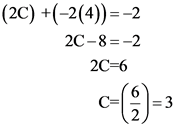
Thus, oxidation state of carbon is  in
in  .
.
(2.ii)
Oxidation state of  is
is  and Oxidation state of
  is
is  .
.  and
and  are neutral.
Thus for , the oxidation state is calculated as follows:

For , the oxidation state is calculated as follows:

Thus oxidation state of  decreases from
  in
in  to
to  in
in .
.
The net ionic equation is as follows:
The oxidation state of carbon is  in .
in .
The  is reduced in the reaction.
Add Answer to:
1) What is the correct net ionic equation, including all
coefficients, charges, and phases, for the...
What is the correct net ionic equation, including all coefficients, charges, and phases, for the following...
 What is the correct net ionic equation, including all coefficients, charges, and phases, for the following set of reactants? Assume that the contribution of protons from H_2SO_4 is near 100 %. Ba(OH)_2(aq) + H_2SO_4(aq) rightarrow Express your answer as a chemical equation.
Express your answer as a net lonic equation including phases Enter a balanced net ionic equations...
 Express your answer as a net lonic equation including phases Enter a balanced net ionic equations for the following reactions in basic solution: ΑΣΦ ? Submit Previous Answers Request Answer Part B CIO (4) + MnO (8) CI" (aq) + MnO," (aq) Express your answer as a net ionic equation including phases. ΑΣΦ Submit Request Answer Part Zn(8) + NON (1) + NH3 (aq) + Zn(OH) 2 (141) Express your answer as a net lonie equation including phases.
26. For the following chemical reaction write the net ionic equation, including the phases. a) 2HBr(aq)+Ba(OH)2(aq)...
26. For the following chemical reaction write the net ionic equation, including the phases. a) 2HBr(aq)+Ba(OH)2(aq) --> 2H2O(L)+BaBr2(aq) write the net ionic equation, including the phases. b) HClO2(aq)+NaOH(aq) --> H2O(L)+NaClO2(aq)
For the chemical reaction 2HBr(aq)+Ba(OH)2(aq)⟶2H2O(l)+BaBr2(aq)2HBr(aq)+Ba(OH)2(aq)⟶2H2O(l)+BaBr2(aq) write the net ionic equation, including the phases. net ionic equation:
For the chemical reaction 2HBr(aq)+Ba(OH)2(aq)⟶2H2O(l)+BaBr2(aq)2HBr(aq)+Ba(OH)2(aq)⟶2H2O(l)+BaBr2(aq) write the net ionic equation, including the phases. net ionic equation:
write the net ionic equation, including the phases. 2HBr(aq)+Ba(OH)2(aq) ---> 2H2O(l)+BaBr2(aq)
write the net ionic equation, including the phases. 2HBr(aq)+Ba(OH)2(aq) ---> 2H2O(l)+BaBr2(aq)
15. For the chemical reaction HCN(aq)+KOH(aq)⟶H2O(l)+KCN(aq) write the net ionic equation, including the phases. 13. Write...
15. For the chemical reaction HCN(aq)+KOH(aq)⟶H2O(l)+KCN(aq) write the net ionic equation, including the phases. 13. Write the balanced molecular equation for the neutralization reaction between HI and Ba(OH)2 in aqueous solution. Include physical states. molecular equation:
Total ionic equation: Net ionic equation: Post-lab: 1. Explain how it is possible for two reactants...
 Total ionic equation: Net ionic equation: Post-lab: 1. Explain how it is possible for two reactants that are each strong electrolytes to react and form products that are nonelectrolytes. by double replacement reactions. 2. Balance the equations and then write total and net ionic equations for each of the following: a. FeCl(aq) + 3NaOH(aq) → Fe(OH), (s) + 3NaCl (aq) Total ionic equation: Fe mg Bet Can + 3 Ath Tha) + 30th Fe (on), a + Station 3 tan...
Write the full ionic and net ionic equation for the neutralization reaction of H2SO4 (aq) with...
Write the full ionic and net ionic equation for the neutralization reaction of H2SO4 (aq) with Ba(OH)2 (aq). Balanced Full ionic Net ionic
Write balanced net ionic equation for the following reaction: Fe(OH)3(s)+H2SO4(aq)→? Express your answer as a chemical...
Write balanced net ionic equation for the following reaction: Fe(OH)3(s)+H2SO4(aq)→? Express your answer as a chemical equation. Identify all of the phases in your answer. Write balanced net ionic equation for the following reaction: HClO3(aq)+NaOH(aq)→? Note that HClO3 is a strong acid. Express your answer as a chemical equation. Identify all of the phases in your answer.
Write the net ionic equation, including phases, that corresponds to the reaction ZnCO, (s)+2 NaNO, (aq)...
 Write the net ionic equation, including phases, that corresponds to the reaction ZnCO, (s)+2 NaNO, (aq) Zn(NO)2 (aq) + Na,CO, (aq) net ionic equation: Zn2+(aq) +S2-(aq) Zn(aq)
 What is the correct net ionic equation, including all coefficients, charges, and phases, for the following set of reactants? Assume that the contribution of protons from H_2SO_4 is near 100 %. Ba(OH)_2(aq) + H_2SO_4(aq) rightarrow Express your answer as a chemical equation.
 Express your answer as a net lonic equation including phases Enter a balanced net ionic equations for the following reactions in basic solution: ΑΣΦ ? Submit Previous Answers Request Answer Part B CIO (4) + MnO (8) CI" (aq) + MnO," (aq) Express your answer as a net ionic equation including phases. ΑΣΦ Submit Request Answer Part Zn(8) + NON (1) + NH3 (aq) + Zn(OH) 2 (141) Express your answer as a net lonie equation including phases.
 Total ionic equation: Net ionic equation: Post-lab: 1. Explain how it is possible for two reactants that are each strong electrolytes to react and form products that are nonelectrolytes. by double replacement reactions. 2. Balance the equations and then write total and net ionic equations for each of the following: a. FeCl(aq) + 3NaOH(aq) → Fe(OH), (s) + 3NaCl (aq) Total ionic equation: Fe mg Bet Can + 3 Ath Tha) + 30th Fe (on), a + Station 3 tan...
 Write the net ionic equation, including phases, that corresponds to the reaction ZnCO, (s)+2 NaNO, (aq) Zn(NO)2 (aq) + Na,CO, (aq) net ionic equation: Zn2+(aq) +S2-(aq) Zn(aq)
Most questions answered within 3 hours.
-
Where is the error in this code sequence?
String s1 = "Hello";
String s2 = "ello";...
asked 10 months ago -
Financial data for Joel de Paris, Inc., for last year
follow:
Joel de Paris, Inc.
Balance...
asked 10 months ago -
Consider this reaction:
Al2(SO4)3 (aq)+ BaCl3
(aq) Al2Cl6 (aq)- +
3BaSO4(s) . What is the...
asked 10 months ago -
Suppose that Savneet is considering increasing her
recent random sample from 20 car rentals to 40...
asked 10 months ago -
Trucks arrive at an unloading terminal at an average rate of 120
per hour.
Trucks arrive...
asked 10 months ago -
Why are methanol and ethanol completely soluble in water while
octanol is not very little soluble....
asked 10 months ago -
A facilities manager at a university reads in a research report
that the mean amount of...
asked 10 months ago -
When the CuSO4 is rehydrated by adding water to the anhydrous
compound, is this an endothermic...
asked 10 months ago -
A ray of sunlight is passing from diamond into crown glass; the
angle of incidence is...
asked 10 months ago -
A block of mass 0.249 kg is placed on top of a light, vertical
spring of...
asked 10 months ago -
how do the kidneys compensate in the presences of acidosis
a) trigger hyperventilate
b) reserve acid...
asked 10 months ago -
Question 501 pts
The rental rate of capital to the firm increases. Which of the
following...
asked 10 months ago