Part A: The electrical conductivities of the following 0.100 M solutions were measured in an apparatus...
Part A:
The electrical conductivities of the following 0.100 M solutions
were measured in an apparatus that contained a light bulb as the
indicator of conductivity. Rank the solutions in order of
decreasing intensity (brightest to dimmest) of the light
bulb.
Rank from brightest to dimmest bulb. To rank items as equivalent,
overlap them.
HF,CH3OH, KI, Al(NO3)3
Brightest Dimmest
Part B:
A 0.100 M solution of K2SO4 would contain the same total ion concentration as which of the following solutions?
0.0800 
0.100 
0.0750 
0.0500
Homework Answers
The concept used to solve this problem is based upon the nature of electrolytes.
Substances are classified into strong electrolytes and weak electrolytes on the basis of their behavior in solution.
Strong electrolytes are the substances which get dissociated completely in solution and conduct electricity. Weak electrolytes are the substances which do not get dissociated completely in solution. Hence, their electricity conduction is weaker.
The conductivity of salts in the solution is determined on the basis of their number of ions present in the solution. Higher is the number of ions formed in the solution, more will be the conductivity and this provides bright light to the bulb connected to the circuit.
The ionic concentration of an electrolytic solution is calculated by the formula given as follows:
…… (1)
(A)
The conductivity of is higher than and because of the formation of highest number of ions in the solution. The conductivity of is higher than because of less covalent character in and for methanol it is lowest because of highest covalent character.
The molecules are arranged in the order of decreasing conductivities as follows:
(A)
The brightness of the bulb increases with an increase in the conductivity of the solution.
Therefore, on the basis of the conductivities, the order from brightest to dimmest light will be as follows:
(B)
Total ions in are . Hence, total ionic concentration of is calculated from the equation (1) as follows:
Total ions in are . Hence, total ionic concentration of is calculated from the equation (1) as follows:
Total ions in are . Hence, total ionic concentration of is calculated from the equation (1) as follows:
Total ions in are . Hence, total ionic concentration of is calculated from the equation (1) as follows:
Total ions in are . Hence, total ionic concentration of is calculated from the equation (1) as follows:
As the number of moles of ions present in the and solution are equal, therefore, the total ion concentration of is same as that of .
Ans: Part ACorrect order from brightest to dimmest light will be as follows:
Part B
The total ion concentration of solution is same as that of solution.
Add Answer to:
Part A:
The electrical conductivities of the following 0.100 M solutions
were measured in an apparatus...
The electrical conductivities of the following 0.100 M solutions were measured in an apparatus that contained...
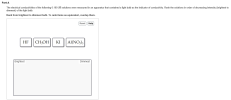 The electrical conductivities of the following 0.100 M solutions were measured in an apparatus that contained a light bulb as the indicator of conductivity. Rank the solutions in order of decreasing intensity (brightest to dimmest) of the light bulb. Rank from brightest to dimmest bulb. To rank items as equivalent, overlap them.
Electrolytic Properties and Molarity
 Part A:The electrical conductivities of the following 0.100 M solutions were measured in an apparatus that contained a light bulb as the indicator of conductivity. Rankthe solutions in order of decreasing intensity (brightest to dimmest) of the light bulb.Rank from brightest to dimmest bulb. To rank items as equivalent, overlap them.HF,CH3OH, KI, Al(NO3)3BrightestDimmestPart B:A 0.100 M solution of K2SO4 would contain the same total ion concentration as which of the following solutions?0.0800 0.100 0.0750 0.0500
 The electrical conductivities of the following 0.100 M solutions were measured in an apparatus that contained a light bulb as the indicator of conductivity. Rank the solutions in order of decreasing intensity (brightest to dimmest) of the light bulb. Rank from brightest to dimmest bulb. To rank items as equivalent, overlap them.
Most questions answered within 3 hours.
-
Where is the error in this code sequence?
String s1 = "Hello";
String s2 = "ello";...
asked 10 months ago -
Financial data for Joel de Paris, Inc., for last year
follow:
Joel de Paris, Inc.
Balance...
asked 10 months ago -
Consider this reaction:
Al2(SO4)3 (aq)+ BaCl3
(aq) Al2Cl6 (aq)- +
3BaSO4(s) . What is the...
asked 10 months ago -
Suppose that Savneet is considering increasing her
recent random sample from 20 car rentals to 40...
asked 10 months ago -
Trucks arrive at an unloading terminal at an average rate of 120
per hour.
Trucks arrive...
asked 10 months ago -
Why are methanol and ethanol completely soluble in water while
octanol is not very little soluble....
asked 10 months ago -
A facilities manager at a university reads in a research report
that the mean amount of...
asked 10 months ago -
When the CuSO4 is rehydrated by adding water to the anhydrous
compound, is this an endothermic...
asked 10 months ago -
A ray of sunlight is passing from diamond into crown glass; the
angle of incidence is...
asked 10 months ago -
A block of mass 0.249 kg is placed on top of a light, vertical
spring of...
asked 10 months ago -
how do the kidneys compensate in the presences of acidosis
a) trigger hyperventilate
b) reserve acid...
asked 10 months ago -
Question 501 pts
The rental rate of capital to the firm increases. Which of the
following...
asked 10 months ago