

we'll show we also can sSUme a Me Then you neel to show that thi orei Ho Mt
Homework Answers
Add Answer to:
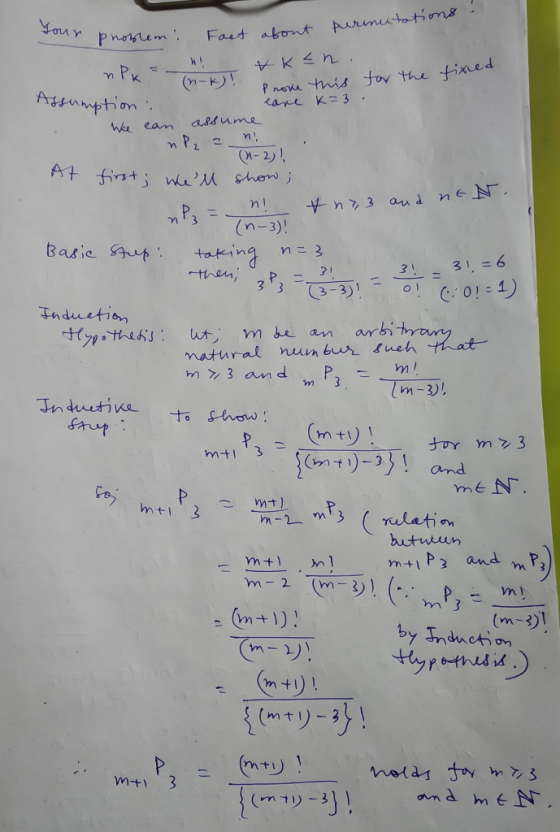
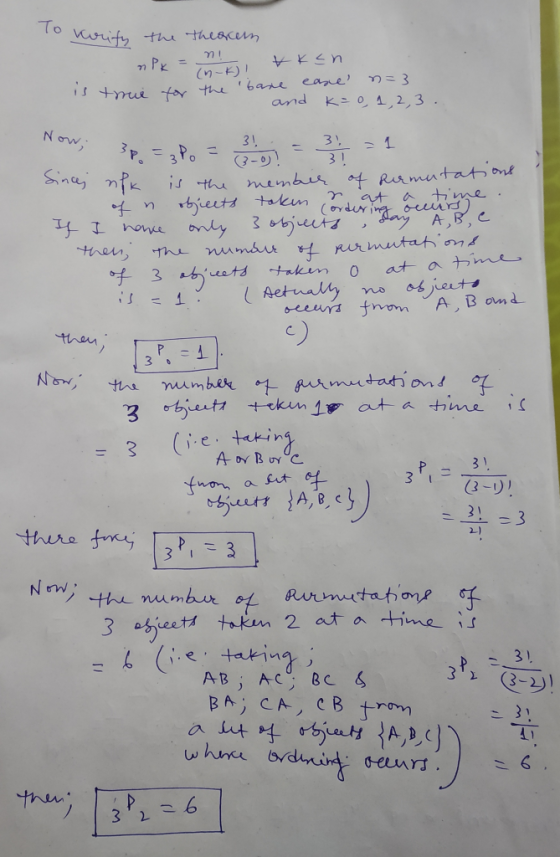
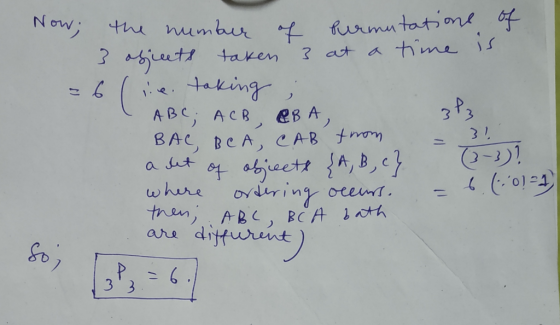
4. Here is a fact about permutations: (*) nPr= n!/(n-k)!, for all k =n. Let's prove...
prove the product of 4 consecutive integers is always divisible by 24 using the principles of math induction
prove the product of 4 consecutive integers is always divisible by 24 using the principles of math induction. Could anyone help me on this one? Thanks in advance!Sure For induction we want to prove some statement P for all the integers. We need: P(1) to be true (or some base case) If P(k) => P(k+1) If the statement's truth for some integer k implies the truth for the next integer, then P is true for all the integers. Look at...
Prove the Binomial Theorem, that is Exercises 173 (vi) x+y y for all n e N...
 Prove the Binomial Theorem, that is Exercises 173 (vi) x+y y for all n e N C) Recall that for all 0rS L is divisible by 8 when n is an odd natural number vii))Show that 2 (vin) Prove Leibniz's Theorem for repeated differentiation of a product: If ande are functions of x, then prove that d (uv) d + +Mat0 for all n e N, where u, and d'a d/v and dy da respectively denote (You will need to...
3 For each positive integer n, define E(n) 2+4++2n (a) Give a recursive definition for E(n)....
 3 For each positive integer n, define E(n) 2+4++2n (a) Give a recursive definition for E(n). (b) Let P(n) be the statement E(n) nn1)." Complete the steps below to give a proof by induction that P(n) holds for every neZ+ i. Verify P(1) is true. (This is the base step.) ii. Let k be some positive integer. We assume P(k) is true. What exactly are we assuming is true? (This is the inductive hypothesis.) iii. What is the statement P(k...
Prove by mathematical induction. 3 +4 +5 + ... + + (n + 2) = n(n+...
 Prove by mathematical induction. 3 +4 +5 + ... + + (n + 2) = n(n+ 5). Verify the formula for n = 1. 1 1 +5) 3 = 3 The formula is true for n = 1. Assume that the formula is true for n=k. 3 + 4 +5+ ... + (x + 2) = x(x + 5) Show that the formula is true for n = k +1. 3+ 4+ 5+... *«* +2)+(( 4+1 |_ )+2) - +...
Could I have help with entire question please. P+1 pt1 for any 2. In this question we will show by first principles tha...
 Could I have help with entire question please.
P+1 pt1 for any 2. In this question we will show by first principles that xpdz = p>0 a) Prove that (b) Use the formula (k +1)3- k3k23k +1 repeatedly to show that (for any n) m n (n+1) 7n and thus k2 mav be written in terms ofk- . Specifi- k-1 cally rL Note: An induction argument is not required here. (c) Using the same method with (complete) induction, or otherwise,...
Could I have help with entire question please.
P+1 pt1 for any 2. In this question we will show by first principles that xpdz = p>0 a) Prove that (b) Use the formula (k +1)3- k3k23k +1 repeatedly to show that (for any n) m n (n+1) 7n and thus k2 mav be written in terms ofk- . Specifi- k-1 cally rL Note: An induction argument is not required here. (c) Using the same method with (complete) induction, or otherwise,...
please answer all the questions. just rearranging. Explanation is not needed. Use modular arithmetic to prove...
 please answer all the questions.
just rearranging. Explanation is not needed.
Use modular arithmetic to prove that 3|(221 – 1) for an integer n > 0. Hence, 3|(221 – 1) for n > 0. To show that 3|(221 – 1), we can show that (221 – 1) = 0 (mod 3). We have: (221 – 1) = (4” – 1) (mod 3) Then, (22n – 1) = (1 - 1) = 0 (mod 3) Since 4 = 1 (mod 3),...
please answer all the questions.
just rearranging. Explanation is not needed.
Use modular arithmetic to prove that 3|(221 – 1) for an integer n > 0. Hence, 3|(221 – 1) for n > 0. To show that 3|(221 – 1), we can show that (221 – 1) = 0 (mod 3). We have: (221 – 1) = (4” – 1) (mod 3) Then, (22n – 1) = (1 - 1) = 0 (mod 3) Since 4 = 1 (mod 3),...
Use mathematical induction to prove the given statement for all positive integers n. 1+4+42 +4 +...+4...
 Use mathematical induction to prove the given statement for all positive integers n. 1+4+42 +4 +...+4 Part: 0 / 6 Part 1 of 6 Let P, be the statement: 1+4+42 +42 + ... + 4 Show that P, is true for -..
(c) contrapositive positiv 2. (a) Prove that for all integers n and k where n >k>0,...
 (c) contrapositive positiv 2. (a) Prove that for all integers n and k where n >k>0, (+1) = 0)+2). (b) Let k be a positive integer. Prove by induction on n that ¿ () = 1) for all integers n > k. 3. An urn contains five white balls numbered from 1 to 5. five red balls numbered from 1 to 5 and fiv
In the following problem, we will work through a proof of an important theorem of arithmetic. Your job will be to read the proof carefully and answer some questions about the argument. Theorem (The Di...
 In the following problem, we will work through a proof of an
important theorem of arithmetic. Your job will be to read the proof
carefully and answer some questions about the argument. Theorem
(The Division Algorithm). For any integer n ≥ 0, and for any
positive integer m, there exist integers d and r such that n = dm +
r and 0 ≤ r < m. Proof: (By strong induction on the variable n.)
Let m be an arbitrary...
In the following problem, we will work through a proof of an
important theorem of arithmetic. Your job will be to read the proof
carefully and answer some questions about the argument. Theorem
(The Division Algorithm). For any integer n ≥ 0, and for any
positive integer m, there exist integers d and r such that n = dm +
r and 0 ≤ r < m. Proof: (By strong induction on the variable n.)
Let m be an arbitrary...
Let S(n) be a statement parameterized by a positive integer n. Consider a proof that uses...
 Let S(n) be a statement parameterized by a positive integer n. Consider a proof that uses strong induction to prove that for all n 4.S(n) is true. The base case proves that S(4), S(5), S(6), S(7), and S(8) are all true. Select the correct expressions to complete the statement of what is assumed and proven in the inductive step. Supposed that for k> (1?),s() is true for everyj in the range 4 through k. Then we will show that (22)...
 Prove the Binomial Theorem, that is Exercises 173 (vi) x+y y for all n e N C) Recall that for all 0rS L is divisible by 8 when n is an odd natural number vii))Show that 2 (vin) Prove Leibniz's Theorem for repeated differentiation of a product: If ande are functions of x, then prove that d (uv) d + +Mat0 for all n e N, where u, and d'a d/v and dy da respectively denote (You will need to...
 3 For each positive integer n, define E(n) 2+4++2n (a) Give a recursive definition for E(n). (b) Let P(n) be the statement E(n) nn1)." Complete the steps below to give a proof by induction that P(n) holds for every neZ+ i. Verify P(1) is true. (This is the base step.) ii. Let k be some positive integer. We assume P(k) is true. What exactly are we assuming is true? (This is the inductive hypothesis.) iii. What is the statement P(k...
 Prove by mathematical induction. 3 +4 +5 + ... + + (n + 2) = n(n+ 5). Verify the formula for n = 1. 1 1 +5) 3 = 3 The formula is true for n = 1. Assume that the formula is true for n=k. 3 + 4 +5+ ... + (x + 2) = x(x + 5) Show that the formula is true for n = k +1. 3+ 4+ 5+... *«* +2)+(( 4+1 |_ )+2) - +...
 Could I have help with entire question please.
P+1 pt1 for any 2. In this question we will show by first principles that xpdz = p>0 a) Prove that (b) Use the formula (k +1)3- k3k23k +1 repeatedly to show that (for any n) m n (n+1) 7n and thus k2 mav be written in terms ofk- . Specifi- k-1 cally rL Note: An induction argument is not required here. (c) Using the same method with (complete) induction, or otherwise,...
Could I have help with entire question please.
P+1 pt1 for any 2. In this question we will show by first principles that xpdz = p>0 a) Prove that (b) Use the formula (k +1)3- k3k23k +1 repeatedly to show that (for any n) m n (n+1) 7n and thus k2 mav be written in terms ofk- . Specifi- k-1 cally rL Note: An induction argument is not required here. (c) Using the same method with (complete) induction, or otherwise,...
 please answer all the questions.
just rearranging. Explanation is not needed.
Use modular arithmetic to prove that 3|(221 – 1) for an integer n > 0. Hence, 3|(221 – 1) for n > 0. To show that 3|(221 – 1), we can show that (221 – 1) = 0 (mod 3). We have: (221 – 1) = (4” – 1) (mod 3) Then, (22n – 1) = (1 - 1) = 0 (mod 3) Since 4 = 1 (mod 3),...
please answer all the questions.
just rearranging. Explanation is not needed.
Use modular arithmetic to prove that 3|(221 – 1) for an integer n > 0. Hence, 3|(221 – 1) for n > 0. To show that 3|(221 – 1), we can show that (221 – 1) = 0 (mod 3). We have: (221 – 1) = (4” – 1) (mod 3) Then, (22n – 1) = (1 - 1) = 0 (mod 3) Since 4 = 1 (mod 3),...
 Use mathematical induction to prove the given statement for all positive integers n. 1+4+42 +4 +...+4 Part: 0 / 6 Part 1 of 6 Let P, be the statement: 1+4+42 +42 + ... + 4 Show that P, is true for -..
 (c) contrapositive positiv 2. (a) Prove that for all integers n and k where n >k>0, (+1) = 0)+2). (b) Let k be a positive integer. Prove by induction on n that ¿ () = 1) for all integers n > k. 3. An urn contains five white balls numbered from 1 to 5. five red balls numbered from 1 to 5 and fiv
 In the following problem, we will work through a proof of an
important theorem of arithmetic. Your job will be to read the proof
carefully and answer some questions about the argument. Theorem
(The Division Algorithm). For any integer n ≥ 0, and for any
positive integer m, there exist integers d and r such that n = dm +
r and 0 ≤ r < m. Proof: (By strong induction on the variable n.)
Let m be an arbitrary...
In the following problem, we will work through a proof of an
important theorem of arithmetic. Your job will be to read the proof
carefully and answer some questions about the argument. Theorem
(The Division Algorithm). For any integer n ≥ 0, and for any
positive integer m, there exist integers d and r such that n = dm +
r and 0 ≤ r < m. Proof: (By strong induction on the variable n.)
Let m be an arbitrary...
 Let S(n) be a statement parameterized by a positive integer n. Consider a proof that uses strong induction to prove that for all n 4.S(n) is true. The base case proves that S(4), S(5), S(6), S(7), and S(8) are all true. Select the correct expressions to complete the statement of what is assumed and proven in the inductive step. Supposed that for k> (1?),s() is true for everyj in the range 4 through k. Then we will show that (22)...
Most questions answered within 3 hours.
-
Where is the error in this code sequence?
String s1 = "Hello";
String s2 = "ello";...
asked 10 months ago -
Financial data for Joel de Paris, Inc., for last year
follow:
Joel de Paris, Inc.
Balance...
asked 10 months ago -
Consider this reaction:
Al2(SO4)3 (aq)+ BaCl3
(aq) Al2Cl6 (aq)- +
3BaSO4(s) . What is the...
asked 10 months ago -
Suppose that Savneet is considering increasing her
recent random sample from 20 car rentals to 40...
asked 10 months ago -
Trucks arrive at an unloading terminal at an average rate of 120
per hour.
Trucks arrive...
asked 10 months ago -
Why are methanol and ethanol completely soluble in water while
octanol is not very little soluble....
asked 10 months ago -
A facilities manager at a university reads in a research report
that the mean amount of...
asked 10 months ago -
When the CuSO4 is rehydrated by adding water to the anhydrous
compound, is this an endothermic...
asked 10 months ago -
A ray of sunlight is passing from diamond into crown glass; the
angle of incidence is...
asked 10 months ago -
A block of mass 0.249 kg is placed on top of a light, vertical
spring of...
asked 10 months ago -
how do the kidneys compensate in the presences of acidosis
a) trigger hyperventilate
b) reserve acid...
asked 10 months ago -
Question 501 pts
The rental rate of capital to the firm increases. Which of the
following...
asked 10 months ago