5) Sulfuric acid reacts with nitric acid as shown to form the nitronium ion. HNO3 (aq)...
5) Sulfuric acid reacts with nitric acid as shown to form the nitronium ion.
HNO3 (aq) + 2H2SO4 (aq) ---> NO2+ (aq) + H3O+ (aq) + 2HSO4- (aq)
Part 2 (1 point)
Identify the acid and conjugate base in the reaction. (Hint:
Draw the Lewis structures for each.)
 Choose one:H2SO4/H3O+
HNO3/H3O+
HNO3/H2SO4
HNO3/HSO4-
H2SO4/NO2+
H2SO4/HSO4-
HNO3/NO2+
Part 3 (1 point)
Identify the base and conjugate acid in the reaction. (Hint:
Draw the Lewis structures for each.)
Choose one:HNO3/H2SO4
HNO3/HSO4-
HNO3/NO2+
H2SO4/H3O+
H2SO4/NO2+
H2SO4/HSO4-
HNO3/H3O+
Homework Answers

Add Answer to:
5) Sulfuric acid reacts with nitric acid as shown to form the
nitronium ion.
HNO3 (aq)...
Nitric acid, HNO3, produces nitronium ion, NO2, by O A) loss of H20 after protonation by...
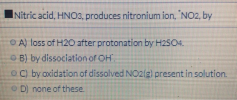 Nitric acid, HNO3, produces nitronium ion, NO2, by O A) loss of H20 after protonation by H2SO4. O B) by dissociation of OH'. 0 C) by oxidation of dissolved NO2(g) present in solution OD) none of these
To obtain a high yield of nitroacetanilide, 2 equivalents of the nitronium ion will be reacted...
To obtain a high yield of nitroacetanilide, 2 equivalents of the nitronium ion will be reacted with acetanilide in this experiment. If 1 g of acetanilide (molecular weight of acetanilide is 135.17 g/mol) is used, what amount (in mol) of nitronium ion is required? (2 sig figs) Using the equation: HNO3 + H2SO4 --> NO2 + HSO4 +H2O If the molecular weight of nitric acid is 63.01 g/mol and its density is 1.5129 g/mL, what volume (mL) of nitric acid...
1. How many moles of HNO3 are contained in 1.0 mL of concentrated nitric acid? Please...
1. How many moles of HNO3 are contained in 1.0 mL of concentrated nitric acid? Please try to show me your calculations so I can learn how to do it. 2. Draw a lewis electron dot structure for the nitronium ion, NO2+. Show all valence electrons.
Sulfuric acid reacts with sodium hydroxide in an acid base reaction (not balanced): H2SO4(aq) + NaOH(aq)⟶ Na2SO4(aq)...
 Sulfuric acid reacts with sodium hydroxide in an acid base
reaction (not balanced):
H2SO4(aq) + NaOH(aq)⟶ Na2SO4(aq)
+ H2O(l)
If 40. g of sulfuric acid are used by this reaction how many
grams of NaOH must be used?
Sulfuric acid reacts with sodium hydroxide in an acid base
reaction (not balanced):
H2SO4(aq) + NaOH(aq)⟶ Na2SO4(aq)
+ H2O(l)
If 40. g of sulfuric acid are used by this reaction how many
grams of NaOH must be used?
Question 2 (1 point) Select the weakest acid from the following. H2CO3 H2SO4 HNO3 HCI Qulestion...
 Question 2 (1 point) Select the weakest acid from the following. H2CO3 H2SO4 HNO3 HCI Qulestion 3 (1 point) Identify the acid and base as well as the conjugate acid and base in the following reactio H20 (I) + HBr (aq) H3O+ (aq) + Br" (aq) 18
A- Identify the reactant that is a Brønsted−Lowry acid in the following reaction: CO32−(aq)+H2O(l)⇌HCO3−(aq)+OH−(aq) B- Identify...
A- Identify the reactant that is a Brønsted−Lowry acid in the following reaction: CO32−(aq)+H2O(l)⇌HCO3−(aq)+OH−(aq) B- Identify the reactant that is a Brønsted−Lowry base in the following reaction: CO32−(aq)+H2O(l)⇌HCO3−(aq)+OH−(aq) Express your answer as a chemical formula. c- Identify the reactant that is a Brønsted−Lowry acid in the following reaction: H2SO4(aq)+H2O(l)→HSO4−(aq)+H3O+(aq) Express your answer as a chemical formula d- Identify the reactant that is a Brønsted−Lowry base in the following reaction: H2SO4(aq)+H2O(l)→HSO4−(aq)+H3O+(aq) Express your answer as a chemical formula.
Copper reacts with nitric acid via the following equation: 3 Cu(s) + 8 HNO3(aq) → 3...
Copper reacts with nitric acid via the following equation: 3 Cu(s) + 8 HNO3(aq) → 3 Cu(NO3)2(aq) + 2 NO(g) + 4 H2O(ℓ) What mass of NO(g) can be formed when 20.7 g of Cu reacts with 50.0 g HNO3? g NO
Another component of acid rain is nitric acid, which forms when NO2, also a pollutant, reacts...
Another component of acid rain is nitric acid, which forms when NO2, also a pollutant, reacts with oxygen and water according to the simplified equation 4NO2(g)+O2(g)+2H2O(l) → 4HNO3(aq) The generation of the electricity used in a medium-sized home produces about 13 kg of NO2 per year. Part A Assuming that there is adequate O2 and H2O, what mass of HNO3, in kg, can form from this amount of NO2 pollutant?
q10 Choose the correct, balanced chemical equation for the following neutralization reaction: nitric acid reacts with...
 q10
Choose the correct, balanced chemical equation for the following neutralization reaction: nitric acid reacts with aqueous barium hydroxide to form aqueous barium nitrate and water O HNO3 + BaOH + BaNO3 + H2O • 2 HNO3(aq) + Ba(OH)2(aq) - Ba(NO3)2(aq) + 2 H2O(1) HNO3(aq) + Ba(OH)2(aq) – Ba(NO3)2(aq) + H2O(1)
q10
Choose the correct, balanced chemical equation for the following neutralization reaction: nitric acid reacts with aqueous barium hydroxide to form aqueous barium nitrate and water O HNO3 + BaOH + BaNO3 + H2O • 2 HNO3(aq) + Ba(OH)2(aq) - Ba(NO3)2(aq) + 2 H2O(1) HNO3(aq) + Ba(OH)2(aq) – Ba(NO3)2(aq) + H2O(1)
4. Explain things in the following question(s) In each reaction, identify the Brønsted-Lowry acid, the Brønsted-Lowry...
 4. Explain things in the following question(s) In each reaction, identify the Brønsted-Lowry acid, the Brønsted-Lowry base, the conjugate acid, and the conjugate base. (a) H2SO4(aq) + H2O(l) —— HSO4 (aq) + H30+(aq) (b) HCO3(aq) + H20(1) = H,CO3(aq) + OH(aq) 5. Using examples, distinguish between a Nucleophile vs Electrophile. Give at least 2 differences between the 2 concepts 6. What are curved arrows or "curly arrows" in Organic Chemistry? What do they represent? Give an example (b) Using Ammonia...
 Nitric acid, HNO3, produces nitronium ion, NO2, by O A) loss of H20 after protonation by H2SO4. O B) by dissociation of OH'. 0 C) by oxidation of dissolved NO2(g) present in solution OD) none of these
 Sulfuric acid reacts with sodium hydroxide in an acid base
reaction (not balanced):
H2SO4(aq) + NaOH(aq)⟶ Na2SO4(aq)
+ H2O(l)
If 40. g of sulfuric acid are used by this reaction how many
grams of NaOH must be used?
Sulfuric acid reacts with sodium hydroxide in an acid base
reaction (not balanced):
H2SO4(aq) + NaOH(aq)⟶ Na2SO4(aq)
+ H2O(l)
If 40. g of sulfuric acid are used by this reaction how many
grams of NaOH must be used?
 Question 2 (1 point) Select the weakest acid from the following. H2CO3 H2SO4 HNO3 HCI Qulestion 3 (1 point) Identify the acid and base as well as the conjugate acid and base in the following reactio H20 (I) + HBr (aq) H3O+ (aq) + Br" (aq) 18
 q10
Choose the correct, balanced chemical equation for the following neutralization reaction: nitric acid reacts with aqueous barium hydroxide to form aqueous barium nitrate and water O HNO3 + BaOH + BaNO3 + H2O • 2 HNO3(aq) + Ba(OH)2(aq) - Ba(NO3)2(aq) + 2 H2O(1) HNO3(aq) + Ba(OH)2(aq) – Ba(NO3)2(aq) + H2O(1)
q10
Choose the correct, balanced chemical equation for the following neutralization reaction: nitric acid reacts with aqueous barium hydroxide to form aqueous barium nitrate and water O HNO3 + BaOH + BaNO3 + H2O • 2 HNO3(aq) + Ba(OH)2(aq) - Ba(NO3)2(aq) + 2 H2O(1) HNO3(aq) + Ba(OH)2(aq) – Ba(NO3)2(aq) + H2O(1)
 4. Explain things in the following question(s) In each reaction, identify the Brønsted-Lowry acid, the Brønsted-Lowry base, the conjugate acid, and the conjugate base. (a) H2SO4(aq) + H2O(l) —— HSO4 (aq) + H30+(aq) (b) HCO3(aq) + H20(1) = H,CO3(aq) + OH(aq) 5. Using examples, distinguish between a Nucleophile vs Electrophile. Give at least 2 differences between the 2 concepts 6. What are curved arrows or "curly arrows" in Organic Chemistry? What do they represent? Give an example (b) Using Ammonia...
Most questions answered within 3 hours.
-
Where is the error in this code sequence?
String s1 = "Hello";
String s2 = "ello";...
asked 10 months ago -
Financial data for Joel de Paris, Inc., for last year
follow:
Joel de Paris, Inc.
Balance...
asked 10 months ago -
Consider this reaction:
Al2(SO4)3 (aq)+ BaCl3
(aq) Al2Cl6 (aq)- +
3BaSO4(s) . What is the...
asked 10 months ago -
Suppose that Savneet is considering increasing her
recent random sample from 20 car rentals to 40...
asked 10 months ago -
Trucks arrive at an unloading terminal at an average rate of 120
per hour.
Trucks arrive...
asked 10 months ago -
Why are methanol and ethanol completely soluble in water while
octanol is not very little soluble....
asked 10 months ago -
A facilities manager at a university reads in a research report
that the mean amount of...
asked 10 months ago -
When the CuSO4 is rehydrated by adding water to the anhydrous
compound, is this an endothermic...
asked 10 months ago -
A ray of sunlight is passing from diamond into crown glass; the
angle of incidence is...
asked 10 months ago -
A block of mass 0.249 kg is placed on top of a light, vertical
spring of...
asked 10 months ago -
how do the kidneys compensate in the presences of acidosis
a) trigger hyperventilate
b) reserve acid...
asked 10 months ago -
Question 501 pts
The rental rate of capital to the firm increases. Which of the
following...
asked 10 months ago