1. The JOBS Act of 2012 enabled what type of offerings? A. OPOs consisting of equity...
1. The JOBS Act of 2012 enabled what type of offerings? A. OPOs consisting of equity crowdfunding offerings conducted over the Internet B. IPOs conducted on regional exchanges C. Rewards-based crowdfunding offerings conducted over the Internet D. Equity crowdfunding offerings conducted on the NYSE
2. A firm has the following sale figures: l Year 2011: $4.6 million; l Year 2012: $5.1 million l Year 2013: $4.2 million l Year 2014: $3.8 million l Year 2015: $4.3 million Using the average approach, determine the forecast for the next year's sales. A. $5.1 million B. $5.4 million C. $3.2 million D. $4.4 million
3. A firm has the following sales figures: l Year 2011: $2.1 million l Year 2012: $2.3 million l Year 2013: $2.5 million l Year 2014 $2.2 million l Year 2015: $3.1 million Using the naïve approach, determine the forecast for next year's sales. A. $3.2 million B. $2.5 million C. $3.4 million D. $3.1 million
Homework Answers
Q - 1
The correct answer is option A. OPOs consisting of equity crowdfunding offerings conducted over the Internet
The JOBS Act of 2012 cleared path of small starts ups and their promoters to seek crowd funcing over internet and social media. It's popularly knows as online public offering ("OPO"s)
Q - 2
Under average approach, demand forecast for next year = (4.6 + 5.1 + 4.2 + 3.8 + 4.3) / 5 = $ 4.4 mn
Hence, the correct answer is option D. $4.4 million
Q - 3
Under naive method, the next year's forecast is same as recent most year's actual sales.
Hence, forecast sale for next year = actual sale of last year i. e Year 2015 = $ 3.1 mn
Hence, the correct answer is option D. $ 3.1 million
Add Answer to:
1. The JOBS Act of 2012 enabled what type of offerings? A. OPOs
consisting of equity...
1. The JOBS Act of 2012 enabled what type of offerings? A. OPOs consisting of equity...
1. The JOBS Act of 2012 enabled what type of offerings? A. OPOs consisting of equity crowdfunding offerings conducted over the Internet B. IPOs conducted on regional exchanges C. Rewards-based crowdfunding offerings conducted over the Internet D. Equity crowdfunding offerings conducted on the NYSE 2. A firm has the following sale figures: l Year 2011: $4.6 million; l Year 2012: $5.1 million l Year 2013: $4.2 million l Year 2014: $3.8 million l Year 2015: $4.3 million Using the average...
Naïve Sales Forecast Suppose a firm has had the following historic sales figures What would be...
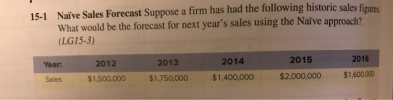 Naïve Sales Forecast Suppose a firm has had the following historic sales figures What would be the forecast for next year's sales using the Naïve approach? 15-1 (LG15-3) Year 2012 2013 2014 2015 2016 Sales $1,500,000 $1,750,000$1,400,000 $2,000,000 $1,600000
Suppose a firm has had the following historic sales figures. Year: 2012 2013 2014 2015 2016...
Suppose a firm has had the following historic sales figures. Year: 2012 2013 2014 2015 2016 Sales $3,900,000 $5,150,000 $3,800,000 $3,400,000 $4,000,000 What would be the forecast for next year’s sales using the naïve approach?
Suppose a firm has had the following historic sales figures. Year: 2012 2013 2014 2015 2016...
Suppose a firm has had the following historic sales figures. Year: 2012 2013 2014 2015 2016 Sales $3,200,000 $4,450,000 $3,100,000 $2,700,000 $3,300,000 What would be the forecast for next year’s sales using the naïve approach?
Suppose a firm has had the following historic sales figures. Year: 2012 2013 2014 2015 2016...
Suppose a firm has had the following historic sales figures. Year: 2012 2013 2014 2015 2016 Sales: $3,200,000 $$3,450,000 $3,100,000 $3,700,000 3,300,000 What would be the forecast for next year's sales using the average approach?
Problem 15-2 Naive Sales Forecast (LG15-3) Suppose a firm has had the following historic sales figures....
 Problem 15-2 Naive Sales Forecast (LG15-3) Suppose a firm has had the following historic sales figures. Year: Sales 2012 $3,700,000 2013 $4,950,000 2014 $3,600,000 2015 $3,200,000 2016 $3,500,000 What would be the forecast for next year's sales using the naive approach? Next year's sales Sybe here to search W F R T Y U I O P s o F C H ] K L Problem 15-2 Naive Sales Forecast (LG15-3) Suppose a firm has had the following historic sales...
Suppose a firm has had the following historic sales figures. Year: 2012 2013 2014 2015 2016...
Suppose a firm has had the following historic sales figures. Year: 2012 2013 2014 2015 2016 Sales $3,100,000 $3,350,000 $3,000,000 $3,600,000 $3,200,000 What would be the forecast for next year’s sales using the average approach?
Suppose a firm has had the following historic sales figures. Year: 2012 2013 2014 2015 2016...
Suppose a firm has had the following historic sales figures. Year: 2012 2013 2014 2015 2016 Sales $2,500,000 $3,750,000 $2,400,000 $2,000,000 $2,600,000 What would be the forecast for next year’s sales using the average approach?
Year Quarter Sales (in Billions) 2009 1 2.62 2009 2 2.33 2009 3 2.4 2009 4...
Year Quarter Sales (in Billions) 2009 1 2.62 2009 2 2.33 2009 3 2.4 2009 4 2.42 2010 1 2.72 2010 2 2.53 2010 3 2.61 2010 4 2.84 2011 1 2.95 2011 2 2.79 2011 3 2.93 2011 4 3.03 2012 1 3.44 2012 2 3.2 2012 3 3.3 2012 4 3.36 2013 1 3.79 2013 2 3.56 2013 3 3.74 2013 4 3.8 2014 1 4.24 2014 2 3.87 2014 3 4.15 2014 4 4.18 2015 1 4.8...
Global smartphone sales experienced extraordinary growth starting in 2007 with the introduction of both the iPhone...
Global smartphone sales experienced extraordinary growth starting in 2007 with the introduction of both the iPhone and Android-platform based devices (see the Chapter Introduction). Following are the yearly global sales (in million units) for smartphones beginning in 2008 through 2015: YEAR SALES 2008 140 2009 173 2010 305 2011 495 2012 730 2013 1030 2014 1300 2015 1430 Develop a linear trend line model to forecast smartphone sales for 2016, 2017, and 2018, and compare these forecasts with those reported...
 Naïve Sales Forecast Suppose a firm has had the following historic sales figures What would be the forecast for next year's sales using the Naïve approach? 15-1 (LG15-3) Year 2012 2013 2014 2015 2016 Sales $1,500,000 $1,750,000$1,400,000 $2,000,000 $1,600000
 Problem 15-2 Naive Sales Forecast (LG15-3) Suppose a firm has had the following historic sales figures. Year: Sales 2012 $3,700,000 2013 $4,950,000 2014 $3,600,000 2015 $3,200,000 2016 $3,500,000 What would be the forecast for next year's sales using the naive approach? Next year's sales Sybe here to search W F R T Y U I O P s o F C H ] K L Problem 15-2 Naive Sales Forecast (LG15-3) Suppose a firm has had the following historic sales...
Most questions answered within 3 hours.
-
Where is the error in this code sequence?
String s1 = "Hello";
String s2 = "ello";...
asked 11 months ago -
Financial data for Joel de Paris, Inc., for last year
follow:
Joel de Paris, Inc.
Balance...
asked 11 months ago -
Consider this reaction:
Al2(SO4)3 (aq)+ BaCl3
(aq) Al2Cl6 (aq)- +
3BaSO4(s) . What is the...
asked 11 months ago -
Suppose that Savneet is considering increasing her
recent random sample from 20 car rentals to 40...
asked 11 months ago -
Trucks arrive at an unloading terminal at an average rate of 120
per hour.
Trucks arrive...
asked 11 months ago -
Why are methanol and ethanol completely soluble in water while
octanol is not very little soluble....
asked 11 months ago -
A facilities manager at a university reads in a research report
that the mean amount of...
asked 11 months ago -
When the CuSO4 is rehydrated by adding water to the anhydrous
compound, is this an endothermic...
asked 11 months ago -
A ray of sunlight is passing from diamond into crown glass; the
angle of incidence is...
asked 11 months ago -
A block of mass 0.249 kg is placed on top of a light, vertical
spring of...
asked 11 months ago -
how do the kidneys compensate in the presences of acidosis
a) trigger hyperventilate
b) reserve acid...
asked 11 months ago -
Question 501 pts
The rental rate of capital to the firm increases. Which of the
following...
asked 11 months ago