
Homework Answers
Oxidation State for Chromium in the complex 

Now d-orbital can have two electronic configuration, such as
high spin 

Here comes a factor Pairing energy 
For 


In this complex 


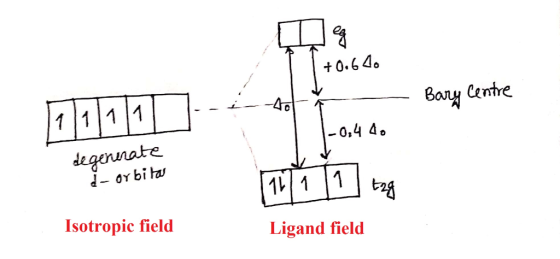
Crystal Field Stabilization Energy (CFSE) = 


CFSE = ![[(- 1.6 \times 150 + 120)- 0] kJ mol^{-1}](http://img.homeworklib.com/images/632bc0c3-7978-4e4e-bbd9-57454be3e41f.6%20%5Ctimes%20150%20+%20120%29-%200%5D%20kJ%20mol%5E%7B-1%7D?x-oss-process=image/resize,w_560)

Add Answer to:
Calculate the crystal field stabilization energy valiue for the complex Cr(NH)J*. The crystal field splitting energy...
Calculate the crystal field splitting energy, Δ, for a complex that absorbs light with a wavelength...
Calculate the crystal field splitting energy, Δ, for a complex that absorbs light with a wavelength of 648 nm. Enter your answer in units of kJ/mol. (Hint: your answer should not be tiny).
A ?1 octahedral complex is found to absorb visible light, with the absorption maximum occurring at 499 nm . Calculate the crystal-field splitting energy, Δ , in kJ/mol.
 A ?1 octahedral complex is found to absorb visible light, with the absorption maximum occurring at 499 nmCalculate the crystal-field splitting energy, Δin kJ/mol.
inorganic chem
3) Consider [Co(H2O)6]2+ and [Cr(C2O4)3]3- complex ionsa) Calculate the splitting energies of these complex ions.b) Compare your results with pairing energies of these metal ions and decide whether the ligands are weak field or strong field ligands.c) Calculate the crystal field stabilization energy for each compound.Complexλ1λ2λ3Pairing Energy (Kj/mol)[Co(H2O)6]2+510460-250. 0[Cr(C2O4)3]3-565415266244.3
Estimate the crystal field stabilization energy for the octahedral ion hexacyanocobaltate(III), if the wavelength of maximum...
 Estimate the crystal field stabilization energy for the octahedral ion hexacyanocobaltate(III), if the wavelength of maximum absorption for the ion is 309 nm. [Note: This is a high-field (low-spin) complex.] kJ mol-1
Estimate the crystal field stabilization energy for the octahedral ion hexafluorocobaltate(III), if the wavelength of maximum...
Estimate the crystal field stabilization energy for the octahedral ion hexafluorocobaltate(III), if the wavelength of maximum absorption for the ion is 710 nm. [Note: This is a weak-field (high-spin) complex.] _____ kJ mol-1
Estimate the crystal field stabilization energy for the octahedral ion hexacyanomanganate(III), if the wavelength of maximum...
Estimate the crystal field stabilization energy for the octahedral ion hexacyanomanganate(III), if the wavelength of maximum absorption for the ion is 600 nm. [Note: This is a high-field (low-spin) complex.] kJ mol-1
(8 pts) 13. a. Give the crystal field splitting diagram for the complex ion, [Cr(CN)! with...
 (8 pts) 13. a. Give the crystal field splitting diagram for the complex ion, [Cr(CN)! with all d orbitals labeled and correct placement of electrons. b. Is the complex ion paramagnetic or diamagnetic? c. List the compounds in order of increasing wavelength that they would absorb light. (longest 2) (shortest A) [Cr(H2O)6]2. [CMNHJs产 [CrF6]4-, ,
The extent of crystal field splitting is often determined from spectra. Given the wavelength (7.) of...
 The extent of crystal field splitting is often determined from spectra. Given the wavelength (7.) of maximum absorption, 2. = 295 nm, find the crystal field splitting energy (A), in kJ/mol, for the complex ion (Rh(NH3).13+. kJ/mol
The complex [Fe(H2O)6]3+ has a maximum absorbance at 724 nm. a.Calculate the crystal field splitting energy,...
The complex [Fe(H2O)6]3+ has a maximum absorbance at 724 nm. a.Calculate the crystal field splitting energy, in kJ, for the complex. b.Predict the colour of the complex.
The wavelength of light (in nanometers) that is absorbed by a complex that has a crystal-field...
The wavelength of light (in nanometers) that is absorbed by a complex that has a crystal-field splitting energy of 3.30×10² kJ/mol is _____. (h = 6.626 × 10⁻³⁴ J·s, c = 3.00 × 10⁸ m/s)
 Estimate the crystal field stabilization energy for the octahedral ion hexacyanocobaltate(III), if the wavelength of maximum absorption for the ion is 309 nm. [Note: This is a high-field (low-spin) complex.] kJ mol-1
 (8 pts) 13. a. Give the crystal field splitting diagram for the complex ion, [Cr(CN)! with all d orbitals labeled and correct placement of electrons. b. Is the complex ion paramagnetic or diamagnetic? c. List the compounds in order of increasing wavelength that they would absorb light. (longest 2) (shortest A) [Cr(H2O)6]2. [CMNHJs产 [CrF6]4-, ,
 The extent of crystal field splitting is often determined from spectra. Given the wavelength (7.) of maximum absorption, 2. = 295 nm, find the crystal field splitting energy (A), in kJ/mol, for the complex ion (Rh(NH3).13+. kJ/mol
Most questions answered within 3 hours.
-
Where is the error in this code sequence?
String s1 = "Hello";
String s2 = "ello";...
asked 10 months ago -
Financial data for Joel de Paris, Inc., for last year
follow:
Joel de Paris, Inc.
Balance...
asked 10 months ago -
Consider this reaction:
Al2(SO4)3 (aq)+ BaCl3
(aq) Al2Cl6 (aq)- +
3BaSO4(s) . What is the...
asked 10 months ago -
Suppose that Savneet is considering increasing her
recent random sample from 20 car rentals to 40...
asked 10 months ago -
Trucks arrive at an unloading terminal at an average rate of 120
per hour.
Trucks arrive...
asked 10 months ago -
Why are methanol and ethanol completely soluble in water while
octanol is not very little soluble....
asked 10 months ago -
A facilities manager at a university reads in a research report
that the mean amount of...
asked 10 months ago -
When the CuSO4 is rehydrated by adding water to the anhydrous
compound, is this an endothermic...
asked 10 months ago -
A ray of sunlight is passing from diamond into crown glass; the
angle of incidence is...
asked 10 months ago -
A block of mass 0.249 kg is placed on top of a light, vertical
spring of...
asked 10 months ago -
how do the kidneys compensate in the presences of acidosis
a) trigger hyperventilate
b) reserve acid...
asked 10 months ago -
Question 501 pts
The rental rate of capital to the firm increases. Which of the
following...
asked 10 months ago