A) Amonton's law expresses the relationship between pressure and temperature. Use Charless law and Boyles law...
A) Amonton's law expresses the relationship between pressure and temperature. Use Charless law and Boyles law to derive the proportionality relationship between P and T.
B) If a car tire is filled to a pressure of 31.5 lbs/in2 (psi)
measured at 72 ∘F, what will be the tire pressure if the tires heat
up to 117 ∘F during driving?
Homework Answers
The tire pressure will be 51.19 psi
The details calculation are in the paper......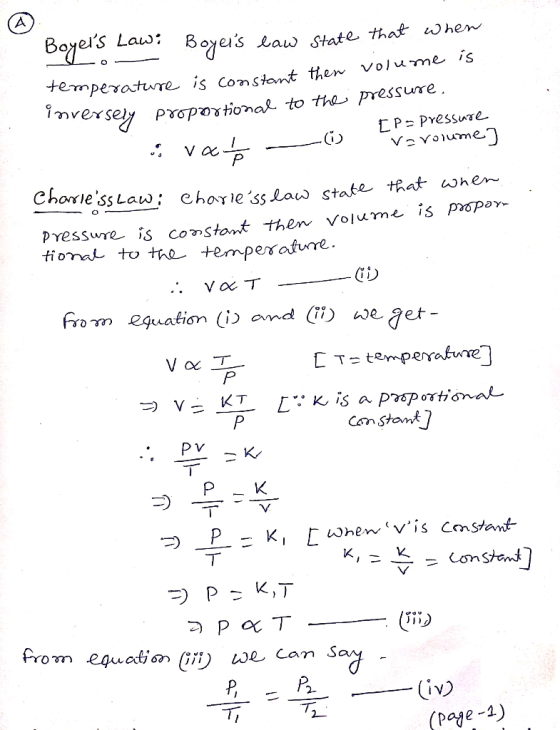

You must use the temperature in Kelvins! the answer to b is 34,7 psi
Add Answer to:
A) Amonton's law expresses the relationship between pressure and
temperature. Use Charless law and Boyles law...
If a car tire is filled to a pressure of 31.9 lbs/in2 (psi) measured at 79...
If a car tire is filled to a pressure of 31.9 lbs/in2 (psi) measured at 79 ∘F, what will be the tire pressure if the tires heat up to 116 ∘F during driving? Express your answer to two significant figures and include the appropriate units.
On a cool morning, when the temperature is 16 ∘ C , you measure the pressure...
On a cool morning, when the temperature is 16 ∘ C , you measure the pressure in your car tires to be 20 psi . After driving 50 mi on the freeway, the temperature of your tires is 55 ∘ C . What pressure will your tire gauge now show? Neglect the change of tires volume.
On a cool morning, when the temperature is 14°C, you measure the pressure in your car...
On a cool morning, when the temperature is 14°C, you measure the pressure in your car tires to be 26.8 psi. After driving 27 mi on the freeway, the temperature of your tires is 46°C. What pressure will your tire gauge now show?
when the temperature of an automobile tire is 20 degrees c, the pressure in the tire...
when the temperature of an automobile tire is 20 degrees c, the pressure in the tire reads 29 psi on a tire gauge. (the gauge measures the difference between the pressures inside and outside the tire.) what is rhe pressure when the tire heats up to 39 degrees c while driving? you may assume that the volume of the tire remains the same and that the atomspheric pressure is a steady 14 psi.
11) The formula C = -32) expresses the relationship between Fahrenheit temperature, F, and Celsius temperature,...
 11) The formula C = -32) expresses the relationship between Fahrenheit temperature, F, and Celsius temperature, C. Use the formula to convert 50°F to it equivalent temperature on the Celsius scale, rounded to the nearest degree A) 28°C B) -4°C C) 32°C D) 10°C I
Describe the relationship between pressure and volume in Boyle's Law. Explain this relationship on a molecular...
Describe the relationship between pressure and volume in Boyle's Law. Explain this relationship on a molecular level. Describe the relationship between temperature and volume in Charle's Law. Explain this relationship on a molecular level.
please answer the questions too. Pressure - Temperature Relationship Data and Calculations for Temperature Pressure Relationship...
 please answer the questions too.
Pressure - Temperature Relationship Data and Calculations for Temperature Pressure Relationship Pressure (kPa) Temperature (°C) Temperature (K) Calculated Constant, k (P/T) Calculated constant, k (PT) 100.88 26.0 105.13 60.1 106.33 75.5 108.40 83.5 110.38 95.0 Processing the data 1. A way to determine if a relationship is inverse or direct is to find a proportionality constant, k, from the data. If this relationship is direct, the k will be a constant fork - PT. If...
please answer the questions too.
Pressure - Temperature Relationship Data and Calculations for Temperature Pressure Relationship Pressure (kPa) Temperature (°C) Temperature (K) Calculated Constant, k (P/T) Calculated constant, k (PT) 100.88 26.0 105.13 60.1 106.33 75.5 108.40 83.5 110.38 95.0 Processing the data 1. A way to determine if a relationship is inverse or direct is to find a proportionality constant, k, from the data. If this relationship is direct, the k will be a constant fork - PT. If...
Combined Gas Relationship Since the Ideal Gas Law produces a constant (R), it can be used...
 Combined Gas Relationship Since the Ideal Gas Law produces a constant (R), it can be used to look at a gas sample in which initial and final conditions have changed. The combined gas relationship is as follows P.V R=P.V2 n, T n2 T2 where P, Vi,and T, and n, are the initial pressure, volume, temperature, and number of moles of gas. The final conditions are represented by P, V2, T2 and n2. If any of the conditions in the initial...
1. (a) What name is given to the law describing the relationship between volume and pressure...
1. (a) What name is given to the law describing the relationship between volume and pressure at constant temperature? Write a mathematical expression that describes this relationship. (2 marks) (b) Sketch a graph of the relationship described in part (a). (2 marks) (c) O2 gas is transferred from a 3 L vessel containing oxygen at 4 atm to an evacuated 20 L vessel at a constant temperature of 350 K. What is the pressure inside the 20 L vessel after...
The speedometer readings in passenger cars are based on angular speed of the car's tire axle....
 The speedometer readings in passenger cars are based on angular speed of the car's tire axle. Because car's tires are filled with air [typically to the pressure of about 30 psi (pounds-square-inch)], the actual tire radius can be a bit different depending on the air temperature. You want to understand the impact of the air temperature on the tire radius and thus on the accuracy of the speedometer reading based on the ideal gas law. To simplify the calculation, you...
 11) The formula C = -32) expresses the relationship between Fahrenheit temperature, F, and Celsius temperature, C. Use the formula to convert 50°F to it equivalent temperature on the Celsius scale, rounded to the nearest degree A) 28°C B) -4°C C) 32°C D) 10°C I
 please answer the questions too.
Pressure - Temperature Relationship Data and Calculations for Temperature Pressure Relationship Pressure (kPa) Temperature (°C) Temperature (K) Calculated Constant, k (P/T) Calculated constant, k (PT) 100.88 26.0 105.13 60.1 106.33 75.5 108.40 83.5 110.38 95.0 Processing the data 1. A way to determine if a relationship is inverse or direct is to find a proportionality constant, k, from the data. If this relationship is direct, the k will be a constant fork - PT. If...
please answer the questions too.
Pressure - Temperature Relationship Data and Calculations for Temperature Pressure Relationship Pressure (kPa) Temperature (°C) Temperature (K) Calculated Constant, k (P/T) Calculated constant, k (PT) 100.88 26.0 105.13 60.1 106.33 75.5 108.40 83.5 110.38 95.0 Processing the data 1. A way to determine if a relationship is inverse or direct is to find a proportionality constant, k, from the data. If this relationship is direct, the k will be a constant fork - PT. If...
 Combined Gas Relationship Since the Ideal Gas Law produces a constant (R), it can be used to look at a gas sample in which initial and final conditions have changed. The combined gas relationship is as follows P.V R=P.V2 n, T n2 T2 where P, Vi,and T, and n, are the initial pressure, volume, temperature, and number of moles of gas. The final conditions are represented by P, V2, T2 and n2. If any of the conditions in the initial...
 The speedometer readings in passenger cars are based on angular speed of the car's tire axle. Because car's tires are filled with air [typically to the pressure of about 30 psi (pounds-square-inch)], the actual tire radius can be a bit different depending on the air temperature. You want to understand the impact of the air temperature on the tire radius and thus on the accuracy of the speedometer reading based on the ideal gas law. To simplify the calculation, you...
Most questions answered within 3 hours.
-
Where is the error in this code sequence?
String s1 = "Hello";
String s2 = "ello";...
asked 10 months ago -
Financial data for Joel de Paris, Inc., for last year
follow:
Joel de Paris, Inc.
Balance...
asked 10 months ago -
Consider this reaction:
Al2(SO4)3 (aq)+ BaCl3
(aq) Al2Cl6 (aq)- +
3BaSO4(s) . What is the...
asked 10 months ago -
Suppose that Savneet is considering increasing her
recent random sample from 20 car rentals to 40...
asked 10 months ago -
Trucks arrive at an unloading terminal at an average rate of 120
per hour.
Trucks arrive...
asked 10 months ago -
Why are methanol and ethanol completely soluble in water while
octanol is not very little soluble....
asked 10 months ago -
A facilities manager at a university reads in a research report
that the mean amount of...
asked 10 months ago -
When the CuSO4 is rehydrated by adding water to the anhydrous
compound, is this an endothermic...
asked 10 months ago -
A ray of sunlight is passing from diamond into crown glass; the
angle of incidence is...
asked 10 months ago -
A block of mass 0.249 kg is placed on top of a light, vertical
spring of...
asked 10 months ago -
how do the kidneys compensate in the presences of acidosis
a) trigger hyperventilate
b) reserve acid...
asked 10 months ago -
Question 501 pts
The rental rate of capital to the firm increases. Which of the
following...
asked 10 months ago