
Homework Answers
A] Let the tension be T and acceleration be a, by force equation on two blocks,
m2g - T = m2a
T = m1a
adding both, m2g = (m1+m2)a
a = m2g/(m1+m2) = 1*9.8/[1+7.9]
= 1.1 m/s^2
B] a = m2g/(m1+m2)
for largest a, m1 = 0 kg
C] a = g = 9.8 m/s^2
Add Answer to:
l Review 1 Constanits1 Parodic Table Part A Find the acceleration of the two masses. Consider...
The masses shown in are given as mi = 1.0kg, m2 = 2.0kg, and m2 112...
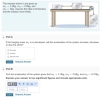 The masses shown in are given as mi = 1.0kg, m2 = 2.0kg, and m2 112 = 3kg. Assume the table is frictionless and the masses move freely. 1m Part A If the hanging mass ms in is decreased, will the acceleration of the system increase, decrease, or stay the same? Decrease O Increase Stay the same Part B Find the acceleration of the system given that m = 1.0kg, m2 = 2.0kg, and m3 = 0.75kg. Express your answer...
2. Atwood's Table with Two Hanging Masses You have table of width L, masses m1, m2,...
2. Atwood's Table with Two Hanging Masses You have table of width L, masses m1, m2, and m3, two frictionless pulleys, and ideal string. Placing m2 on the table, you attach a bit of string to mass m1 the left pulley, to the left side of m2. Similarly, you hang mass m3 from the right side of m2 using the pulley on the right side of the table. The coefficient of friction of the table is mu. The acceleration of...
Two masses are connected by a string over the edge of a table by a frictionless...
Two masses are connected by a string over the edge of a table by a frictionless pulley. The horizontal table holds the second mass m2, and the first mass m1 is suspended off of the pulley. Assume the table is frictionless unless specified otherwise. For each part of this problem: Draw free body diagrams of both objects and write down equations for Newtons second law for both masses. (a) [10 points] Calculate the acceleration if m1 = 5 kg and...
2. Consider two masses conne two masses with friction". Assume that there is a significant friction...
 2. Consider two masses conne two masses with friction". Assume that there is a significant friction between mass m, and the supporting, horizontal surface. What must be the value of the coefficient of kinetic friction u. for the two masses to move at a constant velocity? The constant velocity means that the acceleration a 0. Derive the formula for u, relative to masses m, and m. Remember that the condition for constant velocity is that the sum of forces acting...
Two blocks of masses Mi and M2 are connected by a massless string that passes over...
 Two blocks of masses Mi and M2 are connected by a massless string that passes over a massless pulley (the figure below). M2, which has a mass of 20.0 kg, rests on a long ramp of angle 428.0°. Friction can be ignored in this problem. 1) What is the value of Mi for which the two blocks are in equilibrium (no acceleration)? (Express your answer to three significant figures.) 5.4 Submit Your submissions: 15.4 Computed value: 5.4 Feedback: Submitted: Friday,...
QUESTION 1 An Atwood Machine consists of two masses connected to a cord which is draped...
QUESTION 1 An Atwood Machine consists of two masses connected to a cord which is draped over a pulley. In our experiment, what will be true about the masses? Mass 1 will vary with Mass 2 held constant. Mass 1 will vary with Mass 2 held constant. The masses will have a constant sum. The masses will have a constant mass difference. 3 points QUESTION 2 You will get a value for acceleration for each trial from a LoggerPro...
Part E : Find the magnitude of the angular acceleration. Please and thank you. The seesaw is pivoted in the middle,...
 Torque and Angular Acceleration Learning Goal: To understand and apply the formula τ= Iα to rigid objects rotating about a fixed axis. To find the acceleration a of a particle of mass m, we use Newton's second law. Fnet =ma, where Fnet is the net force acting on the particle. To find the angular acceleration a of a rigid object rotating about a fixed axis, we can use a similar formula: Tnet = Ia, where Tnet=∑T is the net torque acting on the object...
Review The mass center of the cart is at G. (Figure 1) Part A Determine the...
 Review The mass center of the cart is at G. (Figure 1) Part A Determine the magnitude of the largest force P that can be applied to the 47-kg cart, without causing one of the wheel reactions, either at A or at B, to be zero. Express your answer to three significant figures and include the appropriate units. HAO? P= Value Units Submit Request Answer Figure 1 of 1 > Part B What is the acceleration of the cart? Express...
Answer Two blocks are at rest on a frictionless incline, as shown in (Figure 1). Part...
 Answer
Two blocks are at rest on a frictionless incline, as shown in (Figure 1). Part A What is the tension in the string number 1 if mi = 9.0 kg and m2 = 2.0 kg ? Express your answer with the appropriate units. T1 = Value Units Figure 1 of 1 Submit Request Answer Part B What is the tension in the string number 2 if mi = 9.0 kg and m2 = 2.0 kg ? Express your answer...
Answer
Two blocks are at rest on a frictionless incline, as shown in (Figure 1). Part A What is the tension in the string number 1 if mi = 9.0 kg and m2 = 2.0 kg ? Express your answer with the appropriate units. T1 = Value Units Figure 1 of 1 Submit Request Answer Part B What is the tension in the string number 2 if mi = 9.0 kg and m2 = 2.0 kg ? Express your answer...
Two blocks with different masses are attached to either end of a light rope that passes...
 Two blocks with different masses are attached to either end of a light rope that passes over a light, frictionless pulley suspended from the ceiling. The masses are released from rest, and the more massive one starts to descend. After this block has descended 1.20 m, its speed is 3.00 m/s. Part A If the total mass of the two blocks is 33.0 kg, what is the mass of the heavier block? Express your answer with the appropriate units. HÀ...
 The masses shown in are given as mi = 1.0kg, m2 = 2.0kg, and m2 112 = 3kg. Assume the table is frictionless and the masses move freely. 1m Part A If the hanging mass ms in is decreased, will the acceleration of the system increase, decrease, or stay the same? Decrease O Increase Stay the same Part B Find the acceleration of the system given that m = 1.0kg, m2 = 2.0kg, and m3 = 0.75kg. Express your answer...
 2. Consider two masses conne two masses with friction". Assume that there is a significant friction between mass m, and the supporting, horizontal surface. What must be the value of the coefficient of kinetic friction u. for the two masses to move at a constant velocity? The constant velocity means that the acceleration a 0. Derive the formula for u, relative to masses m, and m. Remember that the condition for constant velocity is that the sum of forces acting...
 Two blocks of masses Mi and M2 are connected by a massless string that passes over a massless pulley (the figure below). M2, which has a mass of 20.0 kg, rests on a long ramp of angle 428.0°. Friction can be ignored in this problem. 1) What is the value of Mi for which the two blocks are in equilibrium (no acceleration)? (Express your answer to three significant figures.) 5.4 Submit Your submissions: 15.4 Computed value: 5.4 Feedback: Submitted: Friday,...
 Review The mass center of the cart is at G. (Figure 1) Part A Determine the magnitude of the largest force P that can be applied to the 47-kg cart, without causing one of the wheel reactions, either at A or at B, to be zero. Express your answer to three significant figures and include the appropriate units. HAO? P= Value Units Submit Request Answer Figure 1 of 1 > Part B What is the acceleration of the cart? Express...
 Answer
Two blocks are at rest on a frictionless incline, as shown in (Figure 1). Part A What is the tension in the string number 1 if mi = 9.0 kg and m2 = 2.0 kg ? Express your answer with the appropriate units. T1 = Value Units Figure 1 of 1 Submit Request Answer Part B What is the tension in the string number 2 if mi = 9.0 kg and m2 = 2.0 kg ? Express your answer...
Answer
Two blocks are at rest on a frictionless incline, as shown in (Figure 1). Part A What is the tension in the string number 1 if mi = 9.0 kg and m2 = 2.0 kg ? Express your answer with the appropriate units. T1 = Value Units Figure 1 of 1 Submit Request Answer Part B What is the tension in the string number 2 if mi = 9.0 kg and m2 = 2.0 kg ? Express your answer...
 Two blocks with different masses are attached to either end of a light rope that passes over a light, frictionless pulley suspended from the ceiling. The masses are released from rest, and the more massive one starts to descend. After this block has descended 1.20 m, its speed is 3.00 m/s. Part A If the total mass of the two blocks is 33.0 kg, what is the mass of the heavier block? Express your answer with the appropriate units. HÀ...
Most questions answered within 3 hours.
-
Where is the error in this code sequence?
String s1 = "Hello";
String s2 = "ello";...
asked 10 months ago -
Financial data for Joel de Paris, Inc., for last year
follow:
Joel de Paris, Inc.
Balance...
asked 10 months ago -
Consider this reaction:
Al2(SO4)3 (aq)+ BaCl3
(aq) Al2Cl6 (aq)- +
3BaSO4(s) . What is the...
asked 10 months ago -
Suppose that Savneet is considering increasing her
recent random sample from 20 car rentals to 40...
asked 10 months ago -
Trucks arrive at an unloading terminal at an average rate of 120
per hour.
Trucks arrive...
asked 10 months ago -
Why are methanol and ethanol completely soluble in water while
octanol is not very little soluble....
asked 10 months ago -
A facilities manager at a university reads in a research report
that the mean amount of...
asked 10 months ago -
When the CuSO4 is rehydrated by adding water to the anhydrous
compound, is this an endothermic...
asked 10 months ago -
A ray of sunlight is passing from diamond into crown glass; the
angle of incidence is...
asked 10 months ago -
A block of mass 0.249 kg is placed on top of a light, vertical
spring of...
asked 10 months ago -
how do the kidneys compensate in the presences of acidosis
a) trigger hyperventilate
b) reserve acid...
asked 10 months ago -
Question 501 pts
The rental rate of capital to the firm increases. Which of the
following...
asked 10 months ago