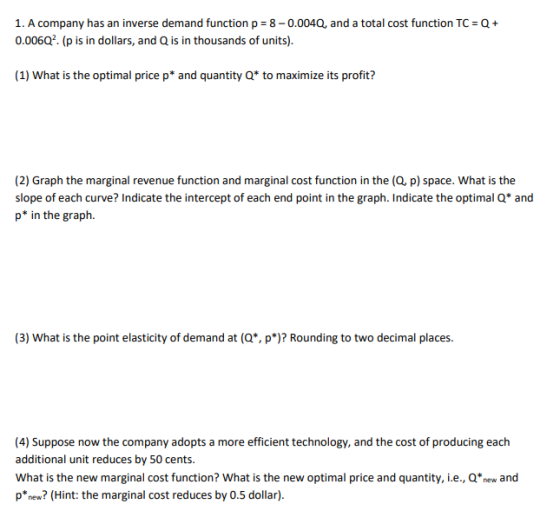
*I am looking for the answer for #4. I have gotten all the work done from #1-#3.
Homework Answers

Add Answer to:
*I am looking for the answer for #4. I have gotten all the work
done from...
i just need the answer for "e". Problem 1 (4 points) Knope Industries is a firm...
 i
just need the answer for "e".
Problem 1 (4 points) Knope Industries is a firm that produces miniature model souvenirs with total cost function TC(Q) = 2500 + 50Q +0.02Q2 (e) Sketch a graph with the demand curve, marginal revenue curve, and marginal cost curve, and label the profit-maximizing price and quantity. (1 pt) Problem 1 (4 points) Knope Industries is a firm that produces miniature model souvenirs with total cost function TCQ) = 2500+ 500+ 0.02Q (a) Write...
i
just need the answer for "e".
Problem 1 (4 points) Knope Industries is a firm that produces miniature model souvenirs with total cost function TC(Q) = 2500 + 50Q +0.02Q2 (e) Sketch a graph with the demand curve, marginal revenue curve, and marginal cost curve, and label the profit-maximizing price and quantity. (1 pt) Problem 1 (4 points) Knope Industries is a firm that produces miniature model souvenirs with total cost function TCQ) = 2500+ 500+ 0.02Q (a) Write...
Please show work! Homework Assignment 1 You must show all your work to earn points ECON...
 Please show work!
Homework Assignment 1 You must show all your work to earn points ECON 3125 SP19 Name: 1. Use the graph below to answer the questions: 80 70 50 40 30 20 10 State the equation for the demand curve (inverse demand function) shown in the graph above using the format P.-a-bQ a. b. State the equation for the demand function implied in the graph using the format Q.-c-dP c. Find the equation for Total Revenue, where TR...
Please show work!
Homework Assignment 1 You must show all your work to earn points ECON 3125 SP19 Name: 1. Use the graph below to answer the questions: 80 70 50 40 30 20 10 State the equation for the demand curve (inverse demand function) shown in the graph above using the format P.-a-bQ a. b. State the equation for the demand function implied in the graph using the format Q.-c-dP c. Find the equation for Total Revenue, where TR...
please answer part A AND B!!!! Let's assume a firm's inverse demand curve and cost equation...
 please answer part A AND B!!!!
Let's assume a firm's inverse demand curve and cost equation is given below: P = 175-2Q C400+50QQ (a) Find the optimal quantity, price, and profit (b) With quantity on the x-axis and price on the y-axis, graph the inverse demand, marginal revenue, and marginal cost curves. Show the optimal price and quantity on the graph.
please answer part A AND B!!!!
Let's assume a firm's inverse demand curve and cost equation is given below: P = 175-2Q C400+50QQ (a) Find the optimal quantity, price, and profit (b) With quantity on the x-axis and price on the y-axis, graph the inverse demand, marginal revenue, and marginal cost curves. Show the optimal price and quantity on the graph.
1. Use the graph below to answer the questions: 80 70 60 50 40 30 20...
 1. Use the graph below to answer the questions: 80 70 60 50 40 30 20 10 State the equation for the demand curve (inverse demand function) shown in the graph above using the format P a-bQi a. b. State the equation for the demand function implied in the graph using the format Q c-dP Find the equation for Total Revenue, where TR is a function of output (Q): c. d. Find the equation for Marginal Revenue, where MR is...
3. Show that MR follows the notion "same intercept, twice the slope" of demand. 4. Is...
 3. Show that MR follows the notion "same intercept, twice the slope" of demand. 4. Is a monopoly the most socially optimal market? How does a monopoly differ from a perfectly competitive market? Explain and show in a graph. What is the difference in welfare? 5. At what point would a monopoly decide to shut down in the short-run? In the long run? 6. A firm facing demand curve p= 24-Q and MC=2Q has a new demand curve of p=36-2Q...
A monopolist faces inverse demand P = on TC(Q) = cQ. (a) Find the optimal price,...
 A monopolist faces inverse demand P = on TC(Q) = cQ. (a) Find the optimal price, P, and quantity, QM (b) Solve for the monopolist's optimal profits, TM (c) Graph the equilibrium and show consumer surplus, producer surplus and deadweight loss. Be 150 -3Q and total cost functi careful with the marginal cost curve. (d) Compute CS and PS. These will be functions of the cost parameter c. (e) Compute DWL. Similarly, it will be functions of the cost parameter...
1) Demand in a market is given by Q=9p-7.3 where p is the market price. What...
1) Demand in a market is given by Q=9p-7.3 where p is the market price. What is the elasticity of demand? Include the negative sign if necessary. 2) Demand in a market is given by Q=3p-3 where p is the market price. There are 18 identical firms in the market. What is the elasticity of the residual demand faced by each firm when the elasticity of supply of the other firms is 2.6? 3) Inverse demand in a market is...
QUESTION ONE A. Suppose the marginal cost and marginal revenue (in ¢000) for a product produced...
 QUESTION ONE A. Suppose the marginal cost and marginal revenue (in ¢000) for a product produced by a company is estimated to be MC = q +35 MR = 560 + 22q-q? Where q is the quantity produced and the firm's break-even is 5 units per week You are Required to 1. determine the total cost and the total revenue function in terms of q. (6 marks) II. estimate the output at which profit is maximize (6 marks) III. calculate...
Problem 1e. The slope of the demand curve indicates that if the price of Fluff increases...
 Problem 1e. The slope
of the demand curve indicates that if the price of Fluff increases
by 20 cents, consumers will buy one less unit. Determine what
happens to profit if price is increased by calculating the new
profit level for Fluff when price is set 20 cents higher than the
profit-maximizing price.
problem 2
Probem 3
Consider the graph, which illustrates the demand for Fluff. Fluff can be produced at a constant marginal and average total cost of $4...
Problem 1e. The slope
of the demand curve indicates that if the price of Fluff increases
by 20 cents, consumers will buy one less unit. Determine what
happens to profit if price is increased by calculating the new
profit level for Fluff when price is set 20 cents higher than the
profit-maximizing price.
problem 2
Probem 3
Consider the graph, which illustrates the demand for Fluff. Fluff can be produced at a constant marginal and average total cost of $4...
1. What is a monopoly? Name 2 differences between a monopoly and a perfectly competitive market....
 1. What is a monopoly? Name 2 differences between a monopoly and a perfectly competitive market. 2. What is the profit maximizing condition for a price-setting monopoly? 3. Show that MR follows the notion "same intercept, twice the slope" of demand. 4. Is a monopoly the most socially optimal market? How does a monopoly differ from a perfectly competitive market? Explain and show in a graph. What is the difference in welfare? 5. At what point would a monopoly decide...
 i
just need the answer for "e".
Problem 1 (4 points) Knope Industries is a firm that produces miniature model souvenirs with total cost function TC(Q) = 2500 + 50Q +0.02Q2 (e) Sketch a graph with the demand curve, marginal revenue curve, and marginal cost curve, and label the profit-maximizing price and quantity. (1 pt) Problem 1 (4 points) Knope Industries is a firm that produces miniature model souvenirs with total cost function TCQ) = 2500+ 500+ 0.02Q (a) Write...
i
just need the answer for "e".
Problem 1 (4 points) Knope Industries is a firm that produces miniature model souvenirs with total cost function TC(Q) = 2500 + 50Q +0.02Q2 (e) Sketch a graph with the demand curve, marginal revenue curve, and marginal cost curve, and label the profit-maximizing price and quantity. (1 pt) Problem 1 (4 points) Knope Industries is a firm that produces miniature model souvenirs with total cost function TCQ) = 2500+ 500+ 0.02Q (a) Write...
 Please show work!
Homework Assignment 1 You must show all your work to earn points ECON 3125 SP19 Name: 1. Use the graph below to answer the questions: 80 70 50 40 30 20 10 State the equation for the demand curve (inverse demand function) shown in the graph above using the format P.-a-bQ a. b. State the equation for the demand function implied in the graph using the format Q.-c-dP c. Find the equation for Total Revenue, where TR...
Please show work!
Homework Assignment 1 You must show all your work to earn points ECON 3125 SP19 Name: 1. Use the graph below to answer the questions: 80 70 50 40 30 20 10 State the equation for the demand curve (inverse demand function) shown in the graph above using the format P.-a-bQ a. b. State the equation for the demand function implied in the graph using the format Q.-c-dP c. Find the equation for Total Revenue, where TR...
 please answer part A AND B!!!!
Let's assume a firm's inverse demand curve and cost equation is given below: P = 175-2Q C400+50QQ (a) Find the optimal quantity, price, and profit (b) With quantity on the x-axis and price on the y-axis, graph the inverse demand, marginal revenue, and marginal cost curves. Show the optimal price and quantity on the graph.
please answer part A AND B!!!!
Let's assume a firm's inverse demand curve and cost equation is given below: P = 175-2Q C400+50QQ (a) Find the optimal quantity, price, and profit (b) With quantity on the x-axis and price on the y-axis, graph the inverse demand, marginal revenue, and marginal cost curves. Show the optimal price and quantity on the graph.
 1. Use the graph below to answer the questions: 80 70 60 50 40 30 20 10 State the equation for the demand curve (inverse demand function) shown in the graph above using the format P a-bQi a. b. State the equation for the demand function implied in the graph using the format Q c-dP Find the equation for Total Revenue, where TR is a function of output (Q): c. d. Find the equation for Marginal Revenue, where MR is...
 3. Show that MR follows the notion "same intercept, twice the slope" of demand. 4. Is a monopoly the most socially optimal market? How does a monopoly differ from a perfectly competitive market? Explain and show in a graph. What is the difference in welfare? 5. At what point would a monopoly decide to shut down in the short-run? In the long run? 6. A firm facing demand curve p= 24-Q and MC=2Q has a new demand curve of p=36-2Q...
 A monopolist faces inverse demand P = on TC(Q) = cQ. (a) Find the optimal price, P, and quantity, QM (b) Solve for the monopolist's optimal profits, TM (c) Graph the equilibrium and show consumer surplus, producer surplus and deadweight loss. Be 150 -3Q and total cost functi careful with the marginal cost curve. (d) Compute CS and PS. These will be functions of the cost parameter c. (e) Compute DWL. Similarly, it will be functions of the cost parameter...
 QUESTION ONE A. Suppose the marginal cost and marginal revenue (in ¢000) for a product produced by a company is estimated to be MC = q +35 MR = 560 + 22q-q? Where q is the quantity produced and the firm's break-even is 5 units per week You are Required to 1. determine the total cost and the total revenue function in terms of q. (6 marks) II. estimate the output at which profit is maximize (6 marks) III. calculate...
 Problem 1e. The slope
of the demand curve indicates that if the price of Fluff increases
by 20 cents, consumers will buy one less unit. Determine what
happens to profit if price is increased by calculating the new
profit level for Fluff when price is set 20 cents higher than the
profit-maximizing price.
problem 2
Probem 3
Consider the graph, which illustrates the demand for Fluff. Fluff can be produced at a constant marginal and average total cost of $4...
Problem 1e. The slope
of the demand curve indicates that if the price of Fluff increases
by 20 cents, consumers will buy one less unit. Determine what
happens to profit if price is increased by calculating the new
profit level for Fluff when price is set 20 cents higher than the
profit-maximizing price.
problem 2
Probem 3
Consider the graph, which illustrates the demand for Fluff. Fluff can be produced at a constant marginal and average total cost of $4...
 1. What is a monopoly? Name 2 differences between a monopoly and a perfectly competitive market. 2. What is the profit maximizing condition for a price-setting monopoly? 3. Show that MR follows the notion "same intercept, twice the slope" of demand. 4. Is a monopoly the most socially optimal market? How does a monopoly differ from a perfectly competitive market? Explain and show in a graph. What is the difference in welfare? 5. At what point would a monopoly decide...
Most questions answered within 3 hours.
-
Where is the error in this code sequence?
String s1 = "Hello";
String s2 = "ello";...
asked 10 months ago -
Financial data for Joel de Paris, Inc., for last year
follow:
Joel de Paris, Inc.
Balance...
asked 10 months ago -
Consider this reaction:
Al2(SO4)3 (aq)+ BaCl3
(aq) Al2Cl6 (aq)- +
3BaSO4(s) . What is the...
asked 10 months ago -
Suppose that Savneet is considering increasing her
recent random sample from 20 car rentals to 40...
asked 10 months ago -
Trucks arrive at an unloading terminal at an average rate of 120
per hour.
Trucks arrive...
asked 10 months ago -
Why are methanol and ethanol completely soluble in water while
octanol is not very little soluble....
asked 10 months ago -
A facilities manager at a university reads in a research report
that the mean amount of...
asked 10 months ago -
When the CuSO4 is rehydrated by adding water to the anhydrous
compound, is this an endothermic...
asked 10 months ago -
A ray of sunlight is passing from diamond into crown glass; the
angle of incidence is...
asked 10 months ago -
A block of mass 0.249 kg is placed on top of a light, vertical
spring of...
asked 10 months ago -
how do the kidneys compensate in the presences of acidosis
a) trigger hyperventilate
b) reserve acid...
asked 10 months ago -
Question 501 pts
The rental rate of capital to the firm increases. Which of the
following...
asked 10 months ago