The speed with which nerve impulses travel is determined in large part by the characteristic time...
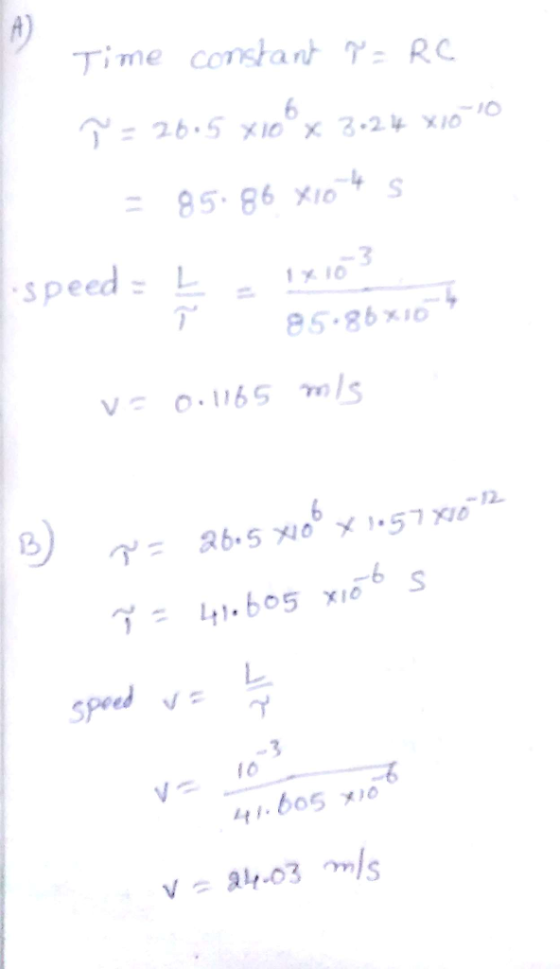
The speed with which nerve impulses travel is determined in large part by the characteristic time constant τ=RC of the circuit formed by the resistivity of the axon and the capacitance of its wall. The resistance of a 1.00-mm-long segment of an axon is 26.5 MΩ.
A) For nerve axons with no protective myelin sheath, the wall capacitance is about 3.24×10⁻¹⁰F for each segment of length L=1.00mm. Find the speed of the nerve impulses given by v=L/τ.
B) Many axons are surrounded by a myelin sheath that decreases the wall capacitance to 1.57×10⁻¹²F. What is the speed of nerve impulses along such myelinated axons?
Homework Answers
Add Answer to:
The speed with which nerve impulses travel is determined in
large part by the characteristic time...
Please help me solve this problem and show your work. Thank you! Problem 21.81 3 of...
 Please help me solve this problem and show your work. Thank
you!
Problem 21.81 3 of 3 I Review The speed with which nerve impulses travel is determined in large part by the characteristic time constant T = RC of the circuit formed by the resistivity of the axon and the capacitance of its wall. The resistance of a 1.00-mm-long segment of an axon is 26.0 M92. Part A For nerve axons with no protective myelin sheath, the wall capacitance...
Please help me solve this problem and show your work. Thank
you!
Problem 21.81 3 of 3 I Review The speed with which nerve impulses travel is determined in large part by the characteristic time constant T = RC of the circuit formed by the resistivity of the axon and the capacitance of its wall. The resistance of a 1.00-mm-long segment of an axon is 26.0 M92. Part A For nerve axons with no protective myelin sheath, the wall capacitance...
A myelinated axon conducts nerve impulses at a speed of 30m/s . What is the signal...
A myelinated axon conducts nerve impulses at a speed of 30m/s . What is the signal speed if the thickness of the myelin sheath is halved but no other changes are made to the axon?
The resistor-capacitor network model we developed in Lecture (see figure below where it is shown only...
 The resistor-capacitor network model we developed in Lecture
(see figure below where it is shown only for the myelinated case)
for the transmission of signals in nerve axons can actually be
applied to both unmyelinated and myelinated nerve cells to estimate
the propagation speed of a nerve impulse. In the unmyelinated case
the 6-7 nm thick plasma membrane (the lipid bilayer) acts both as a
(very thin) dielectric layer forming a capacitor between the inside
of the axon and the...
The resistor-capacitor network model we developed in Lecture
(see figure below where it is shown only for the myelinated case)
for the transmission of signals in nerve axons can actually be
applied to both unmyelinated and myelinated nerve cells to estimate
the propagation speed of a nerve impulse. In the unmyelinated case
the 6-7 nm thick plasma membrane (the lipid bilayer) acts both as a
(very thin) dielectric layer forming a capacitor between the inside
of the axon and the...
please answer question 8-13 This is the prior information: Nerve impulses are electrical currents in the...
 please answer question 8-13
This is the prior information: Nerve impulses are electrical
currents in the form of “ionic flows.” Therefore the electrical
properties of the axon are important to understand in order to
understand the flow of electrical impulses. In this test, you will
explore the capacitance and resistivity of an axon of a nerve cell.
For this test, the axon will be treated as a CYLINDER of arbitrary
length “L” and radius “a” that is filled with a...
please answer question 8-13
This is the prior information: Nerve impulses are electrical
currents in the form of “ionic flows.” Therefore the electrical
properties of the axon are important to understand in order to
understand the flow of electrical impulses. In this test, you will
explore the capacitance and resistivity of an axon of a nerve cell.
For this test, the axon will be treated as a CYLINDER of arbitrary
length “L” and radius “a” that is filled with a...
 Please help me solve this problem and show your work. Thank
you!
Problem 21.81 3 of 3 I Review The speed with which nerve impulses travel is determined in large part by the characteristic time constant T = RC of the circuit formed by the resistivity of the axon and the capacitance of its wall. The resistance of a 1.00-mm-long segment of an axon is 26.0 M92. Part A For nerve axons with no protective myelin sheath, the wall capacitance...
Please help me solve this problem and show your work. Thank
you!
Problem 21.81 3 of 3 I Review The speed with which nerve impulses travel is determined in large part by the characteristic time constant T = RC of the circuit formed by the resistivity of the axon and the capacitance of its wall. The resistance of a 1.00-mm-long segment of an axon is 26.0 M92. Part A For nerve axons with no protective myelin sheath, the wall capacitance...
 The resistor-capacitor network model we developed in Lecture
(see figure below where it is shown only for the myelinated case)
for the transmission of signals in nerve axons can actually be
applied to both unmyelinated and myelinated nerve cells to estimate
the propagation speed of a nerve impulse. In the unmyelinated case
the 6-7 nm thick plasma membrane (the lipid bilayer) acts both as a
(very thin) dielectric layer forming a capacitor between the inside
of the axon and the...
The resistor-capacitor network model we developed in Lecture
(see figure below where it is shown only for the myelinated case)
for the transmission of signals in nerve axons can actually be
applied to both unmyelinated and myelinated nerve cells to estimate
the propagation speed of a nerve impulse. In the unmyelinated case
the 6-7 nm thick plasma membrane (the lipid bilayer) acts both as a
(very thin) dielectric layer forming a capacitor between the inside
of the axon and the...
 please answer question 8-13
This is the prior information: Nerve impulses are electrical
currents in the form of “ionic flows.” Therefore the electrical
properties of the axon are important to understand in order to
understand the flow of electrical impulses. In this test, you will
explore the capacitance and resistivity of an axon of a nerve cell.
For this test, the axon will be treated as a CYLINDER of arbitrary
length “L” and radius “a” that is filled with a...
please answer question 8-13
This is the prior information: Nerve impulses are electrical
currents in the form of “ionic flows.” Therefore the electrical
properties of the axon are important to understand in order to
understand the flow of electrical impulses. In this test, you will
explore the capacitance and resistivity of an axon of a nerve cell.
For this test, the axon will be treated as a CYLINDER of arbitrary
length “L” and radius “a” that is filled with a...
Most questions answered within 3 hours.
-
Where is the error in this code sequence?
String s1 = "Hello";
String s2 = "ello";...
asked 10 months ago -
Financial data for Joel de Paris, Inc., for last year
follow:
Joel de Paris, Inc.
Balance...
asked 10 months ago -
Consider this reaction:
Al2(SO4)3 (aq)+ BaCl3
(aq) Al2Cl6 (aq)- +
3BaSO4(s) . What is the...
asked 10 months ago -
Suppose that Savneet is considering increasing her
recent random sample from 20 car rentals to 40...
asked 10 months ago -
Trucks arrive at an unloading terminal at an average rate of 120
per hour.
Trucks arrive...
asked 10 months ago -
Why are methanol and ethanol completely soluble in water while
octanol is not very little soluble....
asked 10 months ago -
A facilities manager at a university reads in a research report
that the mean amount of...
asked 10 months ago -
When the CuSO4 is rehydrated by adding water to the anhydrous
compound, is this an endothermic...
asked 10 months ago -
A ray of sunlight is passing from diamond into crown glass; the
angle of incidence is...
asked 10 months ago -
A block of mass 0.249 kg is placed on top of a light, vertical
spring of...
asked 10 months ago -
how do the kidneys compensate in the presences of acidosis
a) trigger hyperventilate
b) reserve acid...
asked 10 months ago -
Question 501 pts
The rental rate of capital to the firm increases. Which of the
following...
asked 10 months ago