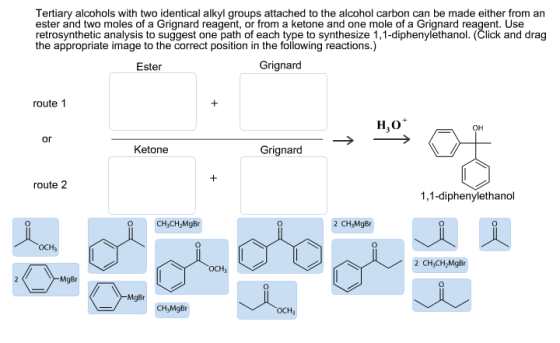
43. Tertiary alcohols with two identical alkyl groups attached to the alcohol carbon can be made either from an ester and two moles of a Grignard reagent, or from a ketone and one mole of a Grignard reagent. Use retrosynthetic analysis to suggest one path of each type to synthesize 1,1-diphenylethanol. (Click and drag the appropriate image to the correct position in the following reactions.)
Homework Answers
This problem is based on the concept of alcohol formation by different methods using Grignard reagent.
Grignard reagent undergoes reaction with ester and carbonyl compounds (ketones and aldehydes) in order to form the compounds containing hydroxyl group  which are called alcohols.
Grignard reagent attacks on the electrophilic carbon of carbonyl group  of ketone and ester group
  in order to form an anion which has negative charge on oxygen atom, further which undergoes hydrolysis to form tertiary alcohols.
The given structure of the compound is shown below.

The structure of the ester and Grignard reagent are given below:

The structure of the ketone and Grignard reagent are given below:

Representation of route 1 to form tertiary alcohol is given below:

Representation of route 2 to form tertiary alcohol is given below:

Add Answer to:
43. Tertiary alcohols with two identical alkyl groups attached
to the alcohol carbon can be made...
Tertiary alcohols with two identical alkyl groups attached to the alcohol carbon can be made either from an ester and...
 Tertiary alcohols with two identical alkyl groups attached to the
alcohol carbon can be made either from an ester and two moles of a
Grignard reagent, or from a ketone and one mole of a Grignard
reagent. Use retrosynthetic analysis to suggest one path of each
type to synthesize 2-phenyl-2-propanol. (Click and drag the
appropriate image to the correct position in the following
reactions.)
Tertiary alcohols with two identical alkyl groups attached to the alcohol carbon can be made either...
Tertiary alcohols with two identical alkyl groups attached to the
alcohol carbon can be made either from an ester and two moles of a
Grignard reagent, or from a ketone and one mole of a Grignard
reagent. Use retrosynthetic analysis to suggest one path of each
type to synthesize 2-phenyl-2-propanol. (Click and drag the
appropriate image to the correct position in the following
reactions.)
Tertiary alcohols with two identical alkyl groups attached to the alcohol carbon can be made either...
Tertiary alcohols with two identical alkyl groups attached to the alcohol carbon can be made either from an ester and...
 Tertiary alcohols with two identical alkyl groups attached to the
alcohol carbon can be made either from an ester and two moles of a
Grignard reagent, or from a ketone and one mole of a Grignard
reagent. Use retrosynthetic analysis to suggest one path of each
type to synthesize 3-methyl-3-pentanol. (Click and drag the
appropriate image to the correct position in the following
reactions.)
Tertiary alcohols with two identical alkyl groups attached to the alcohol carbon can be made either...
Tertiary alcohols with two identical alkyl groups attached to the
alcohol carbon can be made either from an ester and two moles of a
Grignard reagent, or from a ketone and one mole of a Grignard
reagent. Use retrosynthetic analysis to suggest one path of each
type to synthesize 3-methyl-3-pentanol. (Click and drag the
appropriate image to the correct position in the following
reactions.)
Tertiary alcohols with two identical alkyl groups attached to the alcohol carbon can be made either...
Tertiary alcohols with two identical alkyl groups attached to the alcohol carbon can be made either from an ester and t...
 Tertiary alcohols with two identical alkyl groups attached to
the alcohol carbon can be made either from an ester and two moles
of a Grignard reagent, or from a ketone and one mole of a Grignard
reagent. Use retrosynthetic analysis to suggest one path of each
type to synthesize 2-methyl-2-butanol. (Click and drag the
appropriate image to the correct position in the following
reactions.)
Tertiary alcohols with two identical alkyl groups attached to the alcohol carbon can be made either...
Tertiary alcohols with two identical alkyl groups attached to
the alcohol carbon can be made either from an ester and two moles
of a Grignard reagent, or from a ketone and one mole of a Grignard
reagent. Use retrosynthetic analysis to suggest one path of each
type to synthesize 2-methyl-2-butanol. (Click and drag the
appropriate image to the correct position in the following
reactions.)
Tertiary alcohols with two identical alkyl groups attached to the alcohol carbon can be made either...
Tertiary alcohols with two identical alkyl groups attached to the alcohol carbon can be made either from an ester and...
 Tertiary alcohols with two identical alkyl groups attached to the alcohol carbon can be made either from an ester and two moles of a Grignard reagent, or from a ketone and one mole of a Grignard reagent. Use retrosynthetic analysis to suggest one path of each type to synthesize 3-methyl-3-pentanol. (Click and drag the appropriate image to the correct position in the following reactions.)
Tertiary alcohols with two identical alkyl groups attached to the alcohol carbon can be made either from an ester and...
 Tertiary alcohols with two identical alkyl groups attached to the
alcohol carbon can be made either from an ester and two moles of a
Grignard reagent, or from a ketone and one mole of a Grignard
reagent. Use retrosynthetic analysis to suggest one path of each
type to synthesize 3-phenyl-3-pentanol. (Click and drag the
appropriate image to the correct position in the following
reac
tions.)
Tertiary alcohols with two identical alkyl groups attached to the
alcohol carbon can be made either from an ester and two moles of a
Grignard reagent, or from a ketone and one mole of a Grignard
reagent. Use retrosynthetic analysis to suggest one path of each
type to synthesize 3-phenyl-3-pentanol. (Click and drag the
appropriate image to the correct position in the following
reac
tions.)
Tertiary alcohols with two identical alkyl groups attached to the alcohol carbon can be made either from an ester and two moles of a Grignard reagent, or from a ketone and one mole of a Grignard reagent. Use retrosynthetic analysis to suggest one path of
 Tertiary alcohols with two identical alkyl groups attached to the alcohol carbon can be made either from an ester and two moles of a Grignard reagent, or from a ketone and one mole of a Grignard reagent. Use retrosynthetic analysis to suggest one path of each type to synthesize 1,1-diphenyl-1-propanol. (Click and drag the appropriate image to the correct position in the following reactions.)
tertiary alcohols with two identical alkyl groups attached to the alcohol carbon can be made either from an ester and t...
tertiary alcohols with two identical alkyl groups attached to the alcohol carbon can be made either from an ester and two moles of Grignard reagent, or from a ketone and one mole of Grignard reaction .Use retrosynthetic analysis to suggest one path of each type to synthesize 3-phenyl-3-pentanol. Route 1 -----> ester (draw here) + Grignard (draw here) -----> H3O------> 3-phenol-3pentanol Route 2 --------> Ketone (draw here) + Grignard (draw here)
21-Ketones are easily reduced to secondary alcohols. b- Primary CH, CCH, a-Secondary alcohol alcohol C- to...
 21-Ketones are easily reduced to secondary alcohols. b- Primary CH, CCH, a-Secondary alcohol alcohol C- to acetaldehyde acid d-to carboxylic 22-Ozonolysis of alkenes yields aa-ketones if one of the unsaturated carbon atoms is disubstituted b-alcohol C-carboxylic acid d-alkane 23-Aldehyde C=0 is more polarized than ketone C-0 because a-As in carbocations, more alkyl groups stabilize + character b-Ketone has more alkyl groups, stabilizing the C=0 carbon inductively cc- due to a and b d- none of the above 24-Aldehydes and unhindered...
13 SN1: Synthesis of tert-Butyl Chloride Alkyl halides can be prepared from their corresponding alcohols via...
 13 SN1: Synthesis of tert-Butyl Chloride Alkyl halides can be prepared from their corresponding alcohols via an acid catalyzed substitution reaction. The mechanism of these acid catalyzed substitution reactions are labeled as Syl (substitution, nucleophilic, unimolecular) and S2 (substitution, nucleophilic, bimolecular). Tertiary alcohols follow the Snl route, primary alcohols follow the S2 route, and secondary alcohols can follow either path. Under acidic conditions, the mechanism (Figure 1) of the Sul reaction involves rapid protonation of the alcohol, followed by the...
13 SN1: Synthesis of tert-Butyl Chloride Alkyl halides can be prepared from their corresponding alcohols via...
 13 SN1: Synthesis of tert-Butyl Chloride Alkyl halides can be prepared from their corresponding alcohols via an acid catalyzed substitution reaction. The mechanism of these acid catalyzed substitution reactions are labeled as Syl (substitution, nucleophilic, unimolecular) and S2 (substitution, nucleophilic, bimolecular). Tertiary alcohols follow the Snl route, primary alcohols follow the S2 route, and secondary alcohols can follow either path. Under acidic conditions, the mechanism (Figure 1) of the Sul reaction involves rapid protonation of the alcohol, followed by the...
 Tertiary alcohols with two identical alkyl groups attached to the
alcohol carbon can be made either from an ester and two moles of a
Grignard reagent, or from a ketone and one mole of a Grignard
reagent. Use retrosynthetic analysis to suggest one path of each
type to synthesize 2-phenyl-2-propanol. (Click and drag the
appropriate image to the correct position in the following
reactions.)
Tertiary alcohols with two identical alkyl groups attached to the alcohol carbon can be made either...
Tertiary alcohols with two identical alkyl groups attached to the
alcohol carbon can be made either from an ester and two moles of a
Grignard reagent, or from a ketone and one mole of a Grignard
reagent. Use retrosynthetic analysis to suggest one path of each
type to synthesize 2-phenyl-2-propanol. (Click and drag the
appropriate image to the correct position in the following
reactions.)
Tertiary alcohols with two identical alkyl groups attached to the alcohol carbon can be made either...
 Tertiary alcohols with two identical alkyl groups attached to the
alcohol carbon can be made either from an ester and two moles of a
Grignard reagent, or from a ketone and one mole of a Grignard
reagent. Use retrosynthetic analysis to suggest one path of each
type to synthesize 3-methyl-3-pentanol. (Click and drag the
appropriate image to the correct position in the following
reactions.)
Tertiary alcohols with two identical alkyl groups attached to the alcohol carbon can be made either...
Tertiary alcohols with two identical alkyl groups attached to the
alcohol carbon can be made either from an ester and two moles of a
Grignard reagent, or from a ketone and one mole of a Grignard
reagent. Use retrosynthetic analysis to suggest one path of each
type to synthesize 3-methyl-3-pentanol. (Click and drag the
appropriate image to the correct position in the following
reactions.)
Tertiary alcohols with two identical alkyl groups attached to the alcohol carbon can be made either...
 Tertiary alcohols with two identical alkyl groups attached to
the alcohol carbon can be made either from an ester and two moles
of a Grignard reagent, or from a ketone and one mole of a Grignard
reagent. Use retrosynthetic analysis to suggest one path of each
type to synthesize 2-methyl-2-butanol. (Click and drag the
appropriate image to the correct position in the following
reactions.)
Tertiary alcohols with two identical alkyl groups attached to the alcohol carbon can be made either...
Tertiary alcohols with two identical alkyl groups attached to
the alcohol carbon can be made either from an ester and two moles
of a Grignard reagent, or from a ketone and one mole of a Grignard
reagent. Use retrosynthetic analysis to suggest one path of each
type to synthesize 2-methyl-2-butanol. (Click and drag the
appropriate image to the correct position in the following
reactions.)
Tertiary alcohols with two identical alkyl groups attached to the alcohol carbon can be made either...
 Tertiary alcohols with two identical alkyl groups attached to the alcohol carbon can be made either from an ester and two moles of a Grignard reagent, or from a ketone and one mole of a Grignard reagent. Use retrosynthetic analysis to suggest one path of each type to synthesize 3-methyl-3-pentanol. (Click and drag the appropriate image to the correct position in the following reactions.)
 Tertiary alcohols with two identical alkyl groups attached to the
alcohol carbon can be made either from an ester and two moles of a
Grignard reagent, or from a ketone and one mole of a Grignard
reagent. Use retrosynthetic analysis to suggest one path of each
type to synthesize 3-phenyl-3-pentanol. (Click and drag the
appropriate image to the correct position in the following
reac
tions.)
Tertiary alcohols with two identical alkyl groups attached to the
alcohol carbon can be made either from an ester and two moles of a
Grignard reagent, or from a ketone and one mole of a Grignard
reagent. Use retrosynthetic analysis to suggest one path of each
type to synthesize 3-phenyl-3-pentanol. (Click and drag the
appropriate image to the correct position in the following
reac
tions.)
 21-Ketones are easily reduced to secondary alcohols. b- Primary CH, CCH, a-Secondary alcohol alcohol C- to acetaldehyde acid d-to carboxylic 22-Ozonolysis of alkenes yields aa-ketones if one of the unsaturated carbon atoms is disubstituted b-alcohol C-carboxylic acid d-alkane 23-Aldehyde C=0 is more polarized than ketone C-0 because a-As in carbocations, more alkyl groups stabilize + character b-Ketone has more alkyl groups, stabilizing the C=0 carbon inductively cc- due to a and b d- none of the above 24-Aldehydes and unhindered...
 13 SN1: Synthesis of tert-Butyl Chloride Alkyl halides can be prepared from their corresponding alcohols via an acid catalyzed substitution reaction. The mechanism of these acid catalyzed substitution reactions are labeled as Syl (substitution, nucleophilic, unimolecular) and S2 (substitution, nucleophilic, bimolecular). Tertiary alcohols follow the Snl route, primary alcohols follow the S2 route, and secondary alcohols can follow either path. Under acidic conditions, the mechanism (Figure 1) of the Sul reaction involves rapid protonation of the alcohol, followed by the...
 13 SN1: Synthesis of tert-Butyl Chloride Alkyl halides can be prepared from their corresponding alcohols via an acid catalyzed substitution reaction. The mechanism of these acid catalyzed substitution reactions are labeled as Syl (substitution, nucleophilic, unimolecular) and S2 (substitution, nucleophilic, bimolecular). Tertiary alcohols follow the Snl route, primary alcohols follow the S2 route, and secondary alcohols can follow either path. Under acidic conditions, the mechanism (Figure 1) of the Sul reaction involves rapid protonation of the alcohol, followed by the...
Most questions answered within 3 hours.
-
Where is the error in this code sequence?
String s1 = "Hello";
String s2 = "ello";...
asked 10 months ago -
Financial data for Joel de Paris, Inc., for last year
follow:
Joel de Paris, Inc.
Balance...
asked 10 months ago -
Consider this reaction:
Al2(SO4)3 (aq)+ BaCl3
(aq) Al2Cl6 (aq)- +
3BaSO4(s) . What is the...
asked 10 months ago -
Suppose that Savneet is considering increasing her
recent random sample from 20 car rentals to 40...
asked 10 months ago -
Trucks arrive at an unloading terminal at an average rate of 120
per hour.
Trucks arrive...
asked 10 months ago -
Why are methanol and ethanol completely soluble in water while
octanol is not very little soluble....
asked 10 months ago -
A facilities manager at a university reads in a research report
that the mean amount of...
asked 10 months ago -
When the CuSO4 is rehydrated by adding water to the anhydrous
compound, is this an endothermic...
asked 10 months ago -
A ray of sunlight is passing from diamond into crown glass; the
angle of incidence is...
asked 10 months ago -
A block of mass 0.249 kg is placed on top of a light, vertical
spring of...
asked 10 months ago -
how do the kidneys compensate in the presences of acidosis
a) trigger hyperventilate
b) reserve acid...
asked 10 months ago -
Question 501 pts
The rental rate of capital to the firm increases. Which of the
following...
asked 10 months ago