When 1,5-dibromopentane reacts with ammonia, among several products isolated is a water-soluble compound A that rapidly...
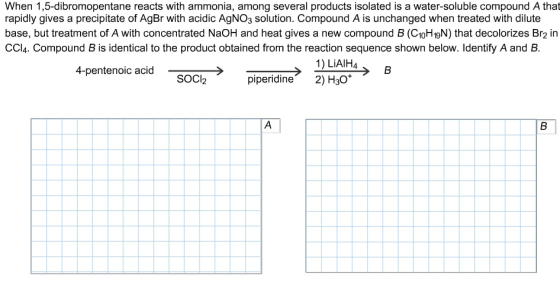
When 1,5-dibromopentane reacts with ammonia, among several products isolated is a water-soluble compound A that rapidly gives a precipitate of AgBr with acidic AgNO3 solution. Compound A is unchanged when treated with dilute base, but treatment of A with concentrated NaOH and heat gives a new compound B (C10H19N) that decolorizes Br2 in CCl4. Compound B is identical to the product obtained from the reaction sequence shown below. Identify A and B.
Homework Answers


Add Answer to:
When 1,5-dibromopentane reacts with ammonia, among several products
isolated is a water-soluble compound A that rapidly...
When 1,5-dibromopentane reacts with ammonia, among several products isolated is a water-soluble compound A that rapidly...
 When 1,5-dibromopentane reacts with ammonia, among several products isolated is a water-soluble compound A that rapidly gives a precipitate of AgBr with acidic AgNO3 solution. Compound A is unchanged when treated with dilute base, but treatment of A with concentrated NaOH and heat gives a new compound B ( CH19N) that decolorizes Brain CCl4. Compound B is identical to the product obtained from the reaction sequence shown below. Identify A and B. 4-pentenoic acid 1) LiAlH4 SOCI2 piperidine 2) H30*...
Exercise 2 Separation of a Mixture Based on Acid-Base Properties One purpose of this exercise is...
Exercise 2 Separation of a Mixture Based on Acid-Base Properties One purpose of this exercise is to learn how to use a separatory funnel to extract a single component away from other compounds in solution. To do so, we will apply the principles of solubility and acid-base behavior you’re seeing in class. One of the compounds is neutral in the acid-base sense. It has no ability to either donate or accept a proton from an aqueous solution, and will remain...
 When 1,5-dibromopentane reacts with ammonia, among several products isolated is a water-soluble compound A that rapidly gives a precipitate of AgBr with acidic AgNO3 solution. Compound A is unchanged when treated with dilute base, but treatment of A with concentrated NaOH and heat gives a new compound B ( CH19N) that decolorizes Brain CCl4. Compound B is identical to the product obtained from the reaction sequence shown below. Identify A and B. 4-pentenoic acid 1) LiAlH4 SOCI2 piperidine 2) H30*...
Most questions answered within 3 hours.
-
Where is the error in this code sequence?
String s1 = "Hello";
String s2 = "ello";...
asked 10 months ago -
Financial data for Joel de Paris, Inc., for last year
follow:
Joel de Paris, Inc.
Balance...
asked 10 months ago -
Consider this reaction:
Al2(SO4)3 (aq)+ BaCl3
(aq) Al2Cl6 (aq)- +
3BaSO4(s) . What is the...
asked 10 months ago -
Suppose that Savneet is considering increasing her
recent random sample from 20 car rentals to 40...
asked 10 months ago -
Trucks arrive at an unloading terminal at an average rate of 120
per hour.
Trucks arrive...
asked 10 months ago -
Why are methanol and ethanol completely soluble in water while
octanol is not very little soluble....
asked 10 months ago -
A facilities manager at a university reads in a research report
that the mean amount of...
asked 10 months ago -
When the CuSO4 is rehydrated by adding water to the anhydrous
compound, is this an endothermic...
asked 10 months ago -
A ray of sunlight is passing from diamond into crown glass; the
angle of incidence is...
asked 10 months ago -
A block of mass 0.249 kg is placed on top of a light, vertical
spring of...
asked 10 months ago -
how do the kidneys compensate in the presences of acidosis
a) trigger hyperventilate
b) reserve acid...
asked 10 months ago -
Question 501 pts
The rental rate of capital to the firm increases. Which of the
following...
asked 10 months ago