Amines can be made by the reduction of nitriles, which in turn can be made from...
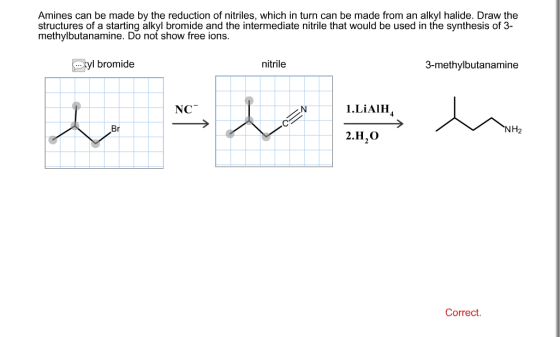
Amines can be made by the reduction of nitriles, which in turn can be made from an alkyl halide. Draw the structures of a starting alkyl bromide and the intermediate nitrile that would be used in the synthesis of 3-methylbutylamine (also known as isoamylamine). Do not show free ions.

Homework Answers

Add Answer to:
Amines can be made by the reduction of nitriles, which in turn
can be made from...
Amines can be made by the reduction of nitriles, which in turn can be made from...
 Amines can be made by the reduction of nitriles, which in turn can be made from an alkyl halide. Draw the structures of a starting alkyl bromide and the intermediate nitrile that would be used in the synthesis of 3-methylbutylamine (also known as isoamylamine). Do not show free ions. alkyl bromide nitrile isoamylamine NC 1.LAH 2.H,0 "NH2
"Carboxylic acids can be made by the hydrolysis of nitriles, which in turn can be made from an alkyl halide. Draw the...
 "Carboxylic acids can be made by the hydrolysis of nitriles,
which in turn can be made from an alkyl halide. Draw the structures
of a starting alkyl bromide and the intermediate nitrile that would
be used in the synthesis of 3-methylbutanoic acid (also known as
isovaleric acid). Do not show free ions."
I answered the first part right but it is saying that the
second part is incorrect. On my carbon that is triple bonded to the
nitrogen has a...
"Carboxylic acids can be made by the hydrolysis of nitriles,
which in turn can be made from an alkyl halide. Draw the structures
of a starting alkyl bromide and the intermediate nitrile that would
be used in the synthesis of 3-methylbutanoic acid (also known as
isovaleric acid). Do not show free ions."
I answered the first part right but it is saying that the
second part is incorrect. On my carbon that is triple bonded to the
nitrogen has a...
Carboxylic acids can be made by the hydrolysis of nitriles, which in turn can be made from an alkyl halide. Draw t...
 Carboxylic acids can be made by the hydrolysis of nitriles, which in turn can be made from an alkyl halide. Draw the structures of a starting alkyl bromide and the intermediate nitrile that would be used in the synthesis of 3-methylbutanoic acid (also known as isovaleric acid). Do not show free ions.
Carboxylic acids can be made by the hydrolysis of nitriles, which in turn can be made from an alkyl halide. Draw the st...
 Carboxylic acids can be made by the hydrolysis of nitriles, which
in turn can be made from an alkyl halide. Draw the structures of a
starting alkyl bromide and the intermediate nitrile that would be
used in the synthesis of 3-methylbutanoic acid (isovaleric acid) Do
not show free ions.
alkyl bromide nitrile isovaleric
acid
Carboxylic acids can be made by the hydrolysis of nitriles, which
in turn can be made from an alkyl halide. Draw the structures of a
starting alkyl bromide and the intermediate nitrile that would be
used in the synthesis of 3-methylbutanoic acid (isovaleric acid) Do
not show free ions.
alkyl bromide nitrile isovaleric
acid
Chem 208 Name: Test 3A May 1, 2019 Which of the following methods of preparation of...
 Chem 208 Name: Test 3A May 1, 2019 Which of the following methods of preparation of amines can be used to prepare primary, secondary, and tertiary amines? (4 pts) a. b. Gabriel synthesis from an alkyl halide c. reduction amination of a ketone 7. reduction of a nitrile Hofman rearrangement of an amide d. e. None of these methods is applicable to all types of amines
Unsymmetrical ethers can be made by the Williamson synthesis, in which an alkoxide ion reacts with...
 Unsymmetrical ethers can be made by the Williamson synthesis, in
which an alkoxide ion reacts with an alkyl bromide. Draw the
structure of the alkoxide and the alkyl bromide needed to produce
2-ethoxy-2-methylpropane (a.k.a t-butyl ethyl ether), shown below.
Show charges where appropriate.
Unsymmetrical ethers can be made by the Williamson synthesis, in which an alkoxide ion reacts with an alkyl bromide. Draw the structure of the alkoxide and the alkyl bromide needed to produce 2-ethoxy-2-methylpropane (a.k.a t-butyl ethyl ether),...
Unsymmetrical ethers can be made by the Williamson synthesis, in
which an alkoxide ion reacts with an alkyl bromide. Draw the
structure of the alkoxide and the alkyl bromide needed to produce
2-ethoxy-2-methylpropane (a.k.a t-butyl ethyl ether), shown below.
Show charges where appropriate.
Unsymmetrical ethers can be made by the Williamson synthesis, in which an alkoxide ion reacts with an alkyl bromide. Draw the structure of the alkoxide and the alkyl bromide needed to produce 2-ethoxy-2-methylpropane (a.k.a t-butyl ethyl ether),...
7. Which of the following amines cannot be made by reduction of a nitrile? PhCH NHA...
 7. Which of the following amines cannot be made by reduction of a nitrile? PhCH NHA ENH2 (CH3)2CHCH2NH Me,CCH2NH2 А B с D Ph2CHNH2 E
Draw the structure Unsymmetrical ethers can be made by the Williamson synthesis, in which an alkoxide...
 Draw the structure
Unsymmetrical ethers can be made by the Williamson synthesis, in which an alkoxide ion reacts with an alkyl bromide. Draw the structure of the alkoxide and the alkyl bromide needed to produce 2-ethoxy-2-methylpropane (a.k.a t-butyl ethyl ether), shown below. Show charges where appropriate. alkoxide alkyl bromide ether Br
Draw the structure
Unsymmetrical ethers can be made by the Williamson synthesis, in which an alkoxide ion reacts with an alkyl bromide. Draw the structure of the alkoxide and the alkyl bromide needed to produce 2-ethoxy-2-methylpropane (a.k.a t-butyl ethyl ether), shown below. Show charges where appropriate. alkoxide alkyl bromide ether Br
Unsymmetrical ethers can be made by the Williamson synthesis, in which an alkoxide ion reacts with...
 Unsymmetrical ethers can be made by the Williamson synthesis, in which an alkoxide ion reacts with an alkyl bromide. Draw the structure of the alkoxide and the alkyl bromide needed to produce 2-ethoxy-2-methylpropane (a.k.a t-butyl ethyl ether), shown below. Show charges where appropriate. alkoxide alkyl bromide ether + Br
1. Unsymmetrical ethers can be made by the Williamson synthesis, in which an alkoxide ion reacts...
 1. Unsymmetrical ethers can be made by
the Williamson synthesis, in which an alkoxide ion reacts with an
alkyl bromide. Draw the structure of the alkoxide and the alkyl
bromide needed to produce 2-ethoxy-2-methylpropane (a.k.a t-butyl
ethyl ether), shown below. Show charges where appropriate.
2. What nucleophile could be used to
react with butyl iodide to prepare the following compound?
1. Unsymmetrical ethers can be made by
the Williamson synthesis, in which an alkoxide ion reacts with an
alkyl bromide. Draw the structure of the alkoxide and the alkyl
bromide needed to produce 2-ethoxy-2-methylpropane (a.k.a t-butyl
ethyl ether), shown below. Show charges where appropriate.
2. What nucleophile could be used to
react with butyl iodide to prepare the following compound?
 Amines can be made by the reduction of nitriles, which in turn can be made from an alkyl halide. Draw the structures of a starting alkyl bromide and the intermediate nitrile that would be used in the synthesis of 3-methylbutylamine (also known as isoamylamine). Do not show free ions. alkyl bromide nitrile isoamylamine NC 1.LAH 2.H,0 "NH2
 "Carboxylic acids can be made by the hydrolysis of nitriles,
which in turn can be made from an alkyl halide. Draw the structures
of a starting alkyl bromide and the intermediate nitrile that would
be used in the synthesis of 3-methylbutanoic acid (also known as
isovaleric acid). Do not show free ions."
I answered the first part right but it is saying that the
second part is incorrect. On my carbon that is triple bonded to the
nitrogen has a...
"Carboxylic acids can be made by the hydrolysis of nitriles,
which in turn can be made from an alkyl halide. Draw the structures
of a starting alkyl bromide and the intermediate nitrile that would
be used in the synthesis of 3-methylbutanoic acid (also known as
isovaleric acid). Do not show free ions."
I answered the first part right but it is saying that the
second part is incorrect. On my carbon that is triple bonded to the
nitrogen has a...
 Carboxylic acids can be made by the hydrolysis of nitriles, which in turn can be made from an alkyl halide. Draw the structures of a starting alkyl bromide and the intermediate nitrile that would be used in the synthesis of 3-methylbutanoic acid (also known as isovaleric acid). Do not show free ions.
 Carboxylic acids can be made by the hydrolysis of nitriles, which
in turn can be made from an alkyl halide. Draw the structures of a
starting alkyl bromide and the intermediate nitrile that would be
used in the synthesis of 3-methylbutanoic acid (isovaleric acid) Do
not show free ions.
alkyl bromide nitrile isovaleric
acid
Carboxylic acids can be made by the hydrolysis of nitriles, which
in turn can be made from an alkyl halide. Draw the structures of a
starting alkyl bromide and the intermediate nitrile that would be
used in the synthesis of 3-methylbutanoic acid (isovaleric acid) Do
not show free ions.
alkyl bromide nitrile isovaleric
acid
 Chem 208 Name: Test 3A May 1, 2019 Which of the following methods of preparation of amines can be used to prepare primary, secondary, and tertiary amines? (4 pts) a. b. Gabriel synthesis from an alkyl halide c. reduction amination of a ketone 7. reduction of a nitrile Hofman rearrangement of an amide d. e. None of these methods is applicable to all types of amines
 Unsymmetrical ethers can be made by the Williamson synthesis, in
which an alkoxide ion reacts with an alkyl bromide. Draw the
structure of the alkoxide and the alkyl bromide needed to produce
2-ethoxy-2-methylpropane (a.k.a t-butyl ethyl ether), shown below.
Show charges where appropriate.
Unsymmetrical ethers can be made by the Williamson synthesis, in which an alkoxide ion reacts with an alkyl bromide. Draw the structure of the alkoxide and the alkyl bromide needed to produce 2-ethoxy-2-methylpropane (a.k.a t-butyl ethyl ether),...
Unsymmetrical ethers can be made by the Williamson synthesis, in
which an alkoxide ion reacts with an alkyl bromide. Draw the
structure of the alkoxide and the alkyl bromide needed to produce
2-ethoxy-2-methylpropane (a.k.a t-butyl ethyl ether), shown below.
Show charges where appropriate.
Unsymmetrical ethers can be made by the Williamson synthesis, in which an alkoxide ion reacts with an alkyl bromide. Draw the structure of the alkoxide and the alkyl bromide needed to produce 2-ethoxy-2-methylpropane (a.k.a t-butyl ethyl ether),...
 7. Which of the following amines cannot be made by reduction of a nitrile? PhCH NHA ENH2 (CH3)2CHCH2NH Me,CCH2NH2 А B с D Ph2CHNH2 E
 Draw the structure
Unsymmetrical ethers can be made by the Williamson synthesis, in which an alkoxide ion reacts with an alkyl bromide. Draw the structure of the alkoxide and the alkyl bromide needed to produce 2-ethoxy-2-methylpropane (a.k.a t-butyl ethyl ether), shown below. Show charges where appropriate. alkoxide alkyl bromide ether Br
Draw the structure
Unsymmetrical ethers can be made by the Williamson synthesis, in which an alkoxide ion reacts with an alkyl bromide. Draw the structure of the alkoxide and the alkyl bromide needed to produce 2-ethoxy-2-methylpropane (a.k.a t-butyl ethyl ether), shown below. Show charges where appropriate. alkoxide alkyl bromide ether Br
 Unsymmetrical ethers can be made by the Williamson synthesis, in which an alkoxide ion reacts with an alkyl bromide. Draw the structure of the alkoxide and the alkyl bromide needed to produce 2-ethoxy-2-methylpropane (a.k.a t-butyl ethyl ether), shown below. Show charges where appropriate. alkoxide alkyl bromide ether + Br
 1. Unsymmetrical ethers can be made by
the Williamson synthesis, in which an alkoxide ion reacts with an
alkyl bromide. Draw the structure of the alkoxide and the alkyl
bromide needed to produce 2-ethoxy-2-methylpropane (a.k.a t-butyl
ethyl ether), shown below. Show charges where appropriate.
2. What nucleophile could be used to
react with butyl iodide to prepare the following compound?
1. Unsymmetrical ethers can be made by
the Williamson synthesis, in which an alkoxide ion reacts with an
alkyl bromide. Draw the structure of the alkoxide and the alkyl
bromide needed to produce 2-ethoxy-2-methylpropane (a.k.a t-butyl
ethyl ether), shown below. Show charges where appropriate.
2. What nucleophile could be used to
react with butyl iodide to prepare the following compound?
Most questions answered within 3 hours.
-
Where is the error in this code sequence?
String s1 = "Hello";
String s2 = "ello";...
asked 10 months ago -
Financial data for Joel de Paris, Inc., for last year
follow:
Joel de Paris, Inc.
Balance...
asked 10 months ago -
Consider this reaction:
Al2(SO4)3 (aq)+ BaCl3
(aq) Al2Cl6 (aq)- +
3BaSO4(s) . What is the...
asked 10 months ago -
Suppose that Savneet is considering increasing her
recent random sample from 20 car rentals to 40...
asked 10 months ago -
Trucks arrive at an unloading terminal at an average rate of 120
per hour.
Trucks arrive...
asked 10 months ago -
Why are methanol and ethanol completely soluble in water while
octanol is not very little soluble....
asked 10 months ago -
A facilities manager at a university reads in a research report
that the mean amount of...
asked 10 months ago -
When the CuSO4 is rehydrated by adding water to the anhydrous
compound, is this an endothermic...
asked 10 months ago -
A ray of sunlight is passing from diamond into crown glass; the
angle of incidence is...
asked 10 months ago -
A block of mass 0.249 kg is placed on top of a light, vertical
spring of...
asked 10 months ago -
how do the kidneys compensate in the presences of acidosis
a) trigger hyperventilate
b) reserve acid...
asked 10 months ago -
Question 501 pts
The rental rate of capital to the firm increases. Which of the
following...
asked 10 months ago