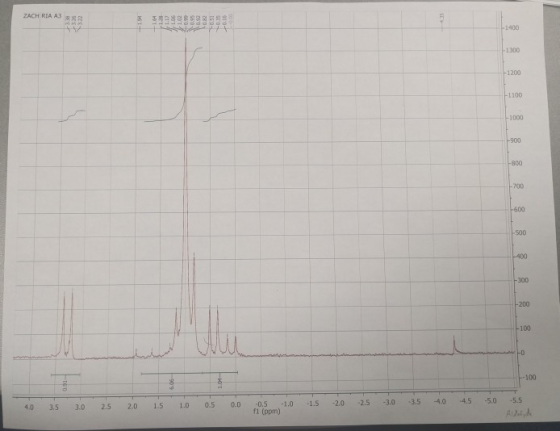
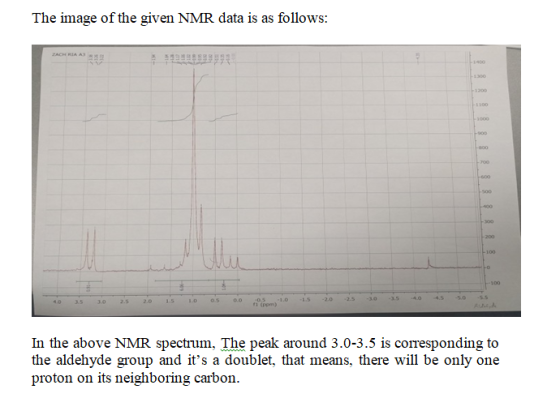
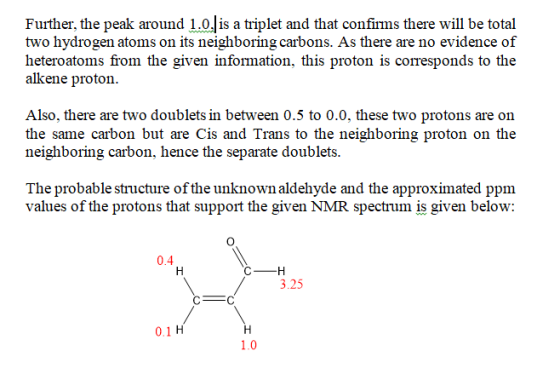
Please help me interpret the proton NMR of this unknown aldehyde.
Homework Answers
Add Answer to:
Please help me interpret the proton NMR of this
unknown aldehyde.
ZACH RIA A3 2 -1400...
label the spectrum OTBS Meo Yome Me H NMR spectrum (CDC13, 400 MHz) 8.5 8.0 7.5...
 label the spectrum
OTBS Meo Yome Me H NMR spectrum (CDC13, 400 MHz) 8.5 8.0 7.5 7.0 6.5 6.0 5.5 5.0 4.5 4.0 f1 (ppm) 3.5 3.0 2.5 2.0 1.5 1.0 0.5 0.0 -0.5 18C NMR spectrum (CDCI, 100 MHz) 210 200 190 180 170 160 150 140 130 120 110 100 fi (ppm) 90 80 70 60 50 40 30 20 10 -10
label the spectrum
OTBS Meo Yome Me H NMR spectrum (CDC13, 400 MHz) 8.5 8.0 7.5 7.0 6.5 6.0 5.5 5.0 4.5 4.0 f1 (ppm) 3.5 3.0 2.5 2.0 1.5 1.0 0.5 0.0 -0.5 18C NMR spectrum (CDCI, 100 MHz) 210 200 190 180 170 160 150 140 130 120 110 100 fi (ppm) 90 80 70 60 50 40 30 20 10 -10
Assign the NMR peaks below DIRECTLY onto the paper, please!!!! The impurities are water at 2.19 p...
 Assign the NMR peaks below DIRECTLY onto the paper,
please!!!!
The impurities are water at 2.19 ppm and acetone at 1.6 ppm. So
just ignore those peaks. The peaks for the aromatic Hydrogens can
be grouped up to one (I believe they are the left most peaks at
around 7 to 7.5 ppm. Given that please assign the rest of the
hydrogens.
We were unable to transcribe this imager2 30 25 20 15 10 9.0 8.5 8.0 7.5 7.0 6.5...
Assign the NMR peaks below DIRECTLY onto the paper,
please!!!!
The impurities are water at 2.19 ppm and acetone at 1.6 ppm. So
just ignore those peaks. The peaks for the aromatic Hydrogens can
be grouped up to one (I believe they are the left most peaks at
around 7 to 7.5 ppm. Given that please assign the rest of the
hydrogens.
We were unable to transcribe this imager2 30 25 20 15 10 9.0 8.5 8.0 7.5 7.0 6.5...
Analyze the proton and carbon NMR for 4-cyclohexane PROTON_02 4632-4-cyclohexane 7.5 7.0 6.5 6.0 5.5 5.0...
 Analyze the proton and carbon NMR for
4-cyclohexane
PROTON_02 4632-4-cyclohexane 7.5 7.0 6.5 6.0 5.5 5.0 4.5 a 4.0 fi (ppm) 3.5 3.0 2.5 2.0 1.5 1.0 0.5 CARBON_01 4632-4-cyclohexane WAWANAN www 230 220 210 200 190 180 170160 150 140 130 120 110 f1 (ppm) 100 90 80 70 60 50 40 30 20 10 0 -10
Analyze the proton and carbon NMR for
4-cyclohexane
PROTON_02 4632-4-cyclohexane 7.5 7.0 6.5 6.0 5.5 5.0 4.5 a 4.0 fi (ppm) 3.5 3.0 2.5 2.0 1.5 1.0 0.5 CARBON_01 4632-4-cyclohexane WAWANAN www 230 220 210 200 190 180 170160 150 140 130 120 110 f1 (ppm) 100 90 80 70 60 50 40 30 20 10 0 -10
In the proton NMR for benzil, there are clearly some impurity peaks below 8 ppm. Although...
 In the proton NMR for benzil, there are clearly some impurity
peaks below 8 ppm. Although we cannot assign these for certain, is
it possible that these peaks come from unreacted benzoin? Why or
why not?
8.0 8.3 7.5 8.2 NMR nuclei observed: H Solvent: CDCl3 NMR field strength: 400MHz 7.0 6.5 6.0 5.5 5.0 4.5 4.0 3.5 3.0 2.5 (ppm) f1 8.1 8.0 7.9 7.8 7.7 7.6 7.5 7.4 7.3 f1 (ppm) 11 10 12 13 14 2.0 1.5...
In the proton NMR for benzil, there are clearly some impurity
peaks below 8 ppm. Although we cannot assign these for certain, is
it possible that these peaks come from unreacted benzoin? Why or
why not?
8.0 8.3 7.5 8.2 NMR nuclei observed: H Solvent: CDCl3 NMR field strength: 400MHz 7.0 6.5 6.0 5.5 5.0 4.5 4.0 3.5 3.0 2.5 (ppm) f1 8.1 8.0 7.9 7.8 7.7 7.6 7.5 7.4 7.3 f1 (ppm) 11 10 12 13 14 2.0 1.5...
Analyze the proton and carbon NMR of hexane PROTON_01 4632-2_Hexane -109 7.5 7.0 6.5 6.0 5.5...
 Analyze the proton and carbon NMR of hexane
PROTON_01 4632-2_Hexane -109 7.5 7.0 6.5 6.0 5.5 5.0 4.5 4.0 3.5 3.0 2.5 2.0 1.5 1.0 0.5 0.0 CARBON_01 4632-2_Hexane www hwilowWWWMWWMWANAMUbwwwwwwwwwwwwwwwwwwwwwwwwwwwwwwwwwwwwwwwwwwwwwwwwwwwwwwwwwwwwwwwwwwwww/WWWWWWWWWWWWwwwwwwwwwwwwwwwwwwwwwwwwwwwwwwwwwww TTTT 230 220 210 200 190 180 170 160 150 140 130 120 110 fi (ppm) 100 90 80 70 60 50 40 30 20 10 0 -10
Analyze the proton and carbon NMR of hexane
PROTON_01 4632-2_Hexane -109 7.5 7.0 6.5 6.0 5.5 5.0 4.5 4.0 3.5 3.0 2.5 2.0 1.5 1.0 0.5 0.0 CARBON_01 4632-2_Hexane www hwilowWWWMWWMWANAMUbwwwwwwwwwwwwwwwwwwwwwwwwwwwwwwwwwwwwwwwwwwwwwwwwwwwwwwwwwwwwwwwwwwwww/WWWWWWWWWWWWwwwwwwwwwwwwwwwwwwwwwwwwwwwwwwwwwww TTTT 230 220 210 200 190 180 170 160 150 140 130 120 110 fi (ppm) 100 90 80 70 60 50 40 30 20 10 0 -10
A variety of spectra for an organic compound with molecular formula C10H16O are presented below. The experimental accurate mass using (+) APCI source is 153.1280 u. The 1H, 13C, COSY, HSQC and HMBC NM...
 A variety of spectra for an organic compound with molecular
formula C10H16O are presented below. The
experimental accurate mass using (+) APCI source is 153.1280 u. The
1H, 13C, COSY, HSQC and HMBC NMR spectra are given in the following
slides. Propose a structure for this unknown and answer or address
the following questions or requirements:
d. If there are still any questionable assignments, propose
additional NMR experiments which would solve those questions and
briefly explain specifically what correlations you...
A variety of spectra for an organic compound with molecular
formula C10H16O are presented below. The
experimental accurate mass using (+) APCI source is 153.1280 u. The
1H, 13C, COSY, HSQC and HMBC NMR spectra are given in the following
slides. Propose a structure for this unknown and answer or address
the following questions or requirements:
d. If there are still any questionable assignments, propose
additional NMR experiments which would solve those questions and
briefly explain specifically what correlations you...
Assign the peaks in your spectrum by: (1) drawing what you think the structure of the...
 Assign the peaks in your spectrum by:
(1) drawing what you think the structure of the product is directly
on your spectrum; (2) identifying the protons with code letters
(e.g., “Ha”, “Hb”, “Hc”, etc.), but grouping protons that give rise
to the same signal under the same label; (3) writing “Ha”, “Hb”,
“Hc”, etc., near the appropriate peaks so that the assignment is
clear; (4) identifying impurity peaks.
1400 1300 1200 1100 1000 -900 -800 700 600 500 -400 300...
Assign the peaks in your spectrum by:
(1) drawing what you think the structure of the product is directly
on your spectrum; (2) identifying the protons with code letters
(e.g., “Ha”, “Hb”, “Hc”, etc.), but grouping protons that give rise
to the same signal under the same label; (3) writing “Ha”, “Hb”,
“Hc”, etc., near the appropriate peaks so that the assignment is
clear; (4) identifying impurity peaks.
1400 1300 1200 1100 1000 -900 -800 700 600 500 -400 300...
which of the following compunds matches the soectrum given? Circle the correct answer and explain your reasoning for A,...
 which of the following compunds matches the soectrum given? Circle
the correct answer and explain your reasoning for A, B, C, D.
We did not cover this in lecture and are now encountering it
in lab. Can you please tell me what the correct answers are, but
also the steps to taje to solve the problem on ny own? Thank
you!
2. Which of the following compounds matches the spectrum given? Circle the correct answer and explain your reasoning. ide...
which of the following compunds matches the soectrum given? Circle
the correct answer and explain your reasoning for A, B, C, D.
We did not cover this in lecture and are now encountering it
in lab. Can you please tell me what the correct answers are, but
also the steps to taje to solve the problem on ny own? Thank
you!
2. Which of the following compounds matches the spectrum given? Circle the correct answer and explain your reasoning. ide...
draw structure of C8H10 and C8H8O2 based on the 1HNMR AND 13C-NMR shown in the pictures...
 draw structure of C8H10 and C8H8O2 based on the 1HNMR AND 13C-NMR
shown in the pictures provided.
any tips of steps will help! thank you!
please scroll for all lictures!
C-NMR data given. D ons: Solve the structures for C8H10 and C8H8O2 using only the molecular formula and 'H- and R data given. DO NOT WORK IN GROUPS. You may ask your TA for minor assistance. You may use your tab manual (pages 31-39). Please write your final structures in...
draw structure of C8H10 and C8H8O2 based on the 1HNMR AND 13C-NMR
shown in the pictures provided.
any tips of steps will help! thank you!
please scroll for all lictures!
C-NMR data given. D ons: Solve the structures for C8H10 and C8H8O2 using only the molecular formula and 'H- and R data given. DO NOT WORK IN GROUPS. You may ask your TA for minor assistance. You may use your tab manual (pages 31-39). Please write your final structures in...
A variety of spectra for an organic compound with molecular formula C10H16O are presented below. The experimental accurate mass using (+) APCI source is 153.1280 u. The 1H, 13C, COSY, HSQC and HMBC NM...
 A variety of spectra for an organic compound with molecular
formula C10H16O are presented below. The
experimental accurate mass using (+) APCI source is 153.1280 u. The
1H, 13C, COSY, HSQC and HMBC NMR spectra are given in the following
slides. Propose a structure for this unknown and answer or address
the following questions or requirements:
a. Using the most abundant isotopes of C, H and O, what are the
errors in ppm and milli-Daltons for the experimental accurate
mass?...
A variety of spectra for an organic compound with molecular
formula C10H16O are presented below. The
experimental accurate mass using (+) APCI source is 153.1280 u. The
1H, 13C, COSY, HSQC and HMBC NMR spectra are given in the following
slides. Propose a structure for this unknown and answer or address
the following questions or requirements:
a. Using the most abundant isotopes of C, H and O, what are the
errors in ppm and milli-Daltons for the experimental accurate
mass?...
 label the spectrum
OTBS Meo Yome Me H NMR spectrum (CDC13, 400 MHz) 8.5 8.0 7.5 7.0 6.5 6.0 5.5 5.0 4.5 4.0 f1 (ppm) 3.5 3.0 2.5 2.0 1.5 1.0 0.5 0.0 -0.5 18C NMR spectrum (CDCI, 100 MHz) 210 200 190 180 170 160 150 140 130 120 110 100 fi (ppm) 90 80 70 60 50 40 30 20 10 -10
label the spectrum
OTBS Meo Yome Me H NMR spectrum (CDC13, 400 MHz) 8.5 8.0 7.5 7.0 6.5 6.0 5.5 5.0 4.5 4.0 f1 (ppm) 3.5 3.0 2.5 2.0 1.5 1.0 0.5 0.0 -0.5 18C NMR spectrum (CDCI, 100 MHz) 210 200 190 180 170 160 150 140 130 120 110 100 fi (ppm) 90 80 70 60 50 40 30 20 10 -10
 Assign the NMR peaks below DIRECTLY onto the paper,
please!!!!
The impurities are water at 2.19 ppm and acetone at 1.6 ppm. So
just ignore those peaks. The peaks for the aromatic Hydrogens can
be grouped up to one (I believe they are the left most peaks at
around 7 to 7.5 ppm. Given that please assign the rest of the
hydrogens.
We were unable to transcribe this imager2 30 25 20 15 10 9.0 8.5 8.0 7.5 7.0 6.5...
Assign the NMR peaks below DIRECTLY onto the paper,
please!!!!
The impurities are water at 2.19 ppm and acetone at 1.6 ppm. So
just ignore those peaks. The peaks for the aromatic Hydrogens can
be grouped up to one (I believe they are the left most peaks at
around 7 to 7.5 ppm. Given that please assign the rest of the
hydrogens.
We were unable to transcribe this imager2 30 25 20 15 10 9.0 8.5 8.0 7.5 7.0 6.5...
 Analyze the proton and carbon NMR for
4-cyclohexane
PROTON_02 4632-4-cyclohexane 7.5 7.0 6.5 6.0 5.5 5.0 4.5 a 4.0 fi (ppm) 3.5 3.0 2.5 2.0 1.5 1.0 0.5 CARBON_01 4632-4-cyclohexane WAWANAN www 230 220 210 200 190 180 170160 150 140 130 120 110 f1 (ppm) 100 90 80 70 60 50 40 30 20 10 0 -10
Analyze the proton and carbon NMR for
4-cyclohexane
PROTON_02 4632-4-cyclohexane 7.5 7.0 6.5 6.0 5.5 5.0 4.5 a 4.0 fi (ppm) 3.5 3.0 2.5 2.0 1.5 1.0 0.5 CARBON_01 4632-4-cyclohexane WAWANAN www 230 220 210 200 190 180 170160 150 140 130 120 110 f1 (ppm) 100 90 80 70 60 50 40 30 20 10 0 -10
 In the proton NMR for benzil, there are clearly some impurity
peaks below 8 ppm. Although we cannot assign these for certain, is
it possible that these peaks come from unreacted benzoin? Why or
why not?
8.0 8.3 7.5 8.2 NMR nuclei observed: H Solvent: CDCl3 NMR field strength: 400MHz 7.0 6.5 6.0 5.5 5.0 4.5 4.0 3.5 3.0 2.5 (ppm) f1 8.1 8.0 7.9 7.8 7.7 7.6 7.5 7.4 7.3 f1 (ppm) 11 10 12 13 14 2.0 1.5...
In the proton NMR for benzil, there are clearly some impurity
peaks below 8 ppm. Although we cannot assign these for certain, is
it possible that these peaks come from unreacted benzoin? Why or
why not?
8.0 8.3 7.5 8.2 NMR nuclei observed: H Solvent: CDCl3 NMR field strength: 400MHz 7.0 6.5 6.0 5.5 5.0 4.5 4.0 3.5 3.0 2.5 (ppm) f1 8.1 8.0 7.9 7.8 7.7 7.6 7.5 7.4 7.3 f1 (ppm) 11 10 12 13 14 2.0 1.5...
 Analyze the proton and carbon NMR of hexane
PROTON_01 4632-2_Hexane -109 7.5 7.0 6.5 6.0 5.5 5.0 4.5 4.0 3.5 3.0 2.5 2.0 1.5 1.0 0.5 0.0 CARBON_01 4632-2_Hexane www hwilowWWWMWWMWANAMUbwwwwwwwwwwwwwwwwwwwwwwwwwwwwwwwwwwwwwwwwwwwwwwwwwwwwwwwwwwwwwwwwwwwww/WWWWWWWWWWWWwwwwwwwwwwwwwwwwwwwwwwwwwwwwwwwwwww TTTT 230 220 210 200 190 180 170 160 150 140 130 120 110 fi (ppm) 100 90 80 70 60 50 40 30 20 10 0 -10
Analyze the proton and carbon NMR of hexane
PROTON_01 4632-2_Hexane -109 7.5 7.0 6.5 6.0 5.5 5.0 4.5 4.0 3.5 3.0 2.5 2.0 1.5 1.0 0.5 0.0 CARBON_01 4632-2_Hexane www hwilowWWWMWWMWANAMUbwwwwwwwwwwwwwwwwwwwwwwwwwwwwwwwwwwwwwwwwwwwwwwwwwwwwwwwwwwwwwwwwwwwww/WWWWWWWWWWWWwwwwwwwwwwwwwwwwwwwwwwwwwwwwwwwwwww TTTT 230 220 210 200 190 180 170 160 150 140 130 120 110 fi (ppm) 100 90 80 70 60 50 40 30 20 10 0 -10
 A variety of spectra for an organic compound with molecular
formula C10H16O are presented below. The
experimental accurate mass using (+) APCI source is 153.1280 u. The
1H, 13C, COSY, HSQC and HMBC NMR spectra are given in the following
slides. Propose a structure for this unknown and answer or address
the following questions or requirements:
d. If there are still any questionable assignments, propose
additional NMR experiments which would solve those questions and
briefly explain specifically what correlations you...
A variety of spectra for an organic compound with molecular
formula C10H16O are presented below. The
experimental accurate mass using (+) APCI source is 153.1280 u. The
1H, 13C, COSY, HSQC and HMBC NMR spectra are given in the following
slides. Propose a structure for this unknown and answer or address
the following questions or requirements:
d. If there are still any questionable assignments, propose
additional NMR experiments which would solve those questions and
briefly explain specifically what correlations you...
 Assign the peaks in your spectrum by:
(1) drawing what you think the structure of the product is directly
on your spectrum; (2) identifying the protons with code letters
(e.g., “Ha”, “Hb”, “Hc”, etc.), but grouping protons that give rise
to the same signal under the same label; (3) writing “Ha”, “Hb”,
“Hc”, etc., near the appropriate peaks so that the assignment is
clear; (4) identifying impurity peaks.
1400 1300 1200 1100 1000 -900 -800 700 600 500 -400 300...
Assign the peaks in your spectrum by:
(1) drawing what you think the structure of the product is directly
on your spectrum; (2) identifying the protons with code letters
(e.g., “Ha”, “Hb”, “Hc”, etc.), but grouping protons that give rise
to the same signal under the same label; (3) writing “Ha”, “Hb”,
“Hc”, etc., near the appropriate peaks so that the assignment is
clear; (4) identifying impurity peaks.
1400 1300 1200 1100 1000 -900 -800 700 600 500 -400 300...
 which of the following compunds matches the soectrum given? Circle
the correct answer and explain your reasoning for A, B, C, D.
We did not cover this in lecture and are now encountering it
in lab. Can you please tell me what the correct answers are, but
also the steps to taje to solve the problem on ny own? Thank
you!
2. Which of the following compounds matches the spectrum given? Circle the correct answer and explain your reasoning. ide...
which of the following compunds matches the soectrum given? Circle
the correct answer and explain your reasoning for A, B, C, D.
We did not cover this in lecture and are now encountering it
in lab. Can you please tell me what the correct answers are, but
also the steps to taje to solve the problem on ny own? Thank
you!
2. Which of the following compounds matches the spectrum given? Circle the correct answer and explain your reasoning. ide...
 draw structure of C8H10 and C8H8O2 based on the 1HNMR AND 13C-NMR
shown in the pictures provided.
any tips of steps will help! thank you!
please scroll for all lictures!
C-NMR data given. D ons: Solve the structures for C8H10 and C8H8O2 using only the molecular formula and 'H- and R data given. DO NOT WORK IN GROUPS. You may ask your TA for minor assistance. You may use your tab manual (pages 31-39). Please write your final structures in...
draw structure of C8H10 and C8H8O2 based on the 1HNMR AND 13C-NMR
shown in the pictures provided.
any tips of steps will help! thank you!
please scroll for all lictures!
C-NMR data given. D ons: Solve the structures for C8H10 and C8H8O2 using only the molecular formula and 'H- and R data given. DO NOT WORK IN GROUPS. You may ask your TA for minor assistance. You may use your tab manual (pages 31-39). Please write your final structures in...
 A variety of spectra for an organic compound with molecular
formula C10H16O are presented below. The
experimental accurate mass using (+) APCI source is 153.1280 u. The
1H, 13C, COSY, HSQC and HMBC NMR spectra are given in the following
slides. Propose a structure for this unknown and answer or address
the following questions or requirements:
a. Using the most abundant isotopes of C, H and O, what are the
errors in ppm and milli-Daltons for the experimental accurate
mass?...
A variety of spectra for an organic compound with molecular
formula C10H16O are presented below. The
experimental accurate mass using (+) APCI source is 153.1280 u. The
1H, 13C, COSY, HSQC and HMBC NMR spectra are given in the following
slides. Propose a structure for this unknown and answer or address
the following questions or requirements:
a. Using the most abundant isotopes of C, H and O, what are the
errors in ppm and milli-Daltons for the experimental accurate
mass?...
Most questions answered within 3 hours.
-
Where is the error in this code sequence?
String s1 = "Hello";
String s2 = "ello";...
asked 11 months ago -
Financial data for Joel de Paris, Inc., for last year
follow:
Joel de Paris, Inc.
Balance...
asked 11 months ago -
Consider this reaction:
Al2(SO4)3 (aq)+ BaCl3
(aq) Al2Cl6 (aq)- +
3BaSO4(s) . What is the...
asked 11 months ago -
Suppose that Savneet is considering increasing her
recent random sample from 20 car rentals to 40...
asked 11 months ago -
Trucks arrive at an unloading terminal at an average rate of 120
per hour.
Trucks arrive...
asked 11 months ago -
Why are methanol and ethanol completely soluble in water while
octanol is not very little soluble....
asked 11 months ago -
A facilities manager at a university reads in a research report
that the mean amount of...
asked 11 months ago -
When the CuSO4 is rehydrated by adding water to the anhydrous
compound, is this an endothermic...
asked 11 months ago -
A ray of sunlight is passing from diamond into crown glass; the
angle of incidence is...
asked 11 months ago -
A block of mass 0.249 kg is placed on top of a light, vertical
spring of...
asked 11 months ago -
how do the kidneys compensate in the presences of acidosis
a) trigger hyperventilate
b) reserve acid...
asked 11 months ago -
Question 501 pts
The rental rate of capital to the firm increases. Which of the
following...
asked 11 months ago