
Homework Answers
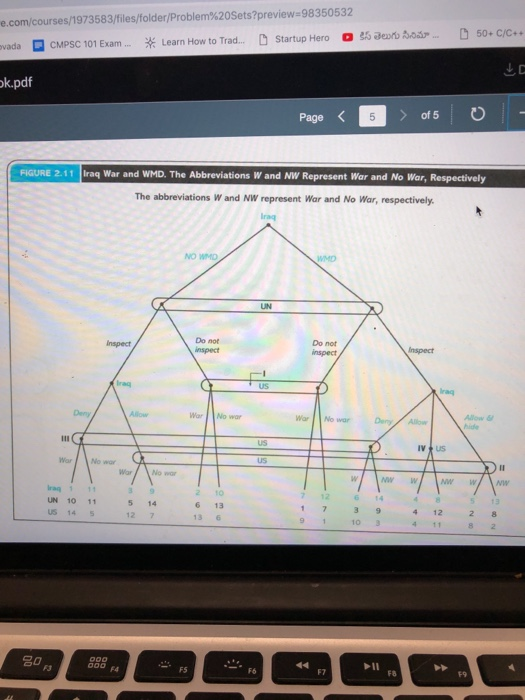
7. In the above diagram, there are three players. They're : Iraq, US and UN. The Iraq has three information sets and Iraq's strategy is a triple of actions. Those are - a) initial code set, b) No WMD set and UN requested inspections and c) WMD set and UN requested inspections. At the information sets, one side it has two actions and the other side it has three actions. The sum total of Iraq strategies are 12.
The other player, US has four information sets. In the first information set a) the UN didn't request inspections, b) in the other, the UN requested inspections and Iraq rejected that request , c) the UN again requested inspections and Iraq has agreed to the request & Weapons of Mass Destruction [WMD] were not found , d) in the last information set the WMD were found and hence the Iraq acquiesced to UN requested inspections. The last information set is considered as a unit set. Hence, the US strategies are four tuple of actions. Each of its four information sets contains two feasible actions such as attacking or not attacking Iraq. The total number of US strategies are 16.
The remaining player, UN has one information set and it contains two nodes corresponding to having WMD or not having WMD of Iraq. The UN strategy set indicates request inspections or not.
Add Answer to:
You have to solve the 7th question
Exercises p one of the two doors not selected...
1. Game simulation, Java programming. In the game show Let’s Make a Deal, a contestant is...
1. Game simulation, Java programming. In the game show Let’s Make a Deal, a contestant is presented with three doors. Behind one of them is a valuable prize. After the contestant chooses a door, the host opens one of the other two doors (never revealing the prize, of course). The contestant is then given the opportunity to switch to the other unopened door. Should the contestant do so? Intuitively, it might seem that the contestant’s initial choice door and the...
please help in java Monty Hall was a television game show host years ago. The contestant...
please help in java Monty Hall was a television game show host years ago. The contestant would have 3 doors to choose from. There was always a prize behind one door and goats behind the other two doors. The contestant would choose a door. Monty Hall would then open a door following these rules: Not a door the contestant chose and not the winning door. Monty ALWAYS showed a goat. He'd then ask the contestant if they wanted to change...
5. Consider the Monty Hall Problem. A game show host shows you three doors, and indicates...
 5. Consider the Monty Hall Problem. A game show host shows you three doors, and indicates that one of them has a car behind it, while the other two have goats. You win a car if you end up choosing a door with a car behind it. The game is conducted as follows: • You pick an initial door out of the three available. • The game show hosts then opens a door (out of the remaining two doors) with...
Monty Hall Problem - Suppose you are going to be on a game show, and you...
Monty Hall Problem - Suppose you are going to be on a game show, and you will be given the choice of three doors: Behind one door is a car; behind the other two doors are goats. You pick a door, say No. 1, and the host, who knows what's behind the doors, opens another door, say No. 3, which has a goat. He then says to you, "Do you want to pick door No. 2?" Is it to your...
126. An article entitled "Behind Monty Hall's Doors: Puzzle, De- bate and Answer?" appeared in the...
 126. An article entitled "Behind Monty Hall's Doors: Puzzle, De- bate and Answer?" appeared in the Sunday New York Times on July 21, 1991. The article discussed the debate that was raging among mathematicians, readers of the "Ask Marilyn" column of Parade Magazine and the fans of the TV game show "Let's Make a Deal." The argument began in Septem- ber, 1990 when Ms. Vos Savant, who is listed in the Guinness Book of World Records Hall of Fame for...
Question 1: Consider the following Monty Hall problem. Suppose you are on a game show, and...
Question 1: Consider the following Monty Hall problem. Suppose you are on a game show, and you are given the choice of three doors. Behind one door is a car, behind the others, goats. You pick a door, say #1, and the host, who knows what is behind the doors, opens another door, say #3, which has a goat. Here we assume that the host cannot open the door to expose the car and when he can open either of...
1.3 Cars and goats: the Monty Hall dilemma On Sunday September 9, 1990, the following question...
 1.3 Cars and goats: the Monty Hall dilemma On Sunday September 9, 1990, the following question appeared in the "Ask Marilyn" column in Parade, a Sunday supplement to many newspapers across the United States: Suppose you're on a game show, and you're given the choice of three doors; behind one door is a car; behind the others, goats. You pick a door, say No. 1, and the host, who knows what's behind the doors, opens another door, say No. 3,...
 5. Consider the Monty Hall Problem. A game show host shows you three doors, and indicates that one of them has a car behind it, while the other two have goats. You win a car if you end up choosing a door with a car behind it. The game is conducted as follows: • You pick an initial door out of the three available. • The game show hosts then opens a door (out of the remaining two doors) with...
 126. An article entitled "Behind Monty Hall's Doors: Puzzle, De- bate and Answer?" appeared in the Sunday New York Times on July 21, 1991. The article discussed the debate that was raging among mathematicians, readers of the "Ask Marilyn" column of Parade Magazine and the fans of the TV game show "Let's Make a Deal." The argument began in Septem- ber, 1990 when Ms. Vos Savant, who is listed in the Guinness Book of World Records Hall of Fame for...
 1.3 Cars and goats: the Monty Hall dilemma On Sunday September 9, 1990, the following question appeared in the "Ask Marilyn" column in Parade, a Sunday supplement to many newspapers across the United States: Suppose you're on a game show, and you're given the choice of three doors; behind one door is a car; behind the others, goats. You pick a door, say No. 1, and the host, who knows what's behind the doors, opens another door, say No. 3,...
Most questions answered within 3 hours.
-
Where is the error in this code sequence?
String s1 = "Hello";
String s2 = "ello";...
asked 10 months ago -
Financial data for Joel de Paris, Inc., for last year
follow:
Joel de Paris, Inc.
Balance...
asked 10 months ago -
Consider this reaction:
Al2(SO4)3 (aq)+ BaCl3
(aq) Al2Cl6 (aq)- +
3BaSO4(s) . What is the...
asked 10 months ago -
Suppose that Savneet is considering increasing her
recent random sample from 20 car rentals to 40...
asked 10 months ago -
Trucks arrive at an unloading terminal at an average rate of 120
per hour.
Trucks arrive...
asked 10 months ago -
Why are methanol and ethanol completely soluble in water while
octanol is not very little soluble....
asked 10 months ago -
A facilities manager at a university reads in a research report
that the mean amount of...
asked 10 months ago -
When the CuSO4 is rehydrated by adding water to the anhydrous
compound, is this an endothermic...
asked 10 months ago -
A ray of sunlight is passing from diamond into crown glass; the
angle of incidence is...
asked 10 months ago -
A block of mass 0.249 kg is placed on top of a light, vertical
spring of...
asked 10 months ago -
how do the kidneys compensate in the presences of acidosis
a) trigger hyperventilate
b) reserve acid...
asked 10 months ago -
Question 501 pts
The rental rate of capital to the firm increases. Which of the
following...
asked 10 months ago