
Homework Answers
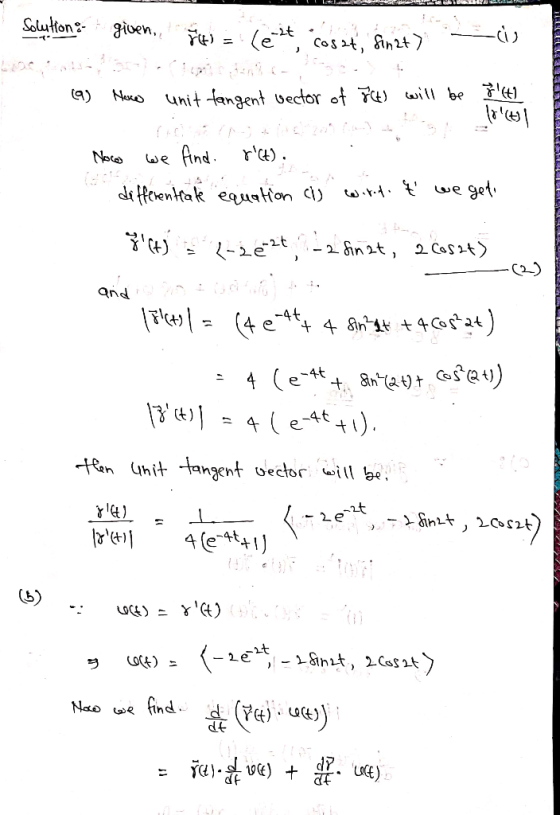
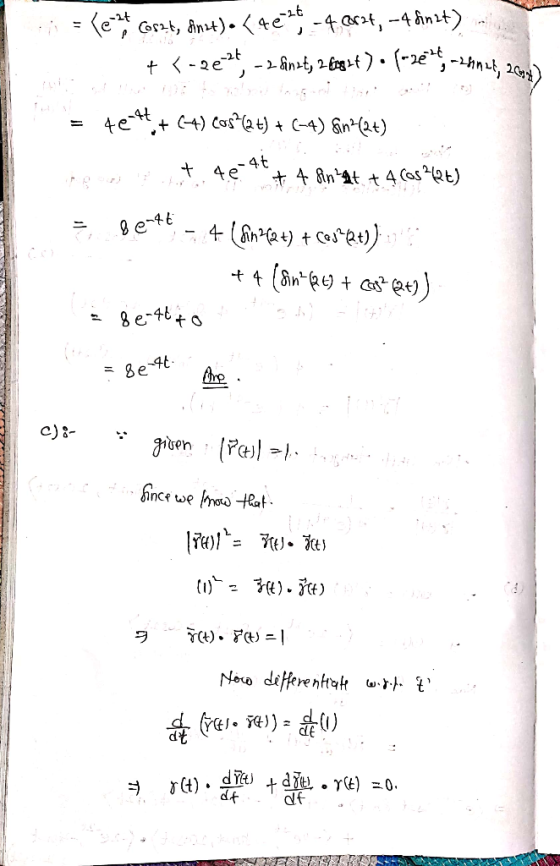
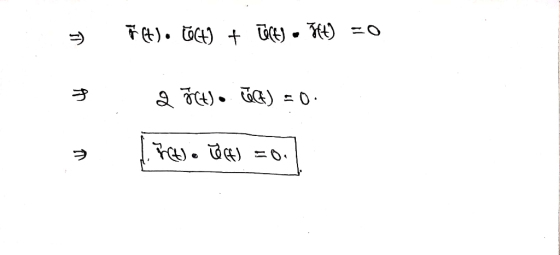
Let u(t) =t^3 i + ln(t) j + e^2t k and v(t) = 1/t^3 i +...
 Let u(t) =t^3 i + ln(t) j + e^2t k and v(t) = 1/t^3 i + 2 j +
t k
2. Let u(t) - ti+In(t)j+ et k and Compute the derivative of the dot product f u(t)v() in two ways and confirm they agree: Compute the dot product u(t) v(t) first and then differentiate the result. . Alternatively, use the following "Dot Product Rule" u(t) v(t)] u'(t) v(t)+ u(t) v'(t) Aside: It's worth noting that there are other forms...
Let u(t) =t^3 i + ln(t) j + e^2t k and v(t) = 1/t^3 i + 2 j +
t k
2. Let u(t) - ti+In(t)j+ et k and Compute the derivative of the dot product f u(t)v() in two ways and confirm they agree: Compute the dot product u(t) v(t) first and then differentiate the result. . Alternatively, use the following "Dot Product Rule" u(t) v(t)] u'(t) v(t)+ u(t) v'(t) Aside: It's worth noting that there are other forms...
Let r(t) = <cos(5t), sin(5t), v7t>. (a) (7 points) Find |r'(t)|| (b) (7 points) Find and...
 Let r(t) = <cos(5t), sin(5t), v7t>. (a) (7 points) Find |r'(t)|| (b) (7 points) Find and simplify T(t), the unit tangent vector. Upload Choose a File
If u(t) = (sin(2t), cos(3), t) and v(t) = (t cos(3), sin(2t)), use Formula 4 of...
 If u(t) = (sin(2t), cos(3), t) and v(t) = (t cos(3), sin(2t)), use Formula 4 of this theorem to find lu(e) • vce). dt
Question 9 Let r(t)={cos 2t, sin 2t, V5t) a) Find the unit tangent vector and the...
 Question 9 Let r(t)={cos 2t, sin 2t, V5t) a) Find the unit tangent vector and the unit normal vector of r(t) at += TI (Round to 2 decimal places) TE)= NG) = < b) Find the binormal vector of r(t) at t = TT 2 (Round to 2 decimal places) BC) =< A Moving to another question will save this response.
' cos(3t), t<n/2, 2. Let f(t) = sin(2t), 7/2<t< , Write f(t) in terms of the...
 ' cos(3t), t<n/2, 2. Let f(t) = sin(2t), 7/2<t< , Write f(t) in terms of the unit step e3 St. function. Then find c{f(t)}.
7.(16 points) Consider the curve F(t) = 4 cos(t)ī + 4 sin(t); +3tk. (a) Find the...
 7.(16 points) Consider the curve F(t) = 4 cos(t)ī + 4 sin(t); +3tk. (a) Find the unit tangent vector T(t) and the unit normal vector function Ñ (t) at the point (-4,0,37). (b) Compute the curvature k at the point (-4,0,31).
(1 point) Given the acceleration vector a(t) = (-4 cos (2t))i + (-4 sin (2t))j +...
 (1 point) Given the acceleration vector a(t) = (-4 cos (2t))i + (-4 sin (2t))j + (-3t) k , an initial velocity of v (0) =i+ k, and an initial position of r (0)=i+j+ k, compute: A. The velocity vector v (t) = j+ . B. The position vector r(t) = j+ k
7. (5 points) Find the linear approximation for f(x) = tan(2x) at a = 0 and...
 7. (5 points) Find the linear approximation for f(x) = tan(2x) at a = 0 and use it to approximate the value of tan(0.002). Hint: The linear approximation is just the tangent line to the curve at a = 2. 8. (5 points) Use the Mean Value Theorem for derivatives to find the value of x = c for f(x) = Vx on the interval (1,9). 9. (5 points) The acceleration of an object moving along the number line at...
please complete all parts Problem F.7: These are independent problems (a) (5 points) Solve the following integral. (Hint: Think Fourier series.) (cos(nt) - 2sin(5rt)e-Jr dt XCj) (b) (5 points) F...
 please complete all parts
Problem F.7: These are independent problems (a) (5 points) Solve the following integral. (Hint: Think Fourier series.) (cos(nt) - 2sin(5rt)e-Jr dt XCj) (b) (5 points) Find the Fourier transform io of the following signal: 2(t) = sin(4t)sin(30) (c) (5 points) Solve the integral: sin(2t) 4t dt (d) (5 points) Use Parseval's theorem and your Fourier transform table to compute this integral:
Problem F.7: These are independent problems (a) (5 points) Solve the following integral. (Hint: Think...
please complete all parts
Problem F.7: These are independent problems (a) (5 points) Solve the following integral. (Hint: Think Fourier series.) (cos(nt) - 2sin(5rt)e-Jr dt XCj) (b) (5 points) Find the Fourier transform io of the following signal: 2(t) = sin(4t)sin(30) (c) (5 points) Solve the integral: sin(2t) 4t dt (d) (5 points) Use Parseval's theorem and your Fourier transform table to compute this integral:
Problem F.7: These are independent problems (a) (5 points) Solve the following integral. (Hint: Think...
Questions 9-11 all deal with the same curve: Consider the curver(t) = (cos(2t), t, sin(2t)) Find...
 Questions 9-11 all deal with the same curve: Consider the curver(t) = (cos(2t), t, sin(2t)) Find the length of the curve from the point wheret = 0 to the point where t = 71 O 75.7 G O 7/3.7 2. O 7V2.7 2 7.T 2 3 (Recall questions 9-11 all ask about the same curve) Find the arc-length parametrization of the curver(t) = (cos(26), t, sin(2t)), measure fromt O in the direction increasing t. Or(s) = (cos(V28), V28, sin(28)) Or(s)...
 Let u(t) =t^3 i + ln(t) j + e^2t k and v(t) = 1/t^3 i + 2 j +
t k
2. Let u(t) - ti+In(t)j+ et k and Compute the derivative of the dot product f u(t)v() in two ways and confirm they agree: Compute the dot product u(t) v(t) first and then differentiate the result. . Alternatively, use the following "Dot Product Rule" u(t) v(t)] u'(t) v(t)+ u(t) v'(t) Aside: It's worth noting that there are other forms...
Let u(t) =t^3 i + ln(t) j + e^2t k and v(t) = 1/t^3 i + 2 j +
t k
2. Let u(t) - ti+In(t)j+ et k and Compute the derivative of the dot product f u(t)v() in two ways and confirm they agree: Compute the dot product u(t) v(t) first and then differentiate the result. . Alternatively, use the following "Dot Product Rule" u(t) v(t)] u'(t) v(t)+ u(t) v'(t) Aside: It's worth noting that there are other forms...
 Let r(t) = <cos(5t), sin(5t), v7t>. (a) (7 points) Find |r'(t)|| (b) (7 points) Find and simplify T(t), the unit tangent vector. Upload Choose a File
 If u(t) = (sin(2t), cos(3), t) and v(t) = (t cos(3), sin(2t)), use Formula 4 of this theorem to find lu(e) • vce). dt
 Question 9 Let r(t)={cos 2t, sin 2t, V5t) a) Find the unit tangent vector and the unit normal vector of r(t) at += TI (Round to 2 decimal places) TE)= NG) = < b) Find the binormal vector of r(t) at t = TT 2 (Round to 2 decimal places) BC) =< A Moving to another question will save this response.
 ' cos(3t), t<n/2, 2. Let f(t) = sin(2t), 7/2<t< , Write f(t) in terms of the unit step e3 St. function. Then find c{f(t)}.
 7.(16 points) Consider the curve F(t) = 4 cos(t)ī + 4 sin(t); +3tk. (a) Find the unit tangent vector T(t) and the unit normal vector function Ñ (t) at the point (-4,0,37). (b) Compute the curvature k at the point (-4,0,31).
 (1 point) Given the acceleration vector a(t) = (-4 cos (2t))i + (-4 sin (2t))j + (-3t) k , an initial velocity of v (0) =i+ k, and an initial position of r (0)=i+j+ k, compute: A. The velocity vector v (t) = j+ . B. The position vector r(t) = j+ k
 7. (5 points) Find the linear approximation for f(x) = tan(2x) at a = 0 and use it to approximate the value of tan(0.002). Hint: The linear approximation is just the tangent line to the curve at a = 2. 8. (5 points) Use the Mean Value Theorem for derivatives to find the value of x = c for f(x) = Vx on the interval (1,9). 9. (5 points) The acceleration of an object moving along the number line at...
 please complete all parts
Problem F.7: These are independent problems (a) (5 points) Solve the following integral. (Hint: Think Fourier series.) (cos(nt) - 2sin(5rt)e-Jr dt XCj) (b) (5 points) Find the Fourier transform io of the following signal: 2(t) = sin(4t)sin(30) (c) (5 points) Solve the integral: sin(2t) 4t dt (d) (5 points) Use Parseval's theorem and your Fourier transform table to compute this integral:
Problem F.7: These are independent problems (a) (5 points) Solve the following integral. (Hint: Think...
please complete all parts
Problem F.7: These are independent problems (a) (5 points) Solve the following integral. (Hint: Think Fourier series.) (cos(nt) - 2sin(5rt)e-Jr dt XCj) (b) (5 points) Find the Fourier transform io of the following signal: 2(t) = sin(4t)sin(30) (c) (5 points) Solve the integral: sin(2t) 4t dt (d) (5 points) Use Parseval's theorem and your Fourier transform table to compute this integral:
Problem F.7: These are independent problems (a) (5 points) Solve the following integral. (Hint: Think...
 Questions 9-11 all deal with the same curve: Consider the curver(t) = (cos(2t), t, sin(2t)) Find the length of the curve from the point wheret = 0 to the point where t = 71 O 75.7 G O 7/3.7 2. O 7V2.7 2 7.T 2 3 (Recall questions 9-11 all ask about the same curve) Find the arc-length parametrization of the curver(t) = (cos(26), t, sin(2t)), measure fromt O in the direction increasing t. Or(s) = (cos(V28), V28, sin(28)) Or(s)...
Most questions answered within 3 hours.
-
Where is the error in this code sequence?
String s1 = "Hello";
String s2 = "ello";...
asked 10 months ago -
Financial data for Joel de Paris, Inc., for last year
follow:
Joel de Paris, Inc.
Balance...
asked 10 months ago -
Consider this reaction:
Al2(SO4)3 (aq)+ BaCl3
(aq) Al2Cl6 (aq)- +
3BaSO4(s) . What is the...
asked 10 months ago -
Suppose that Savneet is considering increasing her
recent random sample from 20 car rentals to 40...
asked 10 months ago -
Trucks arrive at an unloading terminal at an average rate of 120
per hour.
Trucks arrive...
asked 10 months ago -
Why are methanol and ethanol completely soluble in water while
octanol is not very little soluble....
asked 10 months ago -
A facilities manager at a university reads in a research report
that the mean amount of...
asked 10 months ago -
When the CuSO4 is rehydrated by adding water to the anhydrous
compound, is this an endothermic...
asked 10 months ago -
A ray of sunlight is passing from diamond into crown glass; the
angle of incidence is...
asked 10 months ago -
A block of mass 0.249 kg is placed on top of a light, vertical
spring of...
asked 10 months ago -
how do the kidneys compensate in the presences of acidosis
a) trigger hyperventilate
b) reserve acid...
asked 10 months ago -
Question 501 pts
The rental rate of capital to the firm increases. Which of the
following...
asked 10 months ago