A small, 200-g collar D can slide on portion AB of a rod which is bent...
A small, 200-g collar D can slide on portion AB of a rod which is bent as shown. Knowing that the rod rotates about the vertical ACat a constant rate and that α = 30° and r = 600 mm, determine the range of values of the speed v for which the collar will not slide on the rod if the coefficient of static friction between the rod and the collar is 0.30.
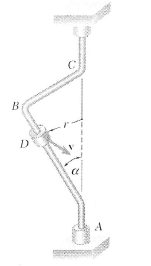
Fig. P12.56
Homework Answers
Given
The mass of the collar D, 

The angle, 


The static friction between the rod and the collar,
Now assuming that the impending motion is in the downward direction

We know that
Acceleration 
By the equilibrium condition


Substituting the known expressions, we get


Now, by the equilibrium condition


Substituting the known expressions


Now, we know that

Substituting the known expressions in the equation (1), we get


By simplifying, we get


Now assuming that the impending motion is in the upward direction

By the equilibrium condition


Substituting the known expressions, we get


By the equilibrium condition


Substituting the known expressions


Now, we know that

Substituting the known expressions in the equation (2)


By simplifying, we get


Therefore, the range of speed is 
Add Answer to:
A small, 200-g collar D can slide on portion AB of a rod which is bent...
300 N 200 mm Fig. P6.138 and 6.138 Rod CD is attached to the collar D...
 300 N 200 mm Fig. P6.138 and 6.138 Rod CD is attached to the collar D and passes through a collar welded to end B of lever AB. Neglecting the effect of friction, determine the couple M required to hold the system in equilibrium when 0 = 30°.
Mmm to B A collar B of mass m is attached to the spring AB and...
 Mmm to B A collar B of mass m is attached to the spring AB and can move along the rod shown. The constant of the spring is k = 1.5 kN/m and the spring is unstretched (neutral) when E=0°. Knowing that the coefficient of static friction between the collar and the rod is 0.40, determine the range of values of m for which equilibrium can be maintained. Please show work and include a free body diagram. Please explain as...
correct answer is 1.pls explain well.. A long horizontal rod has a bead which can slide...
 correct answer is 1.pls explain well..
A long horizontal rod has a bead which can slide along its length and is initially placed at a distance L from one end A of the rod. The rod is set in angular motion about A vwith a constant angular acceleration α. If the coefficient of friction between the rod and bead is μ, and gravity is neglected, then the time after which the bead starts slipping is 关 Ll (4) infinitesimal
correct answer is 1.pls explain well..
A long horizontal rod has a bead which can slide along its length and is initially placed at a distance L from one end A of the rod. The rod is set in angular motion about A vwith a constant angular acceleration α. If the coefficient of friction between the rod and bead is μ, and gravity is neglected, then the time after which the bead starts slipping is 关 Ll (4) infinitesimal
A thin, SQUARE plate of mass M, side length D is rigidly and centrally connected to...
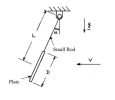 A thin, SQUARE plate of mass M, side length D is rigidly and
centrally connected to a small rigid rod on its top edge. The
plate-rod assembly is hung in a stream of air which blows
horizontally at a constant speed V, and the assembly pivots about a
hinge at the rod’s upper end, as shown. The plate-rod assembly is
well balanced, such that the plate’s top edge is always horizontal.
The whole arrangement is at sea level in standard...
A thin, SQUARE plate of mass M, side length D is rigidly and
centrally connected to a small rigid rod on its top edge. The
plate-rod assembly is hung in a stream of air which blows
horizontally at a constant speed V, and the assembly pivots about a
hinge at the rod’s upper end, as shown. The plate-rod assembly is
well balanced, such that the plate’s top edge is always horizontal.
The whole arrangement is at sea level in standard...
Problem 14.47) Disks A, B, C, and D can ślide freely on a frictionless horizontal surface. Disks B, C, and D are connected by light rods and are at rest in the position shown when disk B is str...
 Problem 14.47) Disks A, B, C, and D can ślide freely on a frictionless horizontal surface. Disks B, C, and D are connected by light rods and are at rest in the position shown when disk B is struck squarely by disk A which is moving to the right with a velocity vo 12 m/s. The masses of the disks are m,-m,-mc - 7.5 kg, and m 15 kg. Knowing that after impact disks A and B are bound togetherV)...
PLEASE EXPLAIN ALL ANSWERS 3 kg vertically cing is 10 kg g is used to frictionless...
 PLEASE EXPLAIN ALL ANSWERS
3 kg vertically cing is 10 kg g is used to frictionless maximum these ag is most 11. Three blocks, A, B, and C. of masses 1, 2, and 3 kg, respectively, are initially at rest on a frictionless surface as indicated in the figure above. What force has to be applied on block C 5= 200 mis? to accelerate the three blocks at 2 m/s? (A) 0.33 N (2) +22) 4362) 16 V=20mis (B) 1.5...
PLEASE EXPLAIN ALL ANSWERS
3 kg vertically cing is 10 kg g is used to frictionless maximum these ag is most 11. Three blocks, A, B, and C. of masses 1, 2, and 3 kg, respectively, are initially at rest on a frictionless surface as indicated in the figure above. What force has to be applied on block C 5= 200 mis? to accelerate the three blocks at 2 m/s? (A) 0.33 N (2) +22) 4362) 16 V=20mis (B) 1.5...
 300 N 200 mm Fig. P6.138 and 6.138 Rod CD is attached to the collar D and passes through a collar welded to end B of lever AB. Neglecting the effect of friction, determine the couple M required to hold the system in equilibrium when 0 = 30°.
 Mmm to B A collar B of mass m is attached to the spring AB and can move along the rod shown. The constant of the spring is k = 1.5 kN/m and the spring is unstretched (neutral) when E=0°. Knowing that the coefficient of static friction between the collar and the rod is 0.40, determine the range of values of m for which equilibrium can be maintained. Please show work and include a free body diagram. Please explain as...
 correct answer is 1.pls explain well..
A long horizontal rod has a bead which can slide along its length and is initially placed at a distance L from one end A of the rod. The rod is set in angular motion about A vwith a constant angular acceleration α. If the coefficient of friction between the rod and bead is μ, and gravity is neglected, then the time after which the bead starts slipping is 关 Ll (4) infinitesimal
correct answer is 1.pls explain well..
A long horizontal rod has a bead which can slide along its length and is initially placed at a distance L from one end A of the rod. The rod is set in angular motion about A vwith a constant angular acceleration α. If the coefficient of friction between the rod and bead is μ, and gravity is neglected, then the time after which the bead starts slipping is 关 Ll (4) infinitesimal
 A thin, SQUARE plate of mass M, side length D is rigidly and
centrally connected to a small rigid rod on its top edge. The
plate-rod assembly is hung in a stream of air which blows
horizontally at a constant speed V, and the assembly pivots about a
hinge at the rod’s upper end, as shown. The plate-rod assembly is
well balanced, such that the plate’s top edge is always horizontal.
The whole arrangement is at sea level in standard...
A thin, SQUARE plate of mass M, side length D is rigidly and
centrally connected to a small rigid rod on its top edge. The
plate-rod assembly is hung in a stream of air which blows
horizontally at a constant speed V, and the assembly pivots about a
hinge at the rod’s upper end, as shown. The plate-rod assembly is
well balanced, such that the plate’s top edge is always horizontal.
The whole arrangement is at sea level in standard...
 Problem 14.47) Disks A, B, C, and D can ślide freely on a frictionless horizontal surface. Disks B, C, and D are connected by light rods and are at rest in the position shown when disk B is struck squarely by disk A which is moving to the right with a velocity vo 12 m/s. The masses of the disks are m,-m,-mc - 7.5 kg, and m 15 kg. Knowing that after impact disks A and B are bound togetherV)...
 PLEASE EXPLAIN ALL ANSWERS
3 kg vertically cing is 10 kg g is used to frictionless maximum these ag is most 11. Three blocks, A, B, and C. of masses 1, 2, and 3 kg, respectively, are initially at rest on a frictionless surface as indicated in the figure above. What force has to be applied on block C 5= 200 mis? to accelerate the three blocks at 2 m/s? (A) 0.33 N (2) +22) 4362) 16 V=20mis (B) 1.5...
PLEASE EXPLAIN ALL ANSWERS
3 kg vertically cing is 10 kg g is used to frictionless maximum these ag is most 11. Three blocks, A, B, and C. of masses 1, 2, and 3 kg, respectively, are initially at rest on a frictionless surface as indicated in the figure above. What force has to be applied on block C 5= 200 mis? to accelerate the three blocks at 2 m/s? (A) 0.33 N (2) +22) 4362) 16 V=20mis (B) 1.5...
Most questions answered within 3 hours.
-
Where is the error in this code sequence?
String s1 = "Hello";
String s2 = "ello";...
asked 10 months ago -
Financial data for Joel de Paris, Inc., for last year
follow:
Joel de Paris, Inc.
Balance...
asked 10 months ago -
Consider this reaction:
Al2(SO4)3 (aq)+ BaCl3
(aq) Al2Cl6 (aq)- +
3BaSO4(s) . What is the...
asked 10 months ago -
Suppose that Savneet is considering increasing her
recent random sample from 20 car rentals to 40...
asked 10 months ago -
Trucks arrive at an unloading terminal at an average rate of 120
per hour.
Trucks arrive...
asked 10 months ago -
Why are methanol and ethanol completely soluble in water while
octanol is not very little soluble....
asked 10 months ago -
A facilities manager at a university reads in a research report
that the mean amount of...
asked 10 months ago -
When the CuSO4 is rehydrated by adding water to the anhydrous
compound, is this an endothermic...
asked 10 months ago -
A ray of sunlight is passing from diamond into crown glass; the
angle of incidence is...
asked 10 months ago -
A block of mass 0.249 kg is placed on top of a light, vertical
spring of...
asked 10 months ago -
how do the kidneys compensate in the presences of acidosis
a) trigger hyperventilate
b) reserve acid...
asked 10 months ago -
Question 501 pts
The rental rate of capital to the firm increases. Which of the
following...
asked 10 months ago