
Homework Answers
11) A) Igneous rock
When magma rises from deep within the earth and explodes out of a volcano, it is called lava, and it cools quickly on the surface.Rock formed in this way is called extrusive igneous rock. It is extruded, or pushed, out of the earth's interior and cools outside of or very near the earth's surface.
12) C.Diagenesis
It is the change of sedimentary rock into different sedimentary
rocks during the rock formation at the temperatures and pressures
less than that required for the formation of metamorphic rocks
13) C) Detrital
It is also known as clastic, sedimentary rocks are composed of rock fragments.they are different from chemical sedimentary rocks which are composed of mineral crystals
14) B)Contact
Contact metamorphism occurs adjacent to igneous intrusions and results from high temperatures associated with the igneous intrusion.Since only a small area surrounding the intrusion is heated by the magma, metamorphism is restricted to the zone surrounding the intrusion, called a metamorphic or contact aureole.
15) D.Texture
The mineral assemblages that occur in metamorphic rocks depend
on four factors:
The bulk chemical composition of the original rock.
The pressure reached during metamorphism.
The temperature reached during metamorphism.
The composition of any fluid phase that was present during metamorphism.
Add Answer to:
If the pressure and temperature on a rock increases to a point where the rock melts...
5. Thermal (contact) metamorphism occurs a) in areas surrounding igneous intrusions (magma bodies) b) only where...
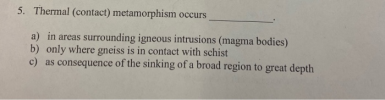 5. Thermal (contact) metamorphism occurs a) in areas surrounding igneous intrusions (magma bodies) b) only where gneiss is in contact with schist c) as consequence of the sinking of a broad region to great depth 2. Igneous rocks can form deep underground or at the surface. a) True b) False
1. Endogenic processes include a. Internal processes b. Volcanic activity c. Tectonic activity d. All of the above 2. Wh...
1. Endogenic processes include a. Internal processes b. Volcanic activity c. Tectonic activity d. All of the above 2. Which of these is not a exogenic process a. Weathering b. erosion c. volcanic activity d. mass wasting 3. The continents and ocean basins are located in the: a. Crust b. Mantle c. Core d. Asthenosphere 4. The oceanic crust is __________ and __________ than continental crust. a. thicker; denser b. thinner; denser c. thicker; less dense d. thinner; less dense...
The textures of igneous rocks, sedimentary rocks, and metamorphic rocks are all described with different terminology. That is, you cannot describe the texture of a sedimentary rock with the terms use...
 The textures of igneous rocks, sedimentary rocks, and metamorphic rocks are all described with different terminology. That is, you cannot describe the texture of a sedimentary rock with the terms used to describe textures of igneous rocks. Bearing this in mind, please sort the terms below pertaining to rock textures into the three rock classes. lgneous rocks have textures that are either comprised of interlocking crystals, or textures that resulted from the cooling of hot liquid material. Sedimentary rocks have...
Metamorphism occurs when _____. mountain ranges are lifted up and eroded. rocks are heated to such...
Metamorphism occurs when _____. mountain ranges are lifted up and eroded. rocks are heated to such a high temperature that they begin to melt. water evaporates from a large body of water at the surface of Earth. solid rock changes in composition and/or texture without the mineral crystals melting. At what temperature will metamorphism begin? 200 degrees Celsius 3,000 kbars 1,000 bars 2,000 degrees Celsius Differential stress (pressure) can cause _______. cause minerals to grow larger cause new minerals to...
Match the terms/concepts listed below with the appropriate blank concept boxes on the three accompanying, linked metamorphic rock concept maps. marble internally layered (foliated) not layered (...
 Match the terms/concepts listed below with the appropriate blank concept boxes on the three accompanying, linked metamorphic rock concept maps. marble internally layered (foliated) not layered (nonfoliated slate quartzite quartz sandstone (a sed. rock) limestone (a sed. rock) schist gneiss deep beneath earth's surface inside mountain ranges in and around hot igneous bodies alteration of physical/chemical properties of other rocks shale (a sedimentary rock) water content pressure during formation temperature during formation Metamorphic Rocks classified by form by texturemineral content...
6. View the metamorphic rock below. It does NOT fizz in HCL (acid). It has a...
 6. View the metamorphic rock below. It does NOT fizz in HCL
(acid). It has a _____________ texture.
a. non foliated
b. foliated
c. No answer text provided.
d. No answer text provided.
7. View the metamorphic rock from Question 6. It is a
_________.
a. quartzite
b. slate
c. schist
d. marble
e. gneiss
8. The half-life of chlorine-36 is 301,000 years. How much of an
800 g sample is left after 903,000 years?
a. 100 g
b. 400...
6. View the metamorphic rock below. It does NOT fizz in HCL
(acid). It has a _____________ texture.
a. non foliated
b. foliated
c. No answer text provided.
d. No answer text provided.
7. View the metamorphic rock from Question 6. It is a
_________.
a. quartzite
b. slate
c. schist
d. marble
e. gneiss
8. The half-life of chlorine-36 is 301,000 years. How much of an
800 g sample is left after 903,000 years?
a. 100 g
b. 400...
20% L Help Window People Bookmarks G 31. Bb filedownload.ashx New Tab N Netflix X abarrus.k12.nc.us/site/handlers/filedownload.ashx?moduleinstanceid...
 20% L Help Window People Bookmarks G 31. Bb filedownload.ashx New Tab N Netflix X abarrus.k12.nc.us/site/handlers/filedownload.ashx?moduleinstanceid 45715&dataid-116286&FileName Ouestions 61 and 62 refer to the following diagram. Ocean surface Sediment and remains of dead organisms Erosion and weathering Sea bed Rock A Rock C Heat and pressure Melting and cooling Rock B 61. Which of the following gives the correct sequence in the rock eyele shows above 62. Which of the following rock types would contain the greatest number of fossils?...
QUESTION 4 [c] metamorphism occurs when magma intrudes on cooler rock at a shallow depth. QUESTION...
 QUESTION 4 [c] metamorphism occurs when magma intrudes on cooler rock at a shallow depth. QUESTION 5 Match the metamorphic rock to the type of metamorphism that produced the rock. - Serpentinite and soapstone A. Contact B. Regional - Gneiss C. Contact or Regional • Hornfels D. Subduction Zone - Marble E. Dynamic F. Hydrothermal QUESTION 6 Parallel re-alignment of inequant minerals under the effects of differential stress creates a metan texture known as [a]. Click Save and Submit to...
the rocks used for image 5 is a Gneiss with folds. figure 6 is Marble with...
 the rocks used for image 5 is a Gneiss with folds. figure 6 is
Marble with graphite. figure 11 is Schist with garnet
prophyoblasts.
Part II Questions 1. Analyze the rock sample in figure 5. The parent rock for this comerherock hade Layers that were folded during metamorphin Describes process that could account for how this rigid gneiss was folded without breaking during regionalnomorphism. Het How could you benda candlestick without breaking in 2. Analyze the metamorphic rock sample pictured...
the rocks used for image 5 is a Gneiss with folds. figure 6 is
Marble with graphite. figure 11 is Schist with garnet
prophyoblasts.
Part II Questions 1. Analyze the rock sample in figure 5. The parent rock for this comerherock hade Layers that were folded during metamorphin Describes process that could account for how this rigid gneiss was folded without breaking during regionalnomorphism. Het How could you benda candlestick without breaking in 2. Analyze the metamorphic rock sample pictured...
Lab Exercise Lab Exercise: Identification of Metamorphic Rocks la this laboratory exercise, you will identify the...
 Lab Exercise Lab Exercise: Identification of Metamorphic Rocks la this laboratory exercise, you will identify the most common metamorphic rocks based on their texture and composition. Feel free to download the Metamorphic Rocks Photo Guide from the online supplement to help you make your identification. Instructions Step 1: Retrieve the bag labeled Lab #8 Metamorphic Rock Samples from your lab kit. and place the specimens (numbered 18 through 25) on a white sheet of paper. Step 2: Determine the identity...
 5. Thermal (contact) metamorphism occurs a) in areas surrounding igneous intrusions (magma bodies) b) only where gneiss is in contact with schist c) as consequence of the sinking of a broad region to great depth 2. Igneous rocks can form deep underground or at the surface. a) True b) False
 The textures of igneous rocks, sedimentary rocks, and metamorphic rocks are all described with different terminology. That is, you cannot describe the texture of a sedimentary rock with the terms used to describe textures of igneous rocks. Bearing this in mind, please sort the terms below pertaining to rock textures into the three rock classes. lgneous rocks have textures that are either comprised of interlocking crystals, or textures that resulted from the cooling of hot liquid material. Sedimentary rocks have...
 Match the terms/concepts listed below with the appropriate blank concept boxes on the three accompanying, linked metamorphic rock concept maps. marble internally layered (foliated) not layered (nonfoliated slate quartzite quartz sandstone (a sed. rock) limestone (a sed. rock) schist gneiss deep beneath earth's surface inside mountain ranges in and around hot igneous bodies alteration of physical/chemical properties of other rocks shale (a sedimentary rock) water content pressure during formation temperature during formation Metamorphic Rocks classified by form by texturemineral content...
 6. View the metamorphic rock below. It does NOT fizz in HCL
(acid). It has a _____________ texture.
a. non foliated
b. foliated
c. No answer text provided.
d. No answer text provided.
7. View the metamorphic rock from Question 6. It is a
_________.
a. quartzite
b. slate
c. schist
d. marble
e. gneiss
8. The half-life of chlorine-36 is 301,000 years. How much of an
800 g sample is left after 903,000 years?
a. 100 g
b. 400...
6. View the metamorphic rock below. It does NOT fizz in HCL
(acid). It has a _____________ texture.
a. non foliated
b. foliated
c. No answer text provided.
d. No answer text provided.
7. View the metamorphic rock from Question 6. It is a
_________.
a. quartzite
b. slate
c. schist
d. marble
e. gneiss
8. The half-life of chlorine-36 is 301,000 years. How much of an
800 g sample is left after 903,000 years?
a. 100 g
b. 400...
 20% L Help Window People Bookmarks G 31. Bb filedownload.ashx New Tab N Netflix X abarrus.k12.nc.us/site/handlers/filedownload.ashx?moduleinstanceid 45715&dataid-116286&FileName Ouestions 61 and 62 refer to the following diagram. Ocean surface Sediment and remains of dead organisms Erosion and weathering Sea bed Rock A Rock C Heat and pressure Melting and cooling Rock B 61. Which of the following gives the correct sequence in the rock eyele shows above 62. Which of the following rock types would contain the greatest number of fossils?...
 QUESTION 4 [c] metamorphism occurs when magma intrudes on cooler rock at a shallow depth. QUESTION 5 Match the metamorphic rock to the type of metamorphism that produced the rock. - Serpentinite and soapstone A. Contact B. Regional - Gneiss C. Contact or Regional • Hornfels D. Subduction Zone - Marble E. Dynamic F. Hydrothermal QUESTION 6 Parallel re-alignment of inequant minerals under the effects of differential stress creates a metan texture known as [a]. Click Save and Submit to...
 the rocks used for image 5 is a Gneiss with folds. figure 6 is
Marble with graphite. figure 11 is Schist with garnet
prophyoblasts.
Part II Questions 1. Analyze the rock sample in figure 5. The parent rock for this comerherock hade Layers that were folded during metamorphin Describes process that could account for how this rigid gneiss was folded without breaking during regionalnomorphism. Het How could you benda candlestick without breaking in 2. Analyze the metamorphic rock sample pictured...
the rocks used for image 5 is a Gneiss with folds. figure 6 is
Marble with graphite. figure 11 is Schist with garnet
prophyoblasts.
Part II Questions 1. Analyze the rock sample in figure 5. The parent rock for this comerherock hade Layers that were folded during metamorphin Describes process that could account for how this rigid gneiss was folded without breaking during regionalnomorphism. Het How could you benda candlestick without breaking in 2. Analyze the metamorphic rock sample pictured...
 Lab Exercise Lab Exercise: Identification of Metamorphic Rocks la this laboratory exercise, you will identify the most common metamorphic rocks based on their texture and composition. Feel free to download the Metamorphic Rocks Photo Guide from the online supplement to help you make your identification. Instructions Step 1: Retrieve the bag labeled Lab #8 Metamorphic Rock Samples from your lab kit. and place the specimens (numbered 18 through 25) on a white sheet of paper. Step 2: Determine the identity...
Most questions answered within 3 hours.
-
Where is the error in this code sequence?
String s1 = "Hello";
String s2 = "ello";...
asked 10 months ago -
Financial data for Joel de Paris, Inc., for last year
follow:
Joel de Paris, Inc.
Balance...
asked 10 months ago -
Consider this reaction:
Al2(SO4)3 (aq)+ BaCl3
(aq) Al2Cl6 (aq)- +
3BaSO4(s) . What is the...
asked 10 months ago -
Suppose that Savneet is considering increasing her
recent random sample from 20 car rentals to 40...
asked 10 months ago -
Trucks arrive at an unloading terminal at an average rate of 120
per hour.
Trucks arrive...
asked 10 months ago -
Why are methanol and ethanol completely soluble in water while
octanol is not very little soluble....
asked 10 months ago -
A facilities manager at a university reads in a research report
that the mean amount of...
asked 10 months ago -
When the CuSO4 is rehydrated by adding water to the anhydrous
compound, is this an endothermic...
asked 10 months ago -
A ray of sunlight is passing from diamond into crown glass; the
angle of incidence is...
asked 10 months ago -
A block of mass 0.249 kg is placed on top of a light, vertical
spring of...
asked 10 months ago -
how do the kidneys compensate in the presences of acidosis
a) trigger hyperventilate
b) reserve acid...
asked 10 months ago -
Question 501 pts
The rental rate of capital to the firm increases. Which of the
following...
asked 10 months ago