
Homework Answers
Add Answer to:
the
title of the experiment is volume of a solid cylinder.
2. State the type of...
Please solve both questions For question #2 the metal we used was brass and it weighed...
 Please solve both questions
For question #2 the metal we used was brass and it weighed
8.6g/mL
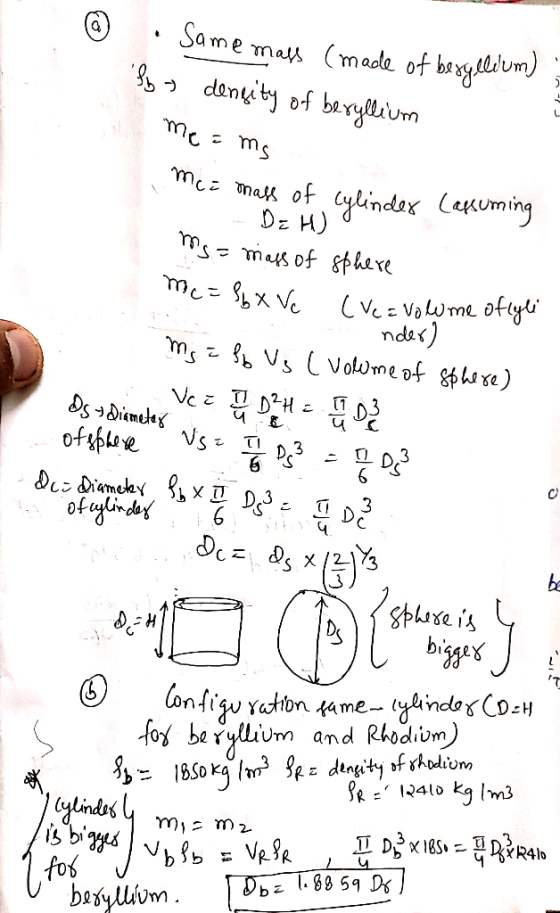
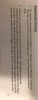
Supplemental Exercises 1. The densities of magnesium and palladium are 1740 kg/m3 and 11900 kg/m respectively [This data was taken from www.webelemen om.] Convert these densities to units of g/mL. 2. type of metal you used in the experiment. If the cylinder used in this experiment had been made of magnesium, but had the same mass, would it have been bigger smaller? If...
Please solve both questions
For question #2 the metal we used was brass and it weighed
8.6g/mL
Supplemental Exercises 1. The densities of magnesium and palladium are 1740 kg/m3 and 11900 kg/m respectively [This data was taken from www.webelemen om.] Convert these densities to units of g/mL. 2. type of metal you used in the experiment. If the cylinder used in this experiment had been made of magnesium, but had the same mass, would it have been bigger smaller? If...
A solid sphere and a solid cylinder are made of the same material. If they have...
A solid sphere and a solid cylinder are made of the same material. If they have the same mass and radius, which one has the larger rotational inertia about its center? (a) the sphere (b) the cylinder (c) They are the same ...help.
10. A hoop, solid sphere, and solid cylinder each have the same mass and same radius....
10. A hoop, solid sphere, and solid cylinder each have the same mass and same radius. When rolling down the same incline, which has the greatest torque from gravity on it? a. the hoop b. the sphere c. the cylinder d. They all have the same torque.
4. Suppose that a student performed the experiment and calculations perfectly as directed except that, unknown...
 4. Suppose that a student performed the experiment and calculations perfectly as directed except that, unknown to the student, the balance was not zeroed but weighed 0.100 g too high throughout the experiment. Would the calculated val- ue for the density of the unknown liquid be correct? That is, would it be equal to, higher than, or lower than the true value. Explain your answer in clear and correct English. 16 LABORATORY EXPERIMENTS IN GENERAL CHEMISTRY ed in question 4...
1. An experiment is performed in the lab, where the mass and the volume of an...
1. An experiment is performed in the lab, where the mass and the volume of an object are measured to determine its density. Two completely different valid methods are used. Each experimental method to measure the density is performed, two considerable sets of data are taken on each and the results are compared. The results of the density measurement by each method should be ... a. dependent on the mass and the volume of the object b. completely different, because...
no Design a simple experiment to determine which type of volumetric glassware is the most accurate...
 no Design a simple experiment to determine which type of volumetric glassware is the most accurate and the most precise at delivering a given volume. Your experiment must incorporate the following materials: analytical balance, distilled water, and a separate beaker used for mass measurements. Hint: Design your experiment around a physical property of water. (3) Be sure to explain which calculations you will perform in your experiment to determine accuracy and precision. (2)
2. Rolling down the hill (a) A solid cylinder of mass 1.0 kg and radius 10...
 2. Rolling down the hill (a) A solid cylinder of mass 1.0 kg and radius 10 cm starts from rest and rolls without slipping down a 1.0 m-high inclined plane. What is the speed of the cylinder when it reaches the bottom of the inclined plane? (b) How about a solid sphere of the same mass and radius? (c) How about a hoop of the same mass and radius? (d) Which of the above objects is moving fastest when it...
answer all parts: 2. You measured the volume of the CO2 by filling your flask with...
answer all parts: 2. You measured the volume of the CO2 by filling your flask with water and tightly inserting the stopper. a. Why was it necessary to tightly stop the water-filled flask and then remove the stopper before you emptied the water into a graduated cylinder for measurement? b. Would your calculated molar volume of CO2 (Vm) have been higher or lower if you had forgotten to stopper the flask before measuring the volume of the flask (V1)? Briefly...
The density experiment involves taking average mass and displaced volume measurements for multiple samples of metal....
 The density experiment involves taking average mass and displaced volume measurements for multiple samples of metal. A student ascertained that the identity of their unknown metal was zinc (d 7.14 g/mL). However, upon consulting their teaching assistant, they learned that the true identity of the metal was copper (d = 8.96 g/mL). What error could the student have made when performing the experiment that would have led to the student's original conclusion? 7.
DISCUSSION QUESTIONS 1. If the liquid did not completely vaporize in the experiment, would the ap-...
 DISCUSSION QUESTIONS 1. If the liquid did not completely vaporize in the experiment, would the ap- parent molecular weight be larger, smaller, or unchanged compared to that determined if the experiment had been properly performed? Would the error in part (1) have a larger, smaller, or the same effect as the errors that might be made in measuring the temperature of the water in the flask, the barometric pressure, or the volume of the flask? Explain your answer. 2. What...
 Please solve both questions
For question #2 the metal we used was brass and it weighed
8.6g/mL
Supplemental Exercises 1. The densities of magnesium and palladium are 1740 kg/m3 and 11900 kg/m respectively [This data was taken from www.webelemen om.] Convert these densities to units of g/mL. 2. type of metal you used in the experiment. If the cylinder used in this experiment had been made of magnesium, but had the same mass, would it have been bigger smaller? If...
Please solve both questions
For question #2 the metal we used was brass and it weighed
8.6g/mL
Supplemental Exercises 1. The densities of magnesium and palladium are 1740 kg/m3 and 11900 kg/m respectively [This data was taken from www.webelemen om.] Convert these densities to units of g/mL. 2. type of metal you used in the experiment. If the cylinder used in this experiment had been made of magnesium, but had the same mass, would it have been bigger smaller? If...
 4. Suppose that a student performed the experiment and calculations perfectly as directed except that, unknown to the student, the balance was not zeroed but weighed 0.100 g too high throughout the experiment. Would the calculated val- ue for the density of the unknown liquid be correct? That is, would it be equal to, higher than, or lower than the true value. Explain your answer in clear and correct English. 16 LABORATORY EXPERIMENTS IN GENERAL CHEMISTRY ed in question 4...
 no Design a simple experiment to determine which type of volumetric glassware is the most accurate and the most precise at delivering a given volume. Your experiment must incorporate the following materials: analytical balance, distilled water, and a separate beaker used for mass measurements. Hint: Design your experiment around a physical property of water. (3) Be sure to explain which calculations you will perform in your experiment to determine accuracy and precision. (2)
 2. Rolling down the hill (a) A solid cylinder of mass 1.0 kg and radius 10 cm starts from rest and rolls without slipping down a 1.0 m-high inclined plane. What is the speed of the cylinder when it reaches the bottom of the inclined plane? (b) How about a solid sphere of the same mass and radius? (c) How about a hoop of the same mass and radius? (d) Which of the above objects is moving fastest when it...
 The density experiment involves taking average mass and displaced volume measurements for multiple samples of metal. A student ascertained that the identity of their unknown metal was zinc (d 7.14 g/mL). However, upon consulting their teaching assistant, they learned that the true identity of the metal was copper (d = 8.96 g/mL). What error could the student have made when performing the experiment that would have led to the student's original conclusion? 7.
 DISCUSSION QUESTIONS 1. If the liquid did not completely vaporize in the experiment, would the ap- parent molecular weight be larger, smaller, or unchanged compared to that determined if the experiment had been properly performed? Would the error in part (1) have a larger, smaller, or the same effect as the errors that might be made in measuring the temperature of the water in the flask, the barometric pressure, or the volume of the flask? Explain your answer. 2. What...
Most questions answered within 3 hours.
-
Where is the error in this code sequence?
String s1 = "Hello";
String s2 = "ello";...
asked 11 months ago -
Financial data for Joel de Paris, Inc., for last year
follow:
Joel de Paris, Inc.
Balance...
asked 11 months ago -
Consider this reaction:
Al2(SO4)3 (aq)+ BaCl3
(aq) Al2Cl6 (aq)- +
3BaSO4(s) . What is the...
asked 11 months ago -
Suppose that Savneet is considering increasing her
recent random sample from 20 car rentals to 40...
asked 11 months ago -
Trucks arrive at an unloading terminal at an average rate of 120
per hour.
Trucks arrive...
asked 11 months ago -
Why are methanol and ethanol completely soluble in water while
octanol is not very little soluble....
asked 11 months ago -
A facilities manager at a university reads in a research report
that the mean amount of...
asked 11 months ago -
When the CuSO4 is rehydrated by adding water to the anhydrous
compound, is this an endothermic...
asked 11 months ago -
A ray of sunlight is passing from diamond into crown glass; the
angle of incidence is...
asked 11 months ago -
A block of mass 0.249 kg is placed on top of a light, vertical
spring of...
asked 11 months ago -
how do the kidneys compensate in the presences of acidosis
a) trigger hyperventilate
b) reserve acid...
asked 11 months ago -
Question 501 pts
The rental rate of capital to the firm increases. Which of the
following...
asked 11 months ago