
Homework Answers
a.
| Year | Scenario 1 | Scenario 2 |
| 0 | $0.00 | $0.00 |
| 1 | $56,250.00 | $225,000.00 |
| 2 | $56,250.00 | $0.00 |
| 3 | $56,250.00 | $0.00 |
| 4 | $56,250.00 | $0.00 |
b.
| Year | Scenario 1 | Scenario 2 | Tax saving scenario 1 | Tax saving scenario 2 | Discount factor | PV scenario 1 | PV scenario 2 |
| 0 | $0.00 | $0.00 | 0 | 0 | 0.12 | 0 | 0 |
| 1 | $56,250.00 | $225,000.00 | $16,875.00 | $67,500.00 | 0.12 | $15,066.96 | $60,267.86 |
| 2 | $56,250.00 | $0.00 | $16,875.00 | $0.00 | 0.12 | $13,452.65 | $0.00 |
| 3 | $56,250.00 | $0.00 | $16,875.00 | $0.00 | 0.12 | $12,011.29 | $0.00 |
| 4 | $56,250.00 | $0.00 | $16,875.00 | $0.00 | 0.12 | $10,724.37 | $0.00 |
| NPV | $51,255.27 | $60,267.86 |
100% bonus depreciation has higher NPV.
$9,012.59 higher NPV in 100% bonus depreciaion.
Add Answer to:
Charlene is evaluating a capital budgeting project that should last for 4 years. The project requires...
Charlene is evaluating a capital budgeting project that should last for 4 years. The project requires...
Charlene is evaluating a capital budgeting project that should last for 4 years. The project requires $900,000 of equipment and is eligible for 100% bonus depreciation. She is unsure whether immediately expensing the equipment or using straight-line depreciation is better for the analysis. Under straight-line depreciation, the cost of the equipment would be depreciated evenly over its 4-year life (ignore the half-year convention for the straight-line method). The company's WACC is 8%, and its tax rate is 20%. What would...
Charlene is evaluating a capital budgeting project that should last for 4 years. The project requires...
Charlene is evaluating a capital budgeting project that should last for 4 years. The project requires $950,000 of equipment and is eligible for 100% bonus depreciation. She is unsure whether immediately expensing the equipment or using straight-line depreciation is better for the analysis. Under straight-line depreciation, the cost of the equipment would be depreciated evenly over its 4-year life (ignore the half-year convention for the straight-line method). The company's WACC is 10%, and its tax rate is 30%. What would...
Charlene is evaluating a capital budgeting project that should last for 4 years. The project requires...
Charlene is evaluating a capital budgeting project that should last for 4 years. The project requires $475,000 of equipment and is eligible for 100% bonus depreciation. She is unsure whether immediately expensing the equipment or using straight-line depreciation is better for the analysis. Under straight-line depreciation, the cost of the equipment would be depreciated evenly over its 4-year life (ignore the half-year convention for the straight-line method). The company's WACC is 8%, and its tax rate is 20%. a. What...
Charlene is evaluating a capital budgeting project that should last for 4 years. The project requires...
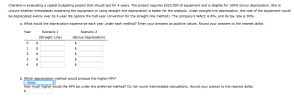 Charlene is evaluating a capital budgeting project that should last for 4 years. The project requires $325,000 of equipment and is eligible for 100% bonus depreciation. She is unsure whether immediately expensing the equipment or using straight-line depreciation is better for the analysis. Under straight-line depreciation, the cost of the equipment would be depreciated evenly over its 4-year life (ignore the half-year convention for the straight-line method). The company's WACC is 8%, and its tax rate is 30%. a. What...
Charlene is evaluating a capital budgeting project that should last for 4 years. The project requires $125,000 of equipm...
Charlene is evaluating a capital budgeting project that should last for 4 years. The project requires $125,000 of equipment and is eligible for 100% bonus depreciation. She is unsure whether immediately expensing the equipment or using straight-line depreciation is better for the analysis. Under straight-line depreciation, the cost of the equipment would be depreciated evenly over its 4-year life (ignore the half-year convention for the straight-line method). The company's WACC is 9%, and its tax rate is 25%. What would...
5. Problem 12.06 (Depreciation Methods) eBook Charlene is evaluating a capital budgeting project that should last...
 5. Problem 12.06 (Depreciation Methods) eBook Charlene is evaluating a capital budgeting project that should last for 4 years. The project requires $250,000 of equipment and is eligible for 100% bonus depreciation. She is unsure whether immediately expensing the equipment or using straight-line depreciation is better for the analysis. Under straight-line depreciation, the cost of the equipment would be depreciated evenly over its 4-year life (ignore the half-year convention for the straight-line method). The company's WACC is 10%, and its...
5. Problem 12.06 (Depreciation Methods) eBook Charlene is evaluating a capital budgeting project that should last...
 5. Problem 12.06 (Depreciation Methods) eBook Charlene is evaluating a capital budgeting project that should last for 4 years. The project requires $975,000 of equipment and is eligible for 100% bonus depreciation. She is unsure whether immediately expensing the equipment or using straight-line depreciation is better for the analysis. Under straight-line depreciation, the cost of the equipment would be depreciated evenly over its 4-year life (ignore the half-year convention for the straight-line method). The company's WACC is 8%, and its...
Charlene is evaluating a capital budgeting project that should last for 4 years. The project requires...
Charlene is evaluating a capital budgeting project that should last for 4 years. The project requires $525,000 of equipment. She is unsure what depreciation method to use in her analysis, straight-line or the 3-year MACRS accelerated method. Under straight-line depreciation, the cost of the equipment would be depreciated evenly over its 4-year life (ignore the half-year convention for the straight-line method). The applicable MACRS depreciation rates are 33%, 45%, 15%, and 7%. The company's WACC is 13%, and its tax...
Charlene is evaluating a capital budgeting project that should last for 4 years. The project requires...
 Charlene is evaluating a capital budgeting project that should last for 4 years. The project requires $900,000 of equipment. She is unsure what depreciation method to use in her analysis, straight-line or the 3-year MACRS accelerated method. Under straight-line depreciation, the cost of the equipment would be depreciated evenly over its 4-year life (ignore the half-year convention for the straight-line method). The applicable MACRS depreciation rates are 33%, 45%, 15%, and 7%. The company's WACC is 11%, and its tax...
Charlene is evaluating a capital budgeting project that should last for 4 years. The project requires...
 Charlene is evaluating a capital budgeting project that should last for 4 years. The project requires $975,000 of equipment. She is unsure what depreciation method to use in her analysis, straight-line or the 3-year MACRS accelerated method. Under straight-line depreciation, the cost of the equipment would be depreciated evenly over its 4-year life (ignore the half-year convention for the straight-line method). The applicable MACRS depreciation rates are 33%, 45%, 15%, and 7%. The company's WACC is 10%, and its tax...
 Charlene is evaluating a capital budgeting project that should last for 4 years. The project requires $325,000 of equipment and is eligible for 100% bonus depreciation. She is unsure whether immediately expensing the equipment or using straight-line depreciation is better for the analysis. Under straight-line depreciation, the cost of the equipment would be depreciated evenly over its 4-year life (ignore the half-year convention for the straight-line method). The company's WACC is 8%, and its tax rate is 30%. a. What...
 5. Problem 12.06 (Depreciation Methods) eBook Charlene is evaluating a capital budgeting project that should last for 4 years. The project requires $250,000 of equipment and is eligible for 100% bonus depreciation. She is unsure whether immediately expensing the equipment or using straight-line depreciation is better for the analysis. Under straight-line depreciation, the cost of the equipment would be depreciated evenly over its 4-year life (ignore the half-year convention for the straight-line method). The company's WACC is 10%, and its...
 5. Problem 12.06 (Depreciation Methods) eBook Charlene is evaluating a capital budgeting project that should last for 4 years. The project requires $975,000 of equipment and is eligible for 100% bonus depreciation. She is unsure whether immediately expensing the equipment or using straight-line depreciation is better for the analysis. Under straight-line depreciation, the cost of the equipment would be depreciated evenly over its 4-year life (ignore the half-year convention for the straight-line method). The company's WACC is 8%, and its...
 Charlene is evaluating a capital budgeting project that should last for 4 years. The project requires $900,000 of equipment. She is unsure what depreciation method to use in her analysis, straight-line or the 3-year MACRS accelerated method. Under straight-line depreciation, the cost of the equipment would be depreciated evenly over its 4-year life (ignore the half-year convention for the straight-line method). The applicable MACRS depreciation rates are 33%, 45%, 15%, and 7%. The company's WACC is 11%, and its tax...
 Charlene is evaluating a capital budgeting project that should last for 4 years. The project requires $975,000 of equipment. She is unsure what depreciation method to use in her analysis, straight-line or the 3-year MACRS accelerated method. Under straight-line depreciation, the cost of the equipment would be depreciated evenly over its 4-year life (ignore the half-year convention for the straight-line method). The applicable MACRS depreciation rates are 33%, 45%, 15%, and 7%. The company's WACC is 10%, and its tax...
Most questions answered within 3 hours.
-
Where is the error in this code sequence?
String s1 = "Hello";
String s2 = "ello";...
asked 10 months ago -
Financial data for Joel de Paris, Inc., for last year
follow:
Joel de Paris, Inc.
Balance...
asked 10 months ago -
Consider this reaction:
Al2(SO4)3 (aq)+ BaCl3
(aq) Al2Cl6 (aq)- +
3BaSO4(s) . What is the...
asked 10 months ago -
Suppose that Savneet is considering increasing her
recent random sample from 20 car rentals to 40...
asked 10 months ago -
Trucks arrive at an unloading terminal at an average rate of 120
per hour.
Trucks arrive...
asked 10 months ago -
Why are methanol and ethanol completely soluble in water while
octanol is not very little soluble....
asked 10 months ago -
A facilities manager at a university reads in a research report
that the mean amount of...
asked 10 months ago -
When the CuSO4 is rehydrated by adding water to the anhydrous
compound, is this an endothermic...
asked 10 months ago -
A ray of sunlight is passing from diamond into crown glass; the
angle of incidence is...
asked 10 months ago -
A block of mass 0.249 kg is placed on top of a light, vertical
spring of...
asked 10 months ago -
how do the kidneys compensate in the presences of acidosis
a) trigger hyperventilate
b) reserve acid...
asked 10 months ago -
Question 501 pts
The rental rate of capital to the firm increases. Which of the
following...
asked 10 months ago