1. In the introduction the crossed-adol condensation reaction to produce dibenzalacetone is discussed. This reaction require 1 equivalent of acetone for every 2 equivalents of benzaldehyde to produce the desired product. What side product would you expect if not enough acetone was used?
2. What reagents and in what equivalent would you use to synthesize
benzalacetophenone?
3. How would you synthesize 2-ethylhex-2-en-1-ol from butanal?
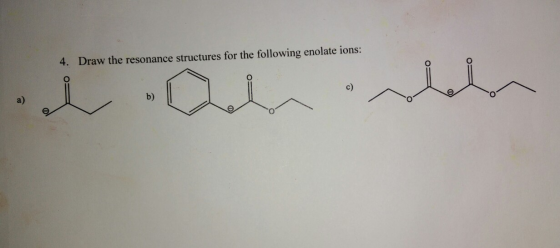
4. Draw the resonance structure for the following enolate ions:
Homework Answers

Add Answer to:
1. In the introduction the crossed-adol condensation reaction to
produce dibenzalacetone is discussed. This reaction require...
Full mechanism of reaction needed: A double crossed aldol condensation reaction will be carried out. The...
Full mechanism of reaction needed: A double crossed aldol condensation reaction will be carried out. The reaction uses the simple starting materials, acetone and benzaldehyde, to form the 17-carbon product known as dibenzalacetone.
give the mechanism of the adol condensation reaction between 2 mola of benzaldehyde and 1 mol...
give the mechanism of the adol condensation reaction between 2 mola of benzaldehyde and 1 mol acetone. show all the intermediates and steps. there should be 10 steps
Dibenzalacetone Synthesis PURPOSE: purpose of this lab exercise is to synthesize dibenzalacetone by means of an...
 Dibenzalacetone Synthesis PURPOSE: purpose of this lab exercise is to synthesize dibenzalacetone by means of an aldol condition. INTRODUCTION: Wow, is it wet in here or what? That's what happens when you condense, right? No, that is not right, you say! You can condense things without getting wet in organic chemistry. Think about aldol condensations, you tell me. Yes. yes..of course you are correct: organic condensations dont get you wet. They get you a new product. Silly me Aldol condensation...
what is the theoretical yield of anisalacetophenone and dibenzalacetone formed? thank you. The Aldol Condensation Precautions:...
 what is the theoretical yield of anisalacetophenone and
dibenzalacetone formed? thank you.
The Aldol Condensation Precautions: Acetone, ethanol and acetophenone are flammable; work in a fume hood. Sodium hydroxide is a strong base and can cause severe skin burns and eye damage. Safety goggles are required. Gloves are recommended. Purpose To carry out two Aldol condensation reactions in which no heat is needed to obtain the condensation product. The two reactions differ in the number of enolizable protons at the...
what is the theoretical yield of anisalacetophenone and
dibenzalacetone formed? thank you.
The Aldol Condensation Precautions: Acetone, ethanol and acetophenone are flammable; work in a fume hood. Sodium hydroxide is a strong base and can cause severe skin burns and eye damage. Safety goggles are required. Gloves are recommended. Purpose To carry out two Aldol condensation reactions in which no heat is needed to obtain the condensation product. The two reactions differ in the number of enolizable protons at the...
QUESTION 33 2 points ($18.7) What is the product of the following crossed aldol condensation? (Complete...
 QUESTION 33 2 points ($18.7) What is the product of the following crossed aldol condensation? (Complete aldol reactions using two different aldehydes or ketones.) Reagents: acetyl aldehyde + p-chlorobenzaldehyde (no alpha hydrogen) + NaOH a strong base + H20 and heat.) HOA o oo QUESTION 34 2 points (518.7) Which compound, in a reaction with the ketone below, would produce the fewest side products? (Identify which aldol reactions will proceed in high yield). Reagents: starting material acetone + (1) NaOH...
1. The dibenzalacetone preparation reaction is almost all reversible. However, good product performance is easily obtained....
 1. The dibenzalacetone preparation reaction is almost all
reversible. However, good product performance is easily obtained.
Explain. 2. State why the reaction between acetone and 2-pentanone
would not be a good method for preparing 4-methyl-3-hepten-2-one.
3. Write down the reaction of the congestion of benzaldehyde with
acetophenone. 4. Suggest a way to modify the procedure used in the
laboratory so that the reaction produces benzalacetone instead of
dibenzalacetone
PREGUNTAS a reversible. Sin lad. Explique este reacción de preparación de dibenzalacetona...
1. The dibenzalacetone preparation reaction is almost all
reversible. However, good product performance is easily obtained.
Explain. 2. State why the reaction between acetone and 2-pentanone
would not be a good method for preparing 4-methyl-3-hepten-2-one.
3. Write down the reaction of the congestion of benzaldehyde with
acetophenone. 4. Suggest a way to modify the procedure used in the
laboratory so that the reaction produces benzalacetone instead of
dibenzalacetone
PREGUNTAS a reversible. Sin lad. Explique este reacción de preparación de dibenzalacetona...
Product was formed successfully based on the exp. below (about 85% yield), please interpret/discuss HNMR/IR in...
 Product was formed successfully based on the exp. below (about
85% yield), please interpret/discuss HNMR/IR in as much detail as
possible and assign peaks on HNMR (which peak represents which
protons of which group, etc). Note: I already know how you
determine the formation of the product so you can skip that part of
part b).
Based on this exp:
Discuss the IR spectrum and what is the peak in IR that you can see for a specific functional group...
Product was formed successfully based on the exp. below (about
85% yield), please interpret/discuss HNMR/IR in as much detail as
possible and assign peaks on HNMR (which peak represents which
protons of which group, etc). Note: I already know how you
determine the formation of the product so you can skip that part of
part b).
Based on this exp:
Discuss the IR spectrum and what is the peak in IR that you can see for a specific functional group...
2) Consider the mixed aldol condensation reaction of 1-(1-methyleyclopentyl ethanone (shown in question 1) and propiophenone...
 2) Consider the mixed aldol condensation reaction of 1-(1-methyleyclopentyl ethanone (shown in question 1) and propiophenone (shown below). Two major MIXED aldol condensation poducts arise from this reaction (shown below, labeled A and B) If you wish to form product B, to which starting carbonyl would you add a strong base such as LDA in order to form the enolate? Which carbonyl would you then add slowly to the enolate of the first carbony!
la) Consider the mixed aldol condensation reaction of 1-methylcyclopentane-1-carbaldehyde (shown below) and 3,3-dimethyl-2-butanone (shown below) in...
 la) Consider the mixed aldol condensation reaction of 1-methylcyclopentane-1-carbaldehyde (shown below) and 3,3-dimethyl-2-butanone (shown below) in the presence of sodium hydroxide Provide the expected major MIXED aldol condensation product for this reaction (can exist as E or Z isomer so you can draw either) b) Would you have to heat the reaction mixture in order for the reaction to form the aldol condensation product? Why or wh y not? 2) Consider the mixed aldol condensation reaction of 3,3-dimethyl-2-butanone (shown in...
Make sure the reaction table described above is completed in your notebook.
Prelab questions:1. Make sure the reaction table described above is completed in your notebook.2. Two benzaldehyde molecules combine with one acetone molecule in this aldol reaction. If someone uses 5.0 mL of benzaldehyde and 2.5 mL of acetone to try to improve the yield of product, is this the correct ratio of molecules so that there is no excess? Why or why not?The Aldol Reaction: Synthesis of DibenzalacetonePurpose: Introduce the student to the hands-on chemistry of carbonyl condensations.Warning: Dispose of...
 Dibenzalacetone Synthesis PURPOSE: purpose of this lab exercise is to synthesize dibenzalacetone by means of an aldol condition. INTRODUCTION: Wow, is it wet in here or what? That's what happens when you condense, right? No, that is not right, you say! You can condense things without getting wet in organic chemistry. Think about aldol condensations, you tell me. Yes. yes..of course you are correct: organic condensations dont get you wet. They get you a new product. Silly me Aldol condensation...
 what is the theoretical yield of anisalacetophenone and
dibenzalacetone formed? thank you.
The Aldol Condensation Precautions: Acetone, ethanol and acetophenone are flammable; work in a fume hood. Sodium hydroxide is a strong base and can cause severe skin burns and eye damage. Safety goggles are required. Gloves are recommended. Purpose To carry out two Aldol condensation reactions in which no heat is needed to obtain the condensation product. The two reactions differ in the number of enolizable protons at the...
what is the theoretical yield of anisalacetophenone and
dibenzalacetone formed? thank you.
The Aldol Condensation Precautions: Acetone, ethanol and acetophenone are flammable; work in a fume hood. Sodium hydroxide is a strong base and can cause severe skin burns and eye damage. Safety goggles are required. Gloves are recommended. Purpose To carry out two Aldol condensation reactions in which no heat is needed to obtain the condensation product. The two reactions differ in the number of enolizable protons at the...
 QUESTION 33 2 points ($18.7) What is the product of the following crossed aldol condensation? (Complete aldol reactions using two different aldehydes or ketones.) Reagents: acetyl aldehyde + p-chlorobenzaldehyde (no alpha hydrogen) + NaOH a strong base + H20 and heat.) HOA o oo QUESTION 34 2 points (518.7) Which compound, in a reaction with the ketone below, would produce the fewest side products? (Identify which aldol reactions will proceed in high yield). Reagents: starting material acetone + (1) NaOH...
 1. The dibenzalacetone preparation reaction is almost all
reversible. However, good product performance is easily obtained.
Explain. 2. State why the reaction between acetone and 2-pentanone
would not be a good method for preparing 4-methyl-3-hepten-2-one.
3. Write down the reaction of the congestion of benzaldehyde with
acetophenone. 4. Suggest a way to modify the procedure used in the
laboratory so that the reaction produces benzalacetone instead of
dibenzalacetone
PREGUNTAS a reversible. Sin lad. Explique este reacción de preparación de dibenzalacetona...
1. The dibenzalacetone preparation reaction is almost all
reversible. However, good product performance is easily obtained.
Explain. 2. State why the reaction between acetone and 2-pentanone
would not be a good method for preparing 4-methyl-3-hepten-2-one.
3. Write down the reaction of the congestion of benzaldehyde with
acetophenone. 4. Suggest a way to modify the procedure used in the
laboratory so that the reaction produces benzalacetone instead of
dibenzalacetone
PREGUNTAS a reversible. Sin lad. Explique este reacción de preparación de dibenzalacetona...
 Product was formed successfully based on the exp. below (about
85% yield), please interpret/discuss HNMR/IR in as much detail as
possible and assign peaks on HNMR (which peak represents which
protons of which group, etc). Note: I already know how you
determine the formation of the product so you can skip that part of
part b).
Based on this exp:
Discuss the IR spectrum and what is the peak in IR that you can see for a specific functional group...
Product was formed successfully based on the exp. below (about
85% yield), please interpret/discuss HNMR/IR in as much detail as
possible and assign peaks on HNMR (which peak represents which
protons of which group, etc). Note: I already know how you
determine the formation of the product so you can skip that part of
part b).
Based on this exp:
Discuss the IR spectrum and what is the peak in IR that you can see for a specific functional group...
 2) Consider the mixed aldol condensation reaction of 1-(1-methyleyclopentyl ethanone (shown in question 1) and propiophenone (shown below). Two major MIXED aldol condensation poducts arise from this reaction (shown below, labeled A and B) If you wish to form product B, to which starting carbonyl would you add a strong base such as LDA in order to form the enolate? Which carbonyl would you then add slowly to the enolate of the first carbony!
 la) Consider the mixed aldol condensation reaction of 1-methylcyclopentane-1-carbaldehyde (shown below) and 3,3-dimethyl-2-butanone (shown below) in the presence of sodium hydroxide Provide the expected major MIXED aldol condensation product for this reaction (can exist as E or Z isomer so you can draw either) b) Would you have to heat the reaction mixture in order for the reaction to form the aldol condensation product? Why or wh y not? 2) Consider the mixed aldol condensation reaction of 3,3-dimethyl-2-butanone (shown in...
Most questions answered within 3 hours.
-
Where is the error in this code sequence?
String s1 = "Hello";
String s2 = "ello";...
asked 10 months ago -
Financial data for Joel de Paris, Inc., for last year
follow:
Joel de Paris, Inc.
Balance...
asked 10 months ago -
Consider this reaction:
Al2(SO4)3 (aq)+ BaCl3
(aq) Al2Cl6 (aq)- +
3BaSO4(s) . What is the...
asked 10 months ago -
Suppose that Savneet is considering increasing her
recent random sample from 20 car rentals to 40...
asked 10 months ago -
Trucks arrive at an unloading terminal at an average rate of 120
per hour.
Trucks arrive...
asked 10 months ago -
Why are methanol and ethanol completely soluble in water while
octanol is not very little soluble....
asked 10 months ago -
A facilities manager at a university reads in a research report
that the mean amount of...
asked 10 months ago -
When the CuSO4 is rehydrated by adding water to the anhydrous
compound, is this an endothermic...
asked 10 months ago -
A ray of sunlight is passing from diamond into crown glass; the
angle of incidence is...
asked 10 months ago -
A block of mass 0.249 kg is placed on top of a light, vertical
spring of...
asked 10 months ago -
how do the kidneys compensate in the presences of acidosis
a) trigger hyperventilate
b) reserve acid...
asked 10 months ago -
Question 501 pts
The rental rate of capital to the firm increases. Which of the
following...
asked 10 months ago