A proton and an electron are released from rest at the same time from the midpoint...
A proton and an electron are released from rest at the same time from the midpoint between two charged parallel plates. The plates are charged with equal surface charge densities of opposite signs. Ignore the interaction between the electron and the proton and consider only the interaction of each charge with the electric field of the plates. After being released, the proton will accelerate toward the negative plate, and the electron will accelerate toward the positive plate.
(a) Which charge will reach the plate first?
- Proton
- Electron
- Both reach the plate at the same time.
If tp and te are the times taken for the proton and electron to reach the plate, calculate the ratio tp / te.
(b) Which charge hits the plate moving the fastest?
- Proton
- Neutron
- Both hit it at the same speed.
If vp and ve are the speeds of the proton and electron as they hit the plate, calculate the ratio vp / ve.
Homework Answers

 ***************************************************************************************************
Check the answer and let me know immediately if you
find something wrong... I will rectify the mistakes asap if
any
Add Answer to:
A proton and an electron are released from rest at the same time
from the midpoint...
A proton and an electron are released from rest at the same time from the midpoint...
 A proton and an electron are released from rest at the same time from the midpoint between two charged parallel plates. The plates are charged with equal surface charge densities of opposite signs. Ignore the interaction between the electron and the proton and consider only the interaction of each charge with the electric field of the plates. After being released, the proton will accelerate toward the negative plate, and the electron will accelerate toward the positive plate. (a) Which charge...
densities of opposite being released, the proton will accelerate toward the e signs. Ignore the interaction...
 densities of opposite being released, the proton will accelerate toward the e signs. Ignore the interaction between the electron and the proton and consider only the interaction of each charge with the electric flield of the plates. After negative plate, and the electron will accelerate toward the positive plate. (a) Which charge will reach the plate first? the proton the electron if tp and te are the times taken for the proton and electron to reach the plate, calculate the...
A proton and an electron are released from rest at the midpoint between the plates of...
A proton and an electron are released from rest at the midpoint between the plates of a charged parallel plate capacitor. Except for these particles, nothing else is between the plates. Ignore the attraction between the proton and the electron, and decide which particle strikes a capacitor plate first. Choose from below: a. proton b. electron c. they strike the plate at the same time
Two oppositely charged parallel plates system has a voltage ‘V’ between them. They are separated by...
Two oppositely charged parallel plates system has a voltage ‘V’ between them. They are separated by a distance ‘d’ An electron at rest is released from the negative plate. It acquires a speed ve and the time it takes to reach the positive plate is noted as te. Then a proton at rest is released from the positive plate of the same system. In the process, the proton acquires a speed vp and the time it takes to reach the...
Three points A, B, and C are located along a horizontal line, as the figure shows....
 Three points A, B, and C are located along a horizontal line, as the figure shows. A positive charge is released from rest at point A and accelerates toward point B. Upon reaching B, it continues to accelerate toward C. If only motion along the line is allowed, what would a negative charge do if it were released from rest at point B? It would remain stationary It would accelerate toward A. O It would accelerate toward C A proton...
An electron is released from rest at the negative plate of a parallel plate capacitor and...
 An electron is released from rest at the negative plate of a
parallel plate capacitor and accelerates to the positive plate (see
the drawing). The plates are separated by a distance of 1.7 cm, and
the electric field within the capacitor has a magnitude of 2.7 x
106 V/m. What is the kinetic energy of the electron just as it
reaches the positive plate? The figure shows a vertical plate on
the left that is negatively charged and another vertical...
An electron is released from rest at the negative plate of a
parallel plate capacitor and accelerates to the positive plate (see
the drawing). The plates are separated by a distance of 1.7 cm, and
the electric field within the capacitor has a magnitude of 2.7 x
106 V/m. What is the kinetic energy of the electron just as it
reaches the positive plate? The figure shows a vertical plate on
the left that is negatively charged and another vertical...
A proton is released from rest at the positive plate of a parallel plate capacitor. The...
 A proton is released from rest at the positive plate of a
parallel plate capacitor. The charge per unit area on each plate is
σ=1.8e-7 C/m2 , and the plates are separated
by a distance of 1.5e-2 m.
a. What is the speed of the proton when it reaches the negative
plate? Solve this problem using conservation of energy.
b.Solve (a) using kinematics equations.
A proton is released from rest at the positive plate of a
parallel plate capacitor. The charge per unit area on each plate is
σ=1.8e-7 C/m2 , and the plates are separated
by a distance of 1.5e-2 m.
a. What is the speed of the proton when it reaches the negative
plate? Solve this problem using conservation of energy.
b.Solve (a) using kinematics equations.
010. A proton is released from rest at the positive plate of a parallel plate capacitor....
 010. A proton is released from rest at the positive plate of a parallel plate capacitor. The charge per unit area on each plate is 1.8x10 Cl, and the plates are separated by a distance of 1.5x10 m. (a) (5 points) What is the magnitude of the electric field between the two plates? (b) (5 points) What is the potential difference between the two plates?
a) b) th An electron is released from rest at the midpoint between a line of...
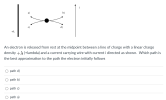 a) b) th An electron is released from rest at the midpoint between a line of charge with a linear charge density + (+lambda) and a current carrying wire with current i directed as shown. Which path is the best approximation to the path the electron initially follows path d) path b) path c) path a)
6) [12 pts Three very large charged plates are arranged as shown (on edge). From left...
 6) [12 pts Three very large charged plates are arranged as shown (on edge). From left to right, the plates have area charge densities of -0.60 uC/m'. +0.60 C/m', and - 1.20 C/m. a) Find the net electric field (direction and magnitude) at points A, B, C, and D. Assume the plates are much larger than the distances between them. b) A proton is released from rest just to the right of the center plate. If the distance between the...
 A proton and an electron are released from rest at the same time from the midpoint between two charged parallel plates. The plates are charged with equal surface charge densities of opposite signs. Ignore the interaction between the electron and the proton and consider only the interaction of each charge with the electric field of the plates. After being released, the proton will accelerate toward the negative plate, and the electron will accelerate toward the positive plate. (a) Which charge...
 densities of opposite being released, the proton will accelerate toward the e signs. Ignore the interaction between the electron and the proton and consider only the interaction of each charge with the electric flield of the plates. After negative plate, and the electron will accelerate toward the positive plate. (a) Which charge will reach the plate first? the proton the electron if tp and te are the times taken for the proton and electron to reach the plate, calculate the...
 Three points A, B, and C are located along a horizontal line, as the figure shows. A positive charge is released from rest at point A and accelerates toward point B. Upon reaching B, it continues to accelerate toward C. If only motion along the line is allowed, what would a negative charge do if it were released from rest at point B? It would remain stationary It would accelerate toward A. O It would accelerate toward C A proton...
 An electron is released from rest at the negative plate of a
parallel plate capacitor and accelerates to the positive plate (see
the drawing). The plates are separated by a distance of 1.7 cm, and
the electric field within the capacitor has a magnitude of 2.7 x
106 V/m. What is the kinetic energy of the electron just as it
reaches the positive plate? The figure shows a vertical plate on
the left that is negatively charged and another vertical...
An electron is released from rest at the negative plate of a
parallel plate capacitor and accelerates to the positive plate (see
the drawing). The plates are separated by a distance of 1.7 cm, and
the electric field within the capacitor has a magnitude of 2.7 x
106 V/m. What is the kinetic energy of the electron just as it
reaches the positive plate? The figure shows a vertical plate on
the left that is negatively charged and another vertical...
 A proton is released from rest at the positive plate of a
parallel plate capacitor. The charge per unit area on each plate is
σ=1.8e-7 C/m2 , and the plates are separated
by a distance of 1.5e-2 m.
a. What is the speed of the proton when it reaches the negative
plate? Solve this problem using conservation of energy.
b.Solve (a) using kinematics equations.
A proton is released from rest at the positive plate of a
parallel plate capacitor. The charge per unit area on each plate is
σ=1.8e-7 C/m2 , and the plates are separated
by a distance of 1.5e-2 m.
a. What is the speed of the proton when it reaches the negative
plate? Solve this problem using conservation of energy.
b.Solve (a) using kinematics equations.
 010. A proton is released from rest at the positive plate of a parallel plate capacitor. The charge per unit area on each plate is 1.8x10 Cl, and the plates are separated by a distance of 1.5x10 m. (a) (5 points) What is the magnitude of the electric field between the two plates? (b) (5 points) What is the potential difference between the two plates?
 a) b) th An electron is released from rest at the midpoint between a line of charge with a linear charge density + (+lambda) and a current carrying wire with current i directed as shown. Which path is the best approximation to the path the electron initially follows path d) path b) path c) path a)
 6) [12 pts Three very large charged plates are arranged as shown (on edge). From left to right, the plates have area charge densities of -0.60 uC/m'. +0.60 C/m', and - 1.20 C/m. a) Find the net electric field (direction and magnitude) at points A, B, C, and D. Assume the plates are much larger than the distances between them. b) A proton is released from rest just to the right of the center plate. If the distance between the...
Most questions answered within 3 hours.
-
Where is the error in this code sequence?
String s1 = "Hello";
String s2 = "ello";...
asked 10 months ago -
Financial data for Joel de Paris, Inc., for last year
follow:
Joel de Paris, Inc.
Balance...
asked 10 months ago -
Consider this reaction:
Al2(SO4)3 (aq)+ BaCl3
(aq) Al2Cl6 (aq)- +
3BaSO4(s) . What is the...
asked 10 months ago -
Suppose that Savneet is considering increasing her
recent random sample from 20 car rentals to 40...
asked 10 months ago -
Trucks arrive at an unloading terminal at an average rate of 120
per hour.
Trucks arrive...
asked 10 months ago -
Why are methanol and ethanol completely soluble in water while
octanol is not very little soluble....
asked 10 months ago -
A facilities manager at a university reads in a research report
that the mean amount of...
asked 10 months ago -
When the CuSO4 is rehydrated by adding water to the anhydrous
compound, is this an endothermic...
asked 10 months ago -
A ray of sunlight is passing from diamond into crown glass; the
angle of incidence is...
asked 10 months ago -
A block of mass 0.249 kg is placed on top of a light, vertical
spring of...
asked 10 months ago -
how do the kidneys compensate in the presences of acidosis
a) trigger hyperventilate
b) reserve acid...
asked 10 months ago -
Question 501 pts
The rental rate of capital to the firm increases. Which of the
following...
asked 10 months ago