
Homework Answers
Add Answer to:
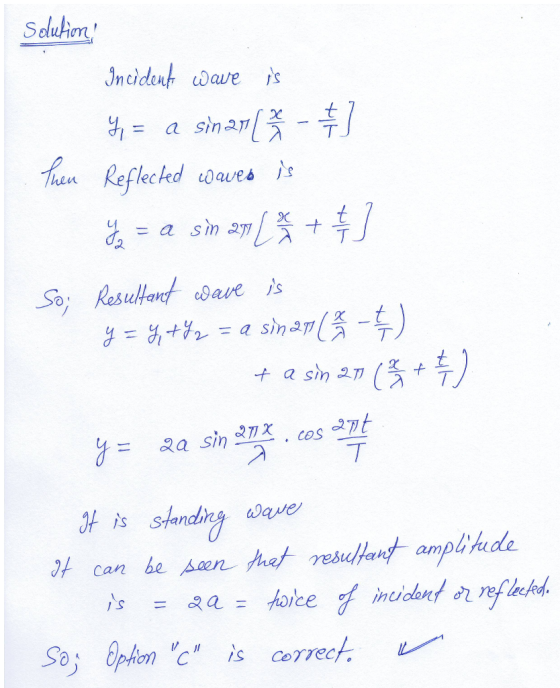
How does the amplitude of the standing wave compare to that of the incident and reflected...
What is the frequency of a point in space on the standing wave? A /2 the...
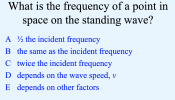 What is the frequency of a point in space on the standing wave? A /2 the incident frequency B the same as the incident frequency C twice the incident frequency D depends on the wave speed,v E depends on other factors
The wave fronts of a standing wave on a string travel at a speed: a) Equal...
The wave fronts of a standing wave on a string travel at a speed: a) Equal to that of a traveling wave of the same string. b) Greater than that of a traveling wave on the same string c) that depends on the amplitude of the wave d) that depends on the wavelength of the wave e) equal to zero A speaker is placed next to one end of tube opened at both ends. The frequency of the sound wave...
A wave reflects off a wall. Which of the following is true of the reflected wave?...
A wave reflects off a wall. Which of the following is true of the reflected wave? a. The reflected wave has about the same amplitude as the incident wave and is inverted. b. The reflected wave has a lesser amplitude than the incident wave and is inverted. c. The reflected wave has a greater amplitude than the incident wave and is upright. d. The reflected wave has about the same amplitude as the incident wave and is upright.
A continuous traveling wave with amplitude A is incident on a boundary.The continuous reflection, with a...
 A continuous traveling wave with amplitude A is incident on a boundary.The continuous reflection, with a smaller amplitude B, travels back through the incoming wave.The resulting interference pattern is displayed in thr figure. The standing wave ratio is defined to be A+B SWR=2 A-B The reflection coefficient Ris the ratio of the power of the reflected wave to the power of the incoming wave and is thus proportional to the ratio (B/A)2. What is the SWR for (a) total reflection...
Consider a vertically incoming (incident) P-wave striking a horizontally stratified earth (Fig. 2). The amplitude of...
 Consider a vertically incoming (incident) P-wave striking a
horizontally stratified earth (Fig. 2). The amplitude of the
transmitted P-wave at the top boundary of layer 1 is 1 (don’t worry
about units for amplitude). What is the amplitude of the P-wave
reflected from the boundary between layers 3 and 4? What is the
amplitude of the P-wave transmitted into layer 4? What are the
amplitudes of the corresponding S-waves? Express amplitudes in
relative terms (relative to the amplitude of the...
Consider a vertically incoming (incident) P-wave striking a
horizontally stratified earth (Fig. 2). The amplitude of the
transmitted P-wave at the top boundary of layer 1 is 1 (don’t worry
about units for amplitude). What is the amplitude of the P-wave
reflected from the boundary between layers 3 and 4? What is the
amplitude of the P-wave transmitted into layer 4? What are the
amplitudes of the corresponding S-waves? Express amplitudes in
relative terms (relative to the amplitude of the...
5. (8 pints) A String that lies along the +x- axis has a free en incident wave at)-Acos(lox + t) is reflected at th...
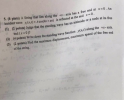 5. (8 pints) A String that lies along the +x- axis has a free en incident wave at)-Acos(lox + t) is reflected at the en (1) (2 points) Judge that end (x 0) (2) (4 points) Write down the standing wave function y (3) (2 points) Find th of the string. d at x=0 . An x=0 the standing wave has an antinode or a node at its free function y(x,tl) along the +x-axis. imum speed of the free end...
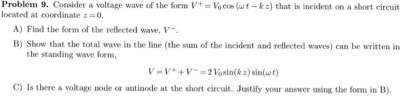
Physics of waves Problem 9 Consider a voltage wave of the form V Vocos (w t...
 Physics of waves
Problem 9 Consider a voltage wave of the form V Vocos (w t -k2) that is incident on a short circuit a located at coordinate 0. A) Find the form of the reflected wave, V B) Show that the total wave in the line (the sum of the incident and reflected waves) can be written in the standing wave form, V V V 2Vo sin (kz) sin (wt) C) Is there a voltage node or antinode at...
Physics of waves
Problem 9 Consider a voltage wave of the form V Vocos (w t -k2) that is incident on a short circuit a located at coordinate 0. A) Find the form of the reflected wave, V B) Show that the total wave in the line (the sum of the incident and reflected waves) can be written in the standing wave form, V V V 2Vo sin (kz) sin (wt) C) Is there a voltage node or antinode at...
Adjacent antinodes of a standing wave of a string are 20.0 cm apart. A particle at...
Adjacent antinodes of a standing wave of a string are 20.0 cm apart. A particle at an antinode oscillates in simple harmonic motion with amplitude 0.600 cm and period 0.100 s. The string lies along the +x-axis and its left end is fixed at x = 0. The string is 70.0 cm long. At time t = 0, the first antinode is at maximum positive displacement. a. Is the right end of the string fixed or free? Explain. b. Sketch...
The displacement of a standing wave on a string is given by D=2.6sin(0.70x)cos(44t), where x and...
The displacement of a standing wave on a string is given by D=2.6sin(0.70x)cos(44t), where x and D are in centimeters and t is in seconds. Answer in 4 sig figs! A) What is the distance (cm) between nodes? B) Give the amplitude of each of the component waves. C) Give the frequency of each of the component waves. D) Give the speed of each of the component waves. E) Find the speed of a particle of the string at x=2.70cm...
The displacement of a standing wave on a string is given by D=3.4sin(0.53x)cos(38t), where xand D...
The displacement of a standing wave on a string is given by D=3.4sin(0.53x)cos(38t), where xand D are in centimeters and t is in seconds. a) What is the distance (cm) between nodes? d = ? b) Give the amplitude of each of the component waves. A1,A2 = ? c) Give the frequency of each of the component waves. f1,f2 = ? d) Give the speed of each of the component waves. v1,v2 = ? e) Find the speed of a...
 What is the frequency of a point in space on the standing wave? A /2 the incident frequency B the same as the incident frequency C twice the incident frequency D depends on the wave speed,v E depends on other factors
 A continuous traveling wave with amplitude A is incident on a boundary.The continuous reflection, with a smaller amplitude B, travels back through the incoming wave.The resulting interference pattern is displayed in thr figure. The standing wave ratio is defined to be A+B SWR=2 A-B The reflection coefficient Ris the ratio of the power of the reflected wave to the power of the incoming wave and is thus proportional to the ratio (B/A)2. What is the SWR for (a) total reflection...
 Consider a vertically incoming (incident) P-wave striking a
horizontally stratified earth (Fig. 2). The amplitude of the
transmitted P-wave at the top boundary of layer 1 is 1 (don’t worry
about units for amplitude). What is the amplitude of the P-wave
reflected from the boundary between layers 3 and 4? What is the
amplitude of the P-wave transmitted into layer 4? What are the
amplitudes of the corresponding S-waves? Express amplitudes in
relative terms (relative to the amplitude of the...
Consider a vertically incoming (incident) P-wave striking a
horizontally stratified earth (Fig. 2). The amplitude of the
transmitted P-wave at the top boundary of layer 1 is 1 (don’t worry
about units for amplitude). What is the amplitude of the P-wave
reflected from the boundary between layers 3 and 4? What is the
amplitude of the P-wave transmitted into layer 4? What are the
amplitudes of the corresponding S-waves? Express amplitudes in
relative terms (relative to the amplitude of the...
 5. (8 pints) A String that lies along the +x- axis has a free en incident wave at)-Acos(lox + t) is reflected at the en (1) (2 points) Judge that end (x 0) (2) (4 points) Write down the standing wave function y (3) (2 points) Find th of the string. d at x=0 . An x=0 the standing wave has an antinode or a node at its free function y(x,tl) along the +x-axis. imum speed of the free end...
 Physics of waves
Problem 9 Consider a voltage wave of the form V Vocos (w t -k2) that is incident on a short circuit a located at coordinate 0. A) Find the form of the reflected wave, V B) Show that the total wave in the line (the sum of the incident and reflected waves) can be written in the standing wave form, V V V 2Vo sin (kz) sin (wt) C) Is there a voltage node or antinode at...
Physics of waves
Problem 9 Consider a voltage wave of the form V Vocos (w t -k2) that is incident on a short circuit a located at coordinate 0. A) Find the form of the reflected wave, V B) Show that the total wave in the line (the sum of the incident and reflected waves) can be written in the standing wave form, V V V 2Vo sin (kz) sin (wt) C) Is there a voltage node or antinode at...
Most questions answered within 3 hours.
-
Where is the error in this code sequence?
String s1 = "Hello";
String s2 = "ello";...
asked 10 months ago -
Financial data for Joel de Paris, Inc., for last year
follow:
Joel de Paris, Inc.
Balance...
asked 10 months ago -
Consider this reaction:
Al2(SO4)3 (aq)+ BaCl3
(aq) Al2Cl6 (aq)- +
3BaSO4(s) . What is the...
asked 10 months ago -
Suppose that Savneet is considering increasing her
recent random sample from 20 car rentals to 40...
asked 10 months ago -
Trucks arrive at an unloading terminal at an average rate of 120
per hour.
Trucks arrive...
asked 10 months ago -
Why are methanol and ethanol completely soluble in water while
octanol is not very little soluble....
asked 10 months ago -
A facilities manager at a university reads in a research report
that the mean amount of...
asked 10 months ago -
When the CuSO4 is rehydrated by adding water to the anhydrous
compound, is this an endothermic...
asked 10 months ago -
A ray of sunlight is passing from diamond into crown glass; the
angle of incidence is...
asked 10 months ago -
A block of mass 0.249 kg is placed on top of a light, vertical
spring of...
asked 10 months ago -
how do the kidneys compensate in the presences of acidosis
a) trigger hyperventilate
b) reserve acid...
asked 10 months ago -
Question 501 pts
The rental rate of capital to the firm increases. Which of the
following...
asked 10 months ago