Chromium III hydroxide is highly insoluble in distilled water but dissolves readily in either acidic or...
Homework Answers
In acidic solution, Cr(OH)3 reacts with excess H+ ions present to form soluble Cr3+ ions:
Cr(OH)3(s) + 3 H+(aq) => Cr3+(aq) + 3 H2O(l)
In basic solution, Cr(OH)3 reacts with excess OH- ions present to form a soluble Cr(OH)4- complex:
Cr(OH)3(s) + OH-(aq) => Cr(OH)4-(aq)
Distilled water is neutral. The concentrations of H+ and OH- ions are very low. Thus Cr(OH)3 does not undergo any reaction and remains in its insoluble Cr(OH)3 form.
Cr(OH)3(s) + H2O(l) => no reaction
Add Answer to:
Chromium III hydroxide is highly insoluble in distilled water but dissolves readily in either acidic or...
Two additional compounds were studied: NO2(OH) dissolved in water and produced an acidic solution, and Ni(OH)2...
Two additional compounds were studied: NO2(OH) dissolved in water and produced an acidic solution, and Ni(OH)2 dissolved only in an acidic solution. What type of compounds were these? A. Both were oxyacids. B. Both were bases. C. NO2(OH) was a base and Ni(OH)2 was an oxyacid. D. NO2(OH) was an oxyacid and Ni(OH)2 was a base. This is the solution: This is a General Chemistry question that falls under the content category “Unique nature of water and its solutions.” The...
3. Classify the following as either acidic, basic or neutral. For acidic and basic salts, write...
 3. Classify the following as either acidic, basic or neutral. For acidic and basic salts, write a net ionic equation to explain why it is acidic or basic. a. Nac b. KNO. c. NaF TAH - (pa) (palgan ob d. KNO3 MoBo to Hodontact e. NH4NO3 f. KC2H2O2
2. For each of the salts below, indicate whether its water solution would be acidic, basic...
 2. For each of the salts below, indicate whether its water solution would be acidic, basic or neutral. Write an equilibrium equation for any reaction that may occur in water. Compound Acidic, basic, Write an equilibrium equation for any reaction that may Zn(HSO4)2 or neutral occur KNO2 Na2CO3 LiBr Na3PO4 Al(NO3)3 K2S Na2SO4 KNO3 FeCl NH4CI KCI
Aluminum fuoride is insoluble in pure liquid HF, but dissolves readily when Naf is added. When...
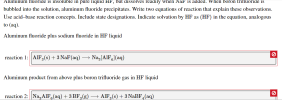 Aluminum fuoride is insoluble in pure liquid HF, but dissolves readily when Naf is added. When boron trifluoride is bubbled into the solution, aluminum fluoride precipitates. Write two equations of reaction that explain these observations. Use acid-base reaction concepts. Include state designations. Indicate solvation by HF as (HF) in the equation, analogous to (aq). Aluminum fluoride plus sodium fluoride in HF liquid reaction 1: A1F3(s) + 3 NaF(aq) + Nag [A1F6](aq) Aluminum product from above plus boron trifluoride gas in...
Question 3 3 pts Zinc hydroxide, Zn(OH)2, is considered insoluble in water. Is it true that...
 Question 3 3 pts Zinc hydroxide, Zn(OH)2, is considered insoluble in water. Is it true that no Zn(OH)2 can dissolve in water? You must explain your answer in words. You may also use chemical reactions. Please use complete sentences. HTML Editon Part BIVA-AI EI31* 1. 12pt true, zinc hydroxide is insoluble in water because the equilibrium will shift more towards the left Zn(OH)2(s) -->Zn2+ (aq)+ 2OH'(aq) only small amount of solid will dissolve 33 words р 3 pts
Copper hydroxide dissolves in water according to the following equation. It is only very slightly soluble....
Copper hydroxide dissolves in water according to the following equation. It is only very slightly soluble. Cu(OH)2(s) Cu2+(aq) + 2OH- (aq) a. Explain how the solubility can be increased by adding HCl to the solution. b. Explain how the concentration of copper (II) ion or of hydroxide ion can be reduced in the solution so that more of the solid copper hydroxide can be dissolved
The boiling point of water is 100.00 °C at 1 atmosphere. A student dissolves 12.70 grams of chromium(III) sulfate, Cr2(...
The boiling point of water is 100.00 °C at 1 atmosphere. A student dissolves 12.70 grams of chromium(III) sulfate, Cr2(SO4)3 (392.2 g/mol), in 214.5 grams of water. Use the table of boiling and freezing point constants to answer the questions below. Solvent Formula Kb (°C/m) Kf (°C/m) Water H2O 0.512 1.86 Ethanol CH3CH2OH 1.22 1.99 Chloroform CHCl3 3.67 Benzene C6H6 2.53 5.12 Diethyl ether CH3CH2OCH2CH3 2.02 The molality of the solution is ___?____m. The boiling point of the solution is...
In reaction between 100.0 g calcium carbide, CaC2 and water (excess), calcium hydroxide, Ca (OH) 2,...
In reaction between 100.0 g calcium carbide, CaC2 and water (excess), calcium hydroxide, Ca (OH) 2, and ethylene gas C2H2 (also called acetylene) are formed. 1) Write down the balanced reaction equation includes states of matter. 2) What is the mass of the ethin produced at the end of the reaction? 3) The reaction gas is delivered in a balloon at 20 ° C and a pressure of 2.00 atm. What is a balloon volume? View calculations 4) What is...
???? Write a net ionic equation to show why solid lithium hydroxide, LiOH (s), forms a...
 ????
Write a net ionic equation to show why solid lithium hydroxide, LiOH (s), forms a basic solution when it dissolves in water. НО Submit Answer Retry Entire Group 9 more group attempts remaining
????
Write a net ionic equation to show why solid lithium hydroxide, LiOH (s), forms a basic solution when it dissolves in water. НО Submit Answer Retry Entire Group 9 more group attempts remaining
6 6. Zinc hydroxide, Zn(OH)2. is practically insoluble in pure water. (Kap 3.0 x 10⁻¹⁶) a) Determine the pH of a saturated aqueous solution of Zn(O1H)2. (You should assume that all hydroxide ions...
 6 6. Zinc hydroxide, Zn(OH)2. is practically insoluble in pure water. (Kap 3.0 x 10⁻¹⁶) a) Determine the pH of a saturated aqueous solution of Zn(O1H)2. (You should assume that all hydroxide ions in the solution come from the Zn(OH)2: you can ignore the autoionization of water.) (4 pts) b) Zn(OH)2 is less soluble in even very dilute solutions of Zn(NOs)2 due to the common ion effect. Determine the molar solubility of zine hydroxide in a 1.0 x 10⁻⁴ M...
 3. Classify the following as either acidic, basic or neutral. For acidic and basic salts, write a net ionic equation to explain why it is acidic or basic. a. Nac b. KNO. c. NaF TAH - (pa) (palgan ob d. KNO3 MoBo to Hodontact e. NH4NO3 f. KC2H2O2
 2. For each of the salts below, indicate whether its water solution would be acidic, basic or neutral. Write an equilibrium equation for any reaction that may occur in water. Compound Acidic, basic, Write an equilibrium equation for any reaction that may Zn(HSO4)2 or neutral occur KNO2 Na2CO3 LiBr Na3PO4 Al(NO3)3 K2S Na2SO4 KNO3 FeCl NH4CI KCI
 Aluminum fuoride is insoluble in pure liquid HF, but dissolves readily when Naf is added. When boron trifluoride is bubbled into the solution, aluminum fluoride precipitates. Write two equations of reaction that explain these observations. Use acid-base reaction concepts. Include state designations. Indicate solvation by HF as (HF) in the equation, analogous to (aq). Aluminum fluoride plus sodium fluoride in HF liquid reaction 1: A1F3(s) + 3 NaF(aq) + Nag [A1F6](aq) Aluminum product from above plus boron trifluoride gas in...
 Question 3 3 pts Zinc hydroxide, Zn(OH)2, is considered insoluble in water. Is it true that no Zn(OH)2 can dissolve in water? You must explain your answer in words. You may also use chemical reactions. Please use complete sentences. HTML Editon Part BIVA-AI EI31* 1. 12pt true, zinc hydroxide is insoluble in water because the equilibrium will shift more towards the left Zn(OH)2(s) -->Zn2+ (aq)+ 2OH'(aq) only small amount of solid will dissolve 33 words р 3 pts
 ????
Write a net ionic equation to show why solid lithium hydroxide, LiOH (s), forms a basic solution when it dissolves in water. НО Submit Answer Retry Entire Group 9 more group attempts remaining
????
Write a net ionic equation to show why solid lithium hydroxide, LiOH (s), forms a basic solution when it dissolves in water. НО Submit Answer Retry Entire Group 9 more group attempts remaining
 6 6. Zinc hydroxide, Zn(OH)2. is practically insoluble in pure water. (Kap 3.0 x 10⁻¹⁶) a) Determine the pH of a saturated aqueous solution of Zn(O1H)2. (You should assume that all hydroxide ions in the solution come from the Zn(OH)2: you can ignore the autoionization of water.) (4 pts) b) Zn(OH)2 is less soluble in even very dilute solutions of Zn(NOs)2 due to the common ion effect. Determine the molar solubility of zine hydroxide in a 1.0 x 10⁻⁴ M...
Most questions answered within 3 hours.
-
Where is the error in this code sequence?
String s1 = "Hello";
String s2 = "ello";...
asked 10 months ago -
Financial data for Joel de Paris, Inc., for last year
follow:
Joel de Paris, Inc.
Balance...
asked 10 months ago -
Consider this reaction:
Al2(SO4)3 (aq)+ BaCl3
(aq) Al2Cl6 (aq)- +
3BaSO4(s) . What is the...
asked 10 months ago -
Suppose that Savneet is considering increasing her
recent random sample from 20 car rentals to 40...
asked 10 months ago -
Trucks arrive at an unloading terminal at an average rate of 120
per hour.
Trucks arrive...
asked 10 months ago -
Why are methanol and ethanol completely soluble in water while
octanol is not very little soluble....
asked 10 months ago -
A facilities manager at a university reads in a research report
that the mean amount of...
asked 10 months ago -
When the CuSO4 is rehydrated by adding water to the anhydrous
compound, is this an endothermic...
asked 10 months ago -
A ray of sunlight is passing from diamond into crown glass; the
angle of incidence is...
asked 10 months ago -
A block of mass 0.249 kg is placed on top of a light, vertical
spring of...
asked 10 months ago -
how do the kidneys compensate in the presences of acidosis
a) trigger hyperventilate
b) reserve acid...
asked 10 months ago -
Question 501 pts
The rental rate of capital to the firm increases. Which of the
following...
asked 10 months ago