A metal sphere is insulated electrically and is given a charge. If 25 electrons are added...
Homework Answers
charge on one electron= 1.6 E-19 C
if 25 electrons are added
charge added=25*1.6 E-19 C =4 E-18 C added
Add Answer to:
A metal sphere is insulated electrically and is given a charge. If 25 electrons are added...
Poms A metal sphere is insulated electrically and is given a charge. If 43 electrons are...
 Poms A metal sphere is insulated electrically and is given a charge. If 43 electrons are added to the sphere in giving a charge, how many Coulombs are added to the sphere? 0 -6.9 x 10⁻²⁰ c -430 690 0 6.9 x 10⁻¹⁸c Activate Windows Go to Question 2018 Moving to another question will save this response.
A conducting metal sphere is insulated from the ground. It is initially charged by contact with...
A conducting metal sphere is insulated from the ground. It is initially charged by contact with a small metal disc which carries a charge q, so that the sphere gains charge Q. The metal disc is then again given a charge q, and is then touched on the sphere a second time. If this process is repeated indefinitely, what would be the final charge on the sphere, Qf ? I do not understand how potential will be the same intially...
A solid metal sphere is given a net charge -Q. How is the charge distributed in...
A solid metal sphere is given a net charge -Q. How is the charge distributed in or on the sphere? A) It is concentrated at the center of the sphere. B) It is uniformly distributed throughout the volume of the sphere. C) Its charge density decreases radially outward from the center. D) Its charge density increases radially outward from the center. E) It is uniformly distributed on the surface of the sphere. explain please
A charge of -16C is transferred from one metal sphere to another. How many electrons were...
A charge of -16C is transferred from one metal sphere to another. How many electrons were transferred between the spheres?
23.1 An uncharged metal sphere, A, is on an insulated base. A second sphere, B, of...
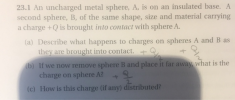 23.1 An uncharged metal sphere, A, is on an insulated base. A second sphere, B, of the same shape, size and material carrying (a) Describe what happens to charges on spheres A and B as b) If we now remove sphere B and place it far away what is the a charge +Q is brought into contact with sphere A. they are brought into contact.Q charge on sphere A? (c) How is this charge (if any) distributed?
1 a) We charge a metal sphere with a positive charge. Now we move an neutral...
1 a) We charge a metal sphere with a positive charge. Now we move an neutral metal sphere, which is well insulated from ground, so that it is close to, but not touching the charged sphere. Draw a charge diagram that shows the charge distributions on both spheres. b) We again charge a metal sphere with a positive charge. Now we ground a second sphere and, keeping it grounded, we move it close to, but not touching, the charged sphere....
A metal sphere has a charge of +8.0 C. What is the net charge after 6.0...
 A metal sphere has a charge of +8.0 C. What is the net charge after 6.0 x 10¹³ electrons have been placed on it? A rod has a charge of -2.0 uC. How many electrons must be moved so that the charge becomes +3.0 C?
A Van de Graaff generator includes a metal sphere of radius R=0.15m that is electrically isolated...
A Van de Graaff generator includes a metal sphere of radius R=0.15m that is electrically isolated from its surroundings except for a wire which can carry current. When operational, the sphere has a potential of 400 kV. a) How much charge is on the sphere when it is fully charged? b) When the current is a steady I = 5.0 uA, how long does it take for the sphere to reach its operating potential if it is initially uncharged?
11. Consider three identical metal spheres, A, B, and C. Sphere A carries a charge of...
11. Consider three identical metal spheres, A, B, and C. Sphere A carries a charge of −2.0 μC; sphere B carries a charge of −6.0 μC; and sphere C carries a charge of +5.0 μC. Spheres A and B are touched together and then separated. Spheres B and C are then touched and separated. Does sphere C end up with an excess or a deficiency of electrons and how many electrons is it?
Prelab Lessons associated with this experiment: Lessons #2, #3 1. We charge a metal sphere with...
 Prelab Lessons associated with this experiment: Lessons #2, #3 1. We charge a metal sphere with a positive charge. Now we move an neutral metal sphere, which is well insulated from ground, so that it is close to, but not touching the charged sphere. Draw a charge diagram that shows the charge distributions on both spheres. 2. We again charge a metal sphere with a positive charge. Now we ground a second sphere and, keeping it grounded, we move it...
 Poms A metal sphere is insulated electrically and is given a charge. If 43 electrons are added to the sphere in giving a charge, how many Coulombs are added to the sphere? 0 -6.9 x 10⁻²⁰ c -430 690 0 6.9 x 10⁻¹⁸c Activate Windows Go to Question 2018 Moving to another question will save this response.
 23.1 An uncharged metal sphere, A, is on an insulated base. A second sphere, B, of the same shape, size and material carrying (a) Describe what happens to charges on spheres A and B as b) If we now remove sphere B and place it far away what is the a charge +Q is brought into contact with sphere A. they are brought into contact.Q charge on sphere A? (c) How is this charge (if any) distributed?
 A metal sphere has a charge of +8.0 C. What is the net charge after 6.0 x 10¹³ electrons have been placed on it? A rod has a charge of -2.0 uC. How many electrons must be moved so that the charge becomes +3.0 C?
 Prelab Lessons associated with this experiment: Lessons #2, #3 1. We charge a metal sphere with a positive charge. Now we move an neutral metal sphere, which is well insulated from ground, so that it is close to, but not touching the charged sphere. Draw a charge diagram that shows the charge distributions on both spheres. 2. We again charge a metal sphere with a positive charge. Now we ground a second sphere and, keeping it grounded, we move it...
Most questions answered within 3 hours.
-
Where is the error in this code sequence?
String s1 = "Hello";
String s2 = "ello";...
asked 10 months ago -
Financial data for Joel de Paris, Inc., for last year
follow:
Joel de Paris, Inc.
Balance...
asked 10 months ago -
Consider this reaction:
Al2(SO4)3 (aq)+ BaCl3
(aq) Al2Cl6 (aq)- +
3BaSO4(s) . What is the...
asked 10 months ago -
Suppose that Savneet is considering increasing her
recent random sample from 20 car rentals to 40...
asked 10 months ago -
Trucks arrive at an unloading terminal at an average rate of 120
per hour.
Trucks arrive...
asked 10 months ago -
Why are methanol and ethanol completely soluble in water while
octanol is not very little soluble....
asked 10 months ago -
A facilities manager at a university reads in a research report
that the mean amount of...
asked 10 months ago -
When the CuSO4 is rehydrated by adding water to the anhydrous
compound, is this an endothermic...
asked 10 months ago -
A ray of sunlight is passing from diamond into crown glass; the
angle of incidence is...
asked 10 months ago -
A block of mass 0.249 kg is placed on top of a light, vertical
spring of...
asked 10 months ago -
how do the kidneys compensate in the presences of acidosis
a) trigger hyperventilate
b) reserve acid...
asked 10 months ago -
Question 501 pts
The rental rate of capital to the firm increases. Which of the
following...
asked 10 months ago