1. Show that S3 is not isomorphic to U(14) 2. How many automorphisms are there from...
1. Show that S3 is not isomorphic to U(14) 2. How many automorphisms are there from Z2 to itself?Define each of them.
can you explain both of??? Two neutral conductors are connected by a wire and a charged...
 can you explain both of???
Two neutral conductors are connected by a wire and a charged rod is brought near, but does not touch. The wire is taken away, and then the charged rod is removed. What are the charges on the conductors? O A) B) D) E) Two neutral conductors are connected by a wire and a charged rod...
can you explain both of???
Two neutral conductors are connected by a wire and a charged rod is brought near, but does not touch. The wire is taken away, and then the charged rod is removed. What are the charges on the conductors? O A) B) D) E) Two neutral conductors are connected by a wire and a charged rod...
The chloride ions in a sodium chloride crystal are in a face-centered cubic lattice. Even though...
The chloride ions in a sodium chloride crystal are in a face-centered cubic lattice. Even though they touch sodium ions, the chloride ions do not touch each other. A sodium ion has a radius of 99 pm, and a chloride ion has a radius of 181 pm. How far apart are the chloride ions at their closest point? Please explain...
1. Use the unity feedback system shown in the following figure. Clearly, apply all 6 rules of ske...
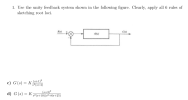 1. Use the unity feedback system shown in the following figure. Clearly, apply all 6 rules of sketching root loci Rs) C(s) G(s) s3(s+4) (s+3) s2(s+10) (82+68+25)
1. Use the unity feedback system shown in the following figure. Clearly, apply all 6 rules of sketching root loci Rs) C(s) G(s) s3(s+4) (s+3) s2(s+10) (82+68+25)
1. Use the unity feedback system shown in the following figure. Clearly, apply all 6 rules of sketching root loci Rs) C(s) G(s) s3(s+4) (s+3) s2(s+10) (82+68+25)
S3. (5 pts) In the EYE the CORNEA which is transparent to the passage of light and the SCLERA, th...
 S3. (5 pts) In the EYE the CORNEA which is transparent to the passage of light and the SCLERA, the white part of the eye that totally blocks the passage of light, both consist of exactly the same constituents, which is collagen fibers surrounded by proteins with sugars. WHY is the CORNEA clear and the SCLERA white?
S3. (5 pts)...
S3. (5 pts) In the EYE the CORNEA which is transparent to the passage of light and the SCLERA, the white part of the eye that totally blocks the passage of light, both consist of exactly the same constituents, which is collagen fibers surrounded by proteins with sugars. WHY is the CORNEA clear and the SCLERA white?
S3. (5 pts)...
The angle θ through which a disk drive turns is given by θ(t)=a+bt−ct3, where a,b and...
The angle θ through which a disk drive turns is given by θ(t)=a+bt−ct3, where a,b and c are constants, tis in seconds, and θ is in radians. When t=0,θ=π/4rad and the angular velocity is 1.50 rad/s, and when t=1.10s, the angular acceleration is 1.40 rad/s2. A. Find a including their units. π/4rad/s π/2rad/s π/4rad π/4rad/s B. Find b including their...
True or False Touch is universally used social contexts as a communication tool among most cultures
True or False Touch is universally used social contexts as a communication tool among most cultures
which of the following would the nurse assess for at the 5th intercostal space midclavicular S3...
which of the following would the nurse assess for at the 5th intercostal space midclavicular S3 Mitral stenosis aortic stenosis Erbs Point s4
(S3)(s4) The response of the system is given by Y(s) s(s+2)(2s 1) Find the initial value...
 (S3)(s4) The response of the system is given by Y(s) s(s+2)(2s 1) Find the initial value of the system output.
Use the convolution theorem to find the inverse Laplace transform of the given function. 6 ਚ...
 Use the convolution theorem to find the inverse Laplace transform of the given function. 6 ਚ s3 (2) +0 (t) = (s +9)
 can you explain both of???
Two neutral conductors are connected by a wire and a charged rod is brought near, but does not touch. The wire is taken away, and then the charged rod is removed. What are the charges on the conductors? O A) B) D) E) Two neutral conductors are connected by a wire and a charged rod...
can you explain both of???
Two neutral conductors are connected by a wire and a charged rod is brought near, but does not touch. The wire is taken away, and then the charged rod is removed. What are the charges on the conductors? O A) B) D) E) Two neutral conductors are connected by a wire and a charged rod...
 1. Use the unity feedback system shown in the following figure. Clearly, apply all 6 rules of sketching root loci Rs) C(s) G(s) s3(s+4) (s+3) s2(s+10) (82+68+25)
1. Use the unity feedback system shown in the following figure. Clearly, apply all 6 rules of sketching root loci Rs) C(s) G(s) s3(s+4) (s+3) s2(s+10) (82+68+25)
1. Use the unity feedback system shown in the following figure. Clearly, apply all 6 rules of sketching root loci Rs) C(s) G(s) s3(s+4) (s+3) s2(s+10) (82+68+25)
 S3. (5 pts) In the EYE the CORNEA which is transparent to the passage of light and the SCLERA, the white part of the eye that totally blocks the passage of light, both consist of exactly the same constituents, which is collagen fibers surrounded by proteins with sugars. WHY is the CORNEA clear and the SCLERA white?
S3. (5 pts)...
S3. (5 pts) In the EYE the CORNEA which is transparent to the passage of light and the SCLERA, the white part of the eye that totally blocks the passage of light, both consist of exactly the same constituents, which is collagen fibers surrounded by proteins with sugars. WHY is the CORNEA clear and the SCLERA white?
S3. (5 pts)...
 (S3)(s4) The response of the system is given by Y(s) s(s+2)(2s 1) Find the initial value of the system output.
 Use the convolution theorem to find the inverse Laplace transform of the given function. 6 ਚ s3 (2) +0 (t) = (s +9)
Most questions answered within 3 hours.