
Homework Answers
Add Answer to:
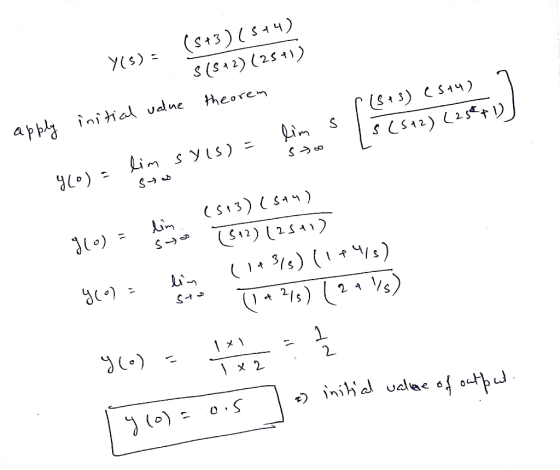
(S3)(s4) The response of the system is given by Y(s) s(s+2)(2s 1) Find the initial value...
Given the system transfer f unction: G, (s) -2S+2) S+4 a) Plot the response y(t) for...
 Given the system transfer f unction: G, (s) -2S+2) S+4 a) Plot the response y(t) for a step input of amplitude 4 for t=[0:0.01:21 b) Verify that the plot is correct using the initial and final value theorems. o) Repeat steps q.and b for G, (s)0S(S + 4). Remember, in input is a step of c) Repeat steps a and b for G2 (S) S+2 amplitude 4.
Automatic Course.. Please answer S4 The differential equation that de s cribe Control System is given...
 Automatic Course.. Please answer
S4 The differential equation that de s cribe Control System is given as y is the system out fut and u is the where inPut signal a) Find the system resPonse yct),if the input Signal is unit step at t 2 scend Uelue b) what is the outPut
Automatic Course.. Please answer
S4 The differential equation that de s cribe Control System is given as y is the system out fut and u is the where inPut signal a) Find the system resPonse yct),if the input Signal is unit step at t 2 scend Uelue b) what is the outPut
Find the first six partial sums S1, S2. S3, S4, S5, S. of the sequence. 1...
 Find the first six partial sums S1, S2. S3, S4, S5, S. of the sequence. 1 1 1 1 3° 32' 33 34 3 Give your answers as fractions. S, = S2 S3 = S4= Ss = So
Find the inverse Laplace transforms of (a) (b) (c) s 1 (2s +1) Y(s) = (822 5s + 8 (2s - 2) 21) Y(s) = Find the inverse Laplace transforms of (2s- 3)e-3,s 1) (2s (a) Y(s)2s+ ) (2s - 2) (c) Y(s)...
 Find the inverse Laplace transforms of
(a)
(b)
(c)
s 1 (2s +1) Y(s) = (822 5s + 8 (2s - 2) 21) Y(s) = Find the inverse Laplace transforms of (2s- 3)e-3,s 1) (2s (a) Y(s)2s+ ) (2s - 2) (c) Y(s) = (5-7)2
s 1 (2s +1)
Y(s) = (822 5s + 8 (2s - 2)
21) Y(s) =
Find the inverse Laplace transforms of (2s- 3)e-3,s 1) (2s (a) Y(s)2s+ ) (2s - 2) (c) Y(s) =...
Find the inverse Laplace transforms of
(a)
(b)
(c)
s 1 (2s +1) Y(s) = (822 5s + 8 (2s - 2) 21) Y(s) = Find the inverse Laplace transforms of (2s- 3)e-3,s 1) (2s (a) Y(s)2s+ ) (2s - 2) (c) Y(s) = (5-7)2
s 1 (2s +1)
Y(s) = (822 5s + 8 (2s - 2)
21) Y(s) =
Find the inverse Laplace transforms of (2s- 3)e-3,s 1) (2s (a) Y(s)2s+ ) (2s - 2) (c) Y(s) =...
Given s = j, find magnitude and phase of Y(s)=2+541 3. s4+s+1
 Given s = j, find magnitude and phase of Y(s)=2+541 3. s4+s+1
(1 point) Calculate S3, S4, and Sg and then find the sum for the telescoping series...
 (1 point) Calculate S3, S4, and Sg and then find the sum for the telescoping series 1 1 S (+12) n=4 where Sk is the partial sum using the first k values of n. S3 = S4= S5= S =
Question S) Compute the initial and final value of the system using the properties and verify...
 Question S) Compute the initial and final value of the system using the properties and verify the answer with the impulse response: Note for all these functions the ROC is Re(s) >O. S+3 s3+3s2 +2s 10 b) G(s)= 25
A linear system is governed by the given initial value problem. Find the transfer function H(s)...
 A linear system is governed by the given initial value problem. Find the transfer function H(s) for the system and the impulse response function h(t) and give a formula for the solution to the initial value problem. y" - 6y' +34y = g(t); y(O)= 0, y' (O) = 5 Find the transfer function. H(s) = Use the convolution theorem to obtain a formula for the solution to the given initial value problem, where g(t) is piecewise continuous on (0,00) and...
Consider the initial value problem Let L[y(t)] = Y(3), then Y(s) equals Select one: 2s +2...
 Consider the initial value problem Let L[y(t)] = Y(3), then Y(s) equals Select one: 2s +2 a. O b. 3s +1 s(232 + s +3) 2s2 + s +1 OC s(2s2 + 8 +3) O d. 2s +1-2/3 252 +8 e. 28 +1 -4/5 28² +8
You found the solution to the initial value problem to be -2s S 1 [e y(t)...
 You found the solution to the initial value problem to be -2s S 1 [e y(t) = L-1 94 +10 Evaluate y(1). O y(1) = 1 Oy(1) = -1 O y(1) = 0 y(1) = -2 Oy(1) = 2
 Given the system transfer f unction: G, (s) -2S+2) S+4 a) Plot the response y(t) for a step input of amplitude 4 for t=[0:0.01:21 b) Verify that the plot is correct using the initial and final value theorems. o) Repeat steps q.and b for G, (s)0S(S + 4). Remember, in input is a step of c) Repeat steps a and b for G2 (S) S+2 amplitude 4.
 Automatic Course.. Please answer
S4 The differential equation that de s cribe Control System is given as y is the system out fut and u is the where inPut signal a) Find the system resPonse yct),if the input Signal is unit step at t 2 scend Uelue b) what is the outPut
Automatic Course.. Please answer
S4 The differential equation that de s cribe Control System is given as y is the system out fut and u is the where inPut signal a) Find the system resPonse yct),if the input Signal is unit step at t 2 scend Uelue b) what is the outPut
 Find the first six partial sums S1, S2. S3, S4, S5, S. of the sequence. 1 1 1 1 3° 32' 33 34 3 Give your answers as fractions. S, = S2 S3 = S4= Ss = So
 Find the inverse Laplace transforms of
(a)
(b)
(c)
s 1 (2s +1) Y(s) = (822 5s + 8 (2s - 2) 21) Y(s) = Find the inverse Laplace transforms of (2s- 3)e-3,s 1) (2s (a) Y(s)2s+ ) (2s - 2) (c) Y(s) = (5-7)2
s 1 (2s +1)
Y(s) = (822 5s + 8 (2s - 2)
21) Y(s) =
Find the inverse Laplace transforms of (2s- 3)e-3,s 1) (2s (a) Y(s)2s+ ) (2s - 2) (c) Y(s) =...
Find the inverse Laplace transforms of
(a)
(b)
(c)
s 1 (2s +1) Y(s) = (822 5s + 8 (2s - 2) 21) Y(s) = Find the inverse Laplace transforms of (2s- 3)e-3,s 1) (2s (a) Y(s)2s+ ) (2s - 2) (c) Y(s) = (5-7)2
s 1 (2s +1)
Y(s) = (822 5s + 8 (2s - 2)
21) Y(s) =
Find the inverse Laplace transforms of (2s- 3)e-3,s 1) (2s (a) Y(s)2s+ ) (2s - 2) (c) Y(s) =...
 Given s = j, find magnitude and phase of Y(s)=2+541 3. s4+s+1
 (1 point) Calculate S3, S4, and Sg and then find the sum for the telescoping series 1 1 S (+12) n=4 where Sk is the partial sum using the first k values of n. S3 = S4= S5= S =
 Question S) Compute the initial and final value of the system using the properties and verify the answer with the impulse response: Note for all these functions the ROC is Re(s) >O. S+3 s3+3s2 +2s 10 b) G(s)= 25
 A linear system is governed by the given initial value problem. Find the transfer function H(s) for the system and the impulse response function h(t) and give a formula for the solution to the initial value problem. y" - 6y' +34y = g(t); y(O)= 0, y' (O) = 5 Find the transfer function. H(s) = Use the convolution theorem to obtain a formula for the solution to the given initial value problem, where g(t) is piecewise continuous on (0,00) and...
 Consider the initial value problem Let L[y(t)] = Y(3), then Y(s) equals Select one: 2s +2 a. O b. 3s +1 s(232 + s +3) 2s2 + s +1 OC s(2s2 + 8 +3) O d. 2s +1-2/3 252 +8 e. 28 +1 -4/5 28² +8
 You found the solution to the initial value problem to be -2s S 1 [e y(t) = L-1 94 +10 Evaluate y(1). O y(1) = 1 Oy(1) = -1 O y(1) = 0 y(1) = -2 Oy(1) = 2
Most questions answered within 3 hours.
-
Where is the error in this code sequence?
String s1 = "Hello";
String s2 = "ello";...
asked 11 months ago -
Financial data for Joel de Paris, Inc., for last year
follow:
Joel de Paris, Inc.
Balance...
asked 11 months ago -
Consider this reaction:
Al2(SO4)3 (aq)+ BaCl3
(aq) Al2Cl6 (aq)- +
3BaSO4(s) . What is the...
asked 11 months ago -
Suppose that Savneet is considering increasing her
recent random sample from 20 car rentals to 40...
asked 11 months ago -
Trucks arrive at an unloading terminal at an average rate of 120
per hour.
Trucks arrive...
asked 11 months ago -
Why are methanol and ethanol completely soluble in water while
octanol is not very little soluble....
asked 11 months ago -
A facilities manager at a university reads in a research report
that the mean amount of...
asked 11 months ago -
When the CuSO4 is rehydrated by adding water to the anhydrous
compound, is this an endothermic...
asked 11 months ago -
A ray of sunlight is passing from diamond into crown glass; the
angle of incidence is...
asked 11 months ago -
A block of mass 0.249 kg is placed on top of a light, vertical
spring of...
asked 11 months ago -
how do the kidneys compensate in the presences of acidosis
a) trigger hyperventilate
b) reserve acid...
asked 11 months ago -
Question 501 pts
The rental rate of capital to the firm increases. Which of the
following...
asked 11 months ago