Predict the major organic product in the following reactions and classify the type of addition reaction it is
 1. Predict the major organic product in the following reactions and classify the type of addition reaction it is (syn vs anti, Markovnikov vs anti-Markovnikov, it can be multiple of these). If there is no reaction say NR. If multiple products are possible, please indicate al major organic products. Be sure to indicate the proper stereochemical outcome!2. Fill in the...
II. Predict the products of the following sequences. No reaction is a (40 points, 5 points...
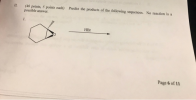 II. Predict the products of the following sequences. No reaction is a (40 points, 5 points each) possible answer Page 6 of 11 NaBH ethanol HBr PBry -0 , ethanol Page
Question 38 2.5 pts Using the activity series, predict if the following reaction will occur, and...
 Question 38 2.5 pts Using the activity series, predict if the following reaction will occur, and what products will form. Mg(s) + HCIO3(aq) - • Spontaneous, Mg(CIO3)2+ H2(g) Spontaneous, H2O + MgCl2 Not Spontaneous (No reaction) Spontaneous, MgCIO3+H2(g)
6. Provide the most efficient synthesis possible by matching the reagents to the reaction. Write the...
 6. Provide the most efficient synthesis possible by matching the reagents to the reaction. Write the letter(s) over or adiacent to the corresponding reaction arrow. As many as three steps represented by each letter may be needed. Assume intermediate products are isolated and purified or used in situ as appropriate. A. H2/Ni B. KI $ C. CuCN NH D. HBF4...
2. When the initial (AB2] is 0.255 M, the half-life of the reaction is 13.5 s...
 2. When the initial (AB2] is 0.255 M, the half-life of the reaction is 13.5 s and when the initial [AB2] is 0.178 M, the half-life of the reaction is 19.3 s. AB2(g) = A(9) + 2B(9) a. Calculate A[B] when [AB] is 0.525 M. (5 pts) ΔΕ Answer: b. Would a 1-step mechanism be plausible for this reaction? Why...
Why must chemical equations be balanced? In a balanced chemical equation, the coefficients in front of...
Why must chemical equations be balanced? In a balanced chemical equation, the coefficients in front of each reactant and product allow us to predict whether the given reaction is possible or not. In a balanced chemical equation, the coefficients in front of each reactant and product allow us to predict whether the reaction requires a catalyst or not. In a...
need help with both questions. 4. Show the structure at the end of each step in...
 need help with both questions.
4. Show the structure at the end of each step in the following reaction sequence. The first step is a Claison reaction. 3) 1.NaOCH 2. H30. Heat 3. Heat Eto Et 5. (From last exam)Predict the organic products of and show the mechanism of the following reaction. H30*
need help with both questions.
4. Show the structure at the end of each step in the following reaction sequence. The first step is a Claison reaction. 3) 1.NaOCH 2. H30. Heat 3. Heat Eto Et 5. (From last exam)Predict the organic products of and show the mechanism of the following reaction. H30*
The following data were obtained for the reaction A+B → products: Experiment [A]O [B]O Initial rate,...
 The following data were obtained for the reaction A+B → products: Experiment [A]O [B]O Initial rate, v (mol L''s') 2 3 1.25 x 10⁻³ M 1.25 x 10⁻³ M 12.50 x 10⁻³ M 1.25 x 10⁻³ M 1.25 x 10⁻³ M 3.13 x 10⁻³ M 3.01 x 10⁻³ M1.00 x 10-3 M 0.0087 0.0174 0.0544 4 ? 10.) Write the...
3. In the reaction where 40.0g of sodium hydroxide reacts with 60.0g of sulfuric acid... Predict...
 3. In the reaction where 40.0g of sodium hydroxide reacts with 60.0g of sulfuric acid... Predict the products. Then, write the balanced chemical equation: Identify the type of reaction Determine the limiting reactant: Calculate the amount (g) of sodium sulfate formed: Calculate the amount (g) of reactant in excess that remains:
Halogenation is often carried out by treating a carbonyl compound with a halogen in acetic acid....
 Halogenation is often carried out by treating a carbonyl compound with a halogen in acetic acid. In this way, acetic acid is both the solvent and the acid catalyst for the reaction. Predict the structure of the products of each reaction below. [12 marks] (a) Cl2 H20, HCI CHO Br2 CH3COOH Br2 CH3COOH
 II. Predict the products of the following sequences. No reaction is a (40 points, 5 points each) possible answer Page 6 of 11 NaBH ethanol HBr PBry -0 , ethanol Page
 Question 38 2.5 pts Using the activity series, predict if the following reaction will occur, and what products will form. Mg(s) + HCIO3(aq) - • Spontaneous, Mg(CIO3)2+ H2(g) Spontaneous, H2O + MgCl2 Not Spontaneous (No reaction) Spontaneous, MgCIO3+H2(g)
 6. Provide the most efficient synthesis possible by matching the reagents to the reaction. Write the letter(s) over or adiacent to the corresponding reaction arrow. As many as three steps represented by each letter may be needed. Assume intermediate products are isolated and purified or used in situ as appropriate. A. H2/Ni B. KI $ C. CuCN NH D. HBF4...
 2. When the initial (AB2] is 0.255 M, the half-life of the reaction is 13.5 s and when the initial [AB2] is 0.178 M, the half-life of the reaction is 19.3 s. AB2(g) = A(9) + 2B(9) a. Calculate A[B] when [AB] is 0.525 M. (5 pts) ΔΕ Answer: b. Would a 1-step mechanism be plausible for this reaction? Why...
 need help with both questions.
4. Show the structure at the end of each step in the following reaction sequence. The first step is a Claison reaction. 3) 1.NaOCH 2. H30. Heat 3. Heat Eto Et 5. (From last exam)Predict the organic products of and show the mechanism of the following reaction. H30*
need help with both questions.
4. Show the structure at the end of each step in the following reaction sequence. The first step is a Claison reaction. 3) 1.NaOCH 2. H30. Heat 3. Heat Eto Et 5. (From last exam)Predict the organic products of and show the mechanism of the following reaction. H30*
 The following data were obtained for the reaction A+B → products: Experiment [A]O [B]O Initial rate, v (mol L''s') 2 3 1.25 x 10⁻³ M 1.25 x 10⁻³ M 12.50 x 10⁻³ M 1.25 x 10⁻³ M 1.25 x 10⁻³ M 3.13 x 10⁻³ M 3.01 x 10⁻³ M1.00 x 10-3 M 0.0087 0.0174 0.0544 4 ? 10.) Write the...
 3. In the reaction where 40.0g of sodium hydroxide reacts with 60.0g of sulfuric acid... Predict the products. Then, write the balanced chemical equation: Identify the type of reaction Determine the limiting reactant: Calculate the amount (g) of sodium sulfate formed: Calculate the amount (g) of reactant in excess that remains:
 Halogenation is often carried out by treating a carbonyl compound with a halogen in acetic acid. In this way, acetic acid is both the solvent and the acid catalyst for the reaction. Predict the structure of the products of each reaction below. [12 marks] (a) Cl2 H20, HCI CHO Br2 CH3COOH Br2 CH3COOH
Most questions answered within 3 hours.