Draw the major organic product(s) of the following reaction (multiple products may be drawn in one box) HBr
 Draw the major organic product(s) of the following reaction (multiple products may be drawn in one box) HBrDraw the major organic product(s) of the following reaction (multiple products may be drawn in one box): HI
Give the major products obtained from the reaction of one equivalent of HCl with the following:...
 Give the major products obtained from the reaction of one equivalent of HCl with the following: 2, 3-dimethyl-1, 3-pentadiene 2, 4-dimethyl-1, 3-pentadiene For each reaction, indicate the kinetic and thermodynamic products.
Draw the curved arrows showing a proton transfer reaction, and draw the products of that proton...
 Draw the curved arrows showing a proton transfer reaction, and
draw the products of that proton transfer. Lone pairs are not
required in the products. This is a Brønsted-Lowry acid
base reaction.
DOCX ® e o + OH H₂CY CH₂
Draw the curved arrows showing a proton transfer reaction, and
draw the products of that proton transfer. Lone pairs are not
required in the products. This is a Brønsted-Lowry acid
base reaction.
DOCX ® e o + OH H₂CY CH₂
8. Provide all the products for each reaction below (no arrow pushing or intermediates). You do...
 8. Provide all the products for each reaction below (no arrow pushing or intermediates). You do not need to label major or minor products or the type of reaction. Et-OM DBN DMSO Foxit HC- DMF Inercih DISC
1. Predict the product for the following reaction. Provide the mechanism for each reaction. Provide the...
 1. Predict the product for the following reaction. Provide the mechanism for each reaction. Provide the sterochemistry and regiochemistry where is appropriate. HBr H2O Cat H+ HBr CHEM 2200-Spring 2020 Hydrohalogenation • Markovnikov orientation • Rearrangement can occur 2. Provide the product for the 2. Provide the product for the following reaction. Provide the sterochemistry and regiochemistry where is appropriate....
2. The following reaction gives two substitution products as well as the three elimination products shown....
 2. The following reaction gives two substitution products as well as the three elimination products shown. Provide a) mechanisms to account for all three elimination products and b) the structures of the substitution products. CH3CH2OH
6-Consider the following balanced chemical reaction: A + B → C The following table shows initial...
6-Consider the following balanced chemical reaction: A + B → C The following table shows initial reaction rates obtained using different initial concentration of A and B: Initial [A] (mol L-1) Initial [B] (mol L-1) Initial Rate (mol L-1 s-1) 0.202 0.350 0.138 0.202 0.701 0.277 0.604 0.350 0.413 0.604 0.701 0.827 If rate = k[A]m[B]n , then m =...
Question 9 10 pts Using the solubility table, predict whether a reaction occurs or no reaction...
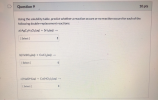 Question 9 10 pts Using the solubility table, predict whether a reaction occurs or no reaction occurs for each of the following double-replacement reactions: a) AgC2H302(aq) + Srlzlaq) → [Select) b) FeSO4(aq) + CuCl(aq) → [Select) c) NaOH(aq) + CO(NO3)2(aq) → [Select)
2. Predict the product CHE CH,SNa 3. Provide a curved-arrow mechanism, and explain the observed stereochemistry...
 2. Predict the product CHE CH,SNa 3. Provide a curved-arrow mechanism, and explain the observed stereochemistry 1) NaOH(aq) (excess) 2) H' workup 4. Explain the difference in reactivity م - م . KOBU no reaction! 5. Explain the difference in reactivity conc. Heso no reaction!
Predict the organic product for the following reaction and complete the arrow pushing mechanism HCI the...
 Predict the organic product for the following reaction and complete the arrow pushing mechanism HCI the reaction by adding the missing curved amows, atoms, bonds, charges, and monbonding electron pairs. Note the resonance arrow(s) in the scheme. Previous ® Give up view SofMhon Check Answer Next Exit
 Give the major products obtained from the reaction of one equivalent of HCl with the following: 2, 3-dimethyl-1, 3-pentadiene 2, 4-dimethyl-1, 3-pentadiene For each reaction, indicate the kinetic and thermodynamic products.
 Draw the curved arrows showing a proton transfer reaction, and
draw the products of that proton transfer. Lone pairs are not
required in the products. This is a Brønsted-Lowry acid
base reaction.
DOCX ® e o + OH H₂CY CH₂
Draw the curved arrows showing a proton transfer reaction, and
draw the products of that proton transfer. Lone pairs are not
required in the products. This is a Brønsted-Lowry acid
base reaction.
DOCX ® e o + OH H₂CY CH₂
 8. Provide all the products for each reaction below (no arrow pushing or intermediates). You do not need to label major or minor products or the type of reaction. Et-OM DBN DMSO Foxit HC- DMF Inercih DISC
 1. Predict the product for the following reaction. Provide the mechanism for each reaction. Provide the sterochemistry and regiochemistry where is appropriate. HBr H2O Cat H+ HBr CHEM 2200-Spring 2020 Hydrohalogenation • Markovnikov orientation • Rearrangement can occur 2. Provide the product for the 2. Provide the product for the following reaction. Provide the sterochemistry and regiochemistry where is appropriate....
 2. The following reaction gives two substitution products as well as the three elimination products shown. Provide a) mechanisms to account for all three elimination products and b) the structures of the substitution products. CH3CH2OH
 Question 9 10 pts Using the solubility table, predict whether a reaction occurs or no reaction occurs for each of the following double-replacement reactions: a) AgC2H302(aq) + Srlzlaq) → [Select) b) FeSO4(aq) + CuCl(aq) → [Select) c) NaOH(aq) + CO(NO3)2(aq) → [Select)
 2. Predict the product CHE CH,SNa 3. Provide a curved-arrow mechanism, and explain the observed stereochemistry 1) NaOH(aq) (excess) 2) H' workup 4. Explain the difference in reactivity م - م . KOBU no reaction! 5. Explain the difference in reactivity conc. Heso no reaction!
 Predict the organic product for the following reaction and complete the arrow pushing mechanism HCI the reaction by adding the missing curved amows, atoms, bonds, charges, and monbonding electron pairs. Note the resonance arrow(s) in the scheme. Previous ® Give up view SofMhon Check Answer Next Exit
Most questions answered within 3 hours.