Predict the major product for the following reaction. H30* Cl2 0 O O O CI CI...
 Predict the major product for the following reaction. H30* Cl2 0 O O O CI CI CI 11 IVCI Ο Ι Ο ΙΙ O 111 O IV
Predict the Product. Provide the stable organic product(s) that would result for each reaction below. Label...
 Predict the Product. Provide the stable organic product(s) that
would result for each reaction below. Label the product formed in
highest yield as “major”.
DME 85 °C DME 85 °C
Predict the Product. Provide the stable organic product(s) that
would result for each reaction below. Label the product formed in
highest yield as “major”.
DME 85 °C DME 85 °C
Predict the product of the following reaction sequence. Note in this case there are two alkylations...
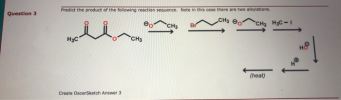 Predict the product of the following reaction sequence. Note in this case there are two alkylations Question 3 Өосн, сн. Өолсн Br H3C-1 Н3СМ осна (heat) Create OscerSketch Answer 3
6. Predict the major product for each of following E2 reaction reactions. KOC(CH3)3 » ДЕГрег косень,...
 6. Predict the major product for each of following E2 reaction reactions. KOC(CH3)3 » ДЕГрег косень, . KOC(CH3)3 © касссны, , KOC(CH3)3 KOC(CHза
Predict the final product for the following reaction sequence. Diethyl malonate 2-methylheptanoic acid 3-methylhexanoic acid 3-methylpentanoic...
 Predict the final product for the following reaction sequence. Diethyl malonate 2-methylheptanoic acid 3-methylhexanoic acid 3-methylpentanoic acid 2-methylpentanoic acid ethyl 2-methylheptanoate Answer:_____
outline a procedure to prepare an ammonia/ammonium buffer solution and use the five step methods to...
outline a procedure to prepare an ammonia/ammonium buffer solution and use the five step methods to predict the quantitive reaction of an ammonia/ ammonium ion buffer solution when a small quantity of HCl is added
Conslder the reaction: H20(g) CO(g)=H2(g) + CO2(g) Which of the following statements are true and which...
 Conslder the reaction: H20(g) CO(g)=H2(g) + CO2(g) Which of the following statements are true and which are false. 1 mol of H2O(g) and 1 mol of CO(g) are placed in a vessel and 1 mol of H2(g) and 1 mol of false CO2(g) are placed in another of equal volume. At equilibrium, at 350°C, the amounts of H2(g) in the...
A 23892U isotope is isolated from a lab sample. (a) What is the nuclear radius (in...
A 23892U isotope is isolated from a lab sample. (a) What is the nuclear radius (in fm)? (b) If a hypothetical isotope with triple the radius (found in part (a)) were isolated from the sample, what would its mass number be?
An isolated vertex is a vertex of degree 0. In the edge probe model, show that...
An isolated vertex is a vertex of degree 0. In the edge probe model, show that the problem of deciding if a graph has an isolated vertex is evasive by constructing an adversary strategy that will make any algorithm query all pairs of vertices.
11. When the temperature is lowered to an equilibrium reaction: a. the reaction moves to the side where there are the gr...
11. When the temperature is lowered to an equilibrium reaction: a. the reaction moves to the side where there are the greatest number of moles b. the reaction will shift to the side of the products c. the reaction will shift to the side of the exothermic reaction d. the reaction will shift to the side of the endothermic reaction
 Predict the major product for the following reaction. H30* Cl2 0 O O O CI CI CI 11 IVCI Ο Ι Ο ΙΙ O 111 O IV
 Predict the Product. Provide the stable organic product(s) that
would result for each reaction below. Label the product formed in
highest yield as “major”.
DME 85 °C DME 85 °C
Predict the Product. Provide the stable organic product(s) that
would result for each reaction below. Label the product formed in
highest yield as “major”.
DME 85 °C DME 85 °C
 Predict the product of the following reaction sequence. Note in this case there are two alkylations Question 3 Өосн, сн. Өолсн Br H3C-1 Н3СМ осна (heat) Create OscerSketch Answer 3
 6. Predict the major product for each of following E2 reaction reactions. KOC(CH3)3 » ДЕГрег косень, . KOC(CH3)3 © касссны, , KOC(CH3)3 KOC(CHза
 Predict the final product for the following reaction sequence. Diethyl malonate 2-methylheptanoic acid 3-methylhexanoic acid 3-methylpentanoic acid 2-methylpentanoic acid ethyl 2-methylheptanoate Answer:_____
 Conslder the reaction: H20(g) CO(g)=H2(g) + CO2(g) Which of the following statements are true and which are false. 1 mol of H2O(g) and 1 mol of CO(g) are placed in a vessel and 1 mol of H2(g) and 1 mol of false CO2(g) are placed in another of equal volume. At equilibrium, at 350°C, the amounts of H2(g) in the...
Most questions answered within 3 hours.