Hydrogen chloride adds ionically to alkenes. In each case predict the major course of the reaction...
Hydrogen chloride adds ionically to alkenes. In each case predict the major course of the reaction of HCL with the following hydrocarbons by writing the structure of the ORGANIC product: a) 1-butene, b) 2-methylpropene, c) 2-phenylpropene
Suggest a mechanism and predict the major product for the following reaction: (Draw the remaining curved...
 Suggest a mechanism and predict the major product for the
following reaction: (Draw the remaining curved arrows and the
product formed in the first step of the mechanism. Include lone
pairs and charges in your answer.)
1) LAH 2) H20
Suggest a mechanism and predict the major product for the
following reaction: (Draw the remaining curved arrows and the
product formed in the first step of the mechanism. Include lone
pairs and charges in your answer.)
1) LAH 2) H20
Predict the structure of A Refluxing Xylene OMOM How would you make B from a Diels...
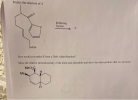 Predict the structure of A Refluxing Xylene OMOM How would you make B from a Diels Alder Reaction? Show the relative stereochemistry of the diene and dienophile and show the other product (the exo product) Me029 Me
Consider the provided mechanism. Even though you have never seen this reaction, use your knowledge of...
 Consider the provided mechanism. Even though you have never seen this reaction, use your knowledge of mechanisms to predict the product(s). OH + CO OH ОН O он он он + H0
Predict the product for the following reaction. Choose from the list of compounds given below. 1-hexanol...
 Predict the product for the following reaction. Choose from the list of compounds given below. 1-hexanol 1. DMSO, (COCI), 2. Etz 2-chlorohexane 2-hexanone hexanoic acid 1-hexanol hexanal
Predict the major product of the reaction shown. CH, 1. Воно 2. Н.О., NaOH CH3 (B)...
 Predict the major product of the reaction shown. CH, 1. Воно 2. Н.О., NaOH CH3 (B) (А) CH3 н ОН ОН CH (D) CH3 Н 3- ОН ОН ОН
Predict three (3) properties of a macroscopic amount of a chemical compound formed upon reaction of...
Predict three (3) properties of a macroscopic amount of a chemical compound formed upon reaction of two (2) elements with each other whose difference in relative electronegativity (∆x) is 3.0. (Attempt to rationalize your answer.)
Write out the reaction for (Label reagents, products, reactants, and mechanisms) 1. (Simmon-Smith Reaction) cyclopropanation of...
 Write out the reaction for (Label reagents, products, reactants, and mechanisms) 1. (Simmon-Smith Reaction) cyclopropanation of an alkene
what are the major products of the reaction below and give a complete step by step...
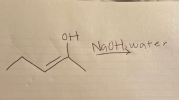 what are the major products of the reaction below and give a
complete step by step of the reaction mechanism.
OH NaOH, water
what are the major products of the reaction below and give a
complete step by step of the reaction mechanism.
OH NaOH, water
6. Show the mechanism and products for the acid/base reaction between cyanidin in its neutral for...
 6. Show the mechanism and products for the acid/base reaction between cyanidin in its neutral form (clearly show the bond between the most acidic hydrogen atom and the oxygen to which it is attached) and a strong base, Sodium Hydroxide. 7. Show the mechanism and products for the acid/base reaction between cyanidin in its neutral form and a strong acid,...
 Suggest a mechanism and predict the major product for the
following reaction: (Draw the remaining curved arrows and the
product formed in the first step of the mechanism. Include lone
pairs and charges in your answer.)
1) LAH 2) H20
Suggest a mechanism and predict the major product for the
following reaction: (Draw the remaining curved arrows and the
product formed in the first step of the mechanism. Include lone
pairs and charges in your answer.)
1) LAH 2) H20
 Predict the structure of A Refluxing Xylene OMOM How would you make B from a Diels Alder Reaction? Show the relative stereochemistry of the diene and dienophile and show the other product (the exo product) Me029 Me
 Consider the provided mechanism. Even though you have never seen this reaction, use your knowledge of mechanisms to predict the product(s). OH + CO OH ОН O он он он + H0
 Predict the product for the following reaction. Choose from the list of compounds given below. 1-hexanol 1. DMSO, (COCI), 2. Etz 2-chlorohexane 2-hexanone hexanoic acid 1-hexanol hexanal
 Predict the major product of the reaction shown. CH, 1. Воно 2. Н.О., NaOH CH3 (B) (А) CH3 н ОН ОН CH (D) CH3 Н 3- ОН ОН ОН
 Write out the reaction for (Label reagents, products, reactants, and mechanisms) 1. (Simmon-Smith Reaction) cyclopropanation of an alkene
 what are the major products of the reaction below and give a
complete step by step of the reaction mechanism.
OH NaOH, water
what are the major products of the reaction below and give a
complete step by step of the reaction mechanism.
OH NaOH, water
 6. Show the mechanism and products for the acid/base reaction between cyanidin in its neutral form (clearly show the bond between the most acidic hydrogen atom and the oxygen to which it is attached) and a strong base, Sodium Hydroxide. 7. Show the mechanism and products for the acid/base reaction between cyanidin in its neutral form and a strong acid,...
Most questions answered within 3 hours.