At the instant shown, point B has a velocity and acceleration, ūB = 4ſ ft's and...
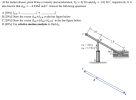 At the instant shown, point B has a velocity and acceleration, ūB = 4ſ ft's and àg = 1.5j ft/s, respectively. It is also known that ã ab = -3.945k rad/s. Answer the following questions: A [20%] A/B = T + B [20%] Draw the vector ŽABXA/B in the bar figure below. C [20%] Draw the vector WABXWABXPA/B) in the...
At the instant represented, the velocity of point A of the 2.06-m bar is 3.1 m/s...
 At the instant represented, the velocity of point A of the 2.06-m bar is 3.1 m/s to the right. Determine the speed Va of point B and the magnitude of the angular velocity w of the bar. The diameter of the small end wheels may be neglected. 0.52 m 59° BC 2.06 m А VA Answers: Va = m/s rad/s
on link BC at the instant shown. Determine the velocity of point Express your answer to...
 on link BC at the instant shown. Determine the velocity of point Express your answer to three significant figures and include the appropriate units. Link CD has an angular velocity of wCD (Figure 1) 6 rad/s. C. 7 Value Units UB = Figure 1 of 1 Submit Request Answern Part B 0.3 m 0.3 m Determine the angular velocity link...
Determine the angular velocity of links BC and AB at the instant shown, if point C...
 Determine the angular velocity of links BC and AB at the instant shown, if point C is having a velocity of 3 ft/s. -3 ft VC В. 1.5 ft 45 po А
1. Two infinitely long parallel wires are situated at x = +1 meter along the x-axis...
 1. Two infinitely long parallel wires are situated at x = +1 meter along the x-axis as shown in the figure. They each carry a current of 1 ampere the wire on left out of page the wire on the right into page. A point P is located at y = 1 meter on the y-axis. a. Make a qualitative...
7. Consider two waves traveling in the same direction but with two slightly different angular frequencies ω- Δω and ω+ 2Δο. Let the fields have the same amplitude and polarization. a. Show the sum of...
 7. Consider two waves traveling in the same direction but with two slightly different angular frequencies ω- Δω and ω+ 2Δο. Let the fields have the same amplitude and polarization. a. Show the sum of the two waves is equivalent to a wave moving with a phase velocity vp-ωΚ but with an amplitude envelope which moves with a group velocity...
2. [50 pts] Given: A 100-MHZ TM polarized wave with an amplitude of 1 V/m is...
 2. [50 pts] Given: A 100-MHZ TM polarized wave with an amplitude of 1 V/m is obliquely incident from air (z <0) onto a slab of lossless, nonmagnetic material with er = 25. The angle of incidence is 40°. Find: a) Determine the angle of transmission; b) determine the reflection and transmission coefficients and c) determine expressions for the incident,...
A conventional current passing through a resistor. Which of the following statements are correct if we...
 A conventional current passing through a resistor. Which of the following statements are correct if we are moving opposite direction of current? (There could be more than one correct choice.) The charges are moving slower. The electric potential remains same. The current remains same. The electric potential is increasing. The electric potential is decreasing.
SOLVE THE 3RD ONE INCLUDE ALL THE STEPS At a given temperature the rotational states of molecules are distributed according to the Boltzmann distribution. Of the hydrogen molecules in the ground state...
 SOLVE THE 3RD ONE INCLUDE ALL
THE STEPS
At a given temperature the rotational states of molecules are distributed according to the Boltzmann distribution. Of the hydrogen molecules in the ground state estimate the ratio of the number in the ground rotational state to the number in the first excited rotational state at 300 K. Take the interatomic distance as...
SOLVE THE 3RD ONE INCLUDE ALL
THE STEPS
At a given temperature the rotational states of molecules are distributed according to the Boltzmann distribution. Of the hydrogen molecules in the ground state estimate the ratio of the number in the ground rotational state to the number in the first excited rotational state at 300 K. Take the interatomic distance as...
Solve 1st one asap At a given temperature the rotational states of molecules are distributed according to the Boltzmann distribution. Of the hydrogen molecules in the ground state estimate the ratio o...
 Solve 1st one asap
At a given temperature the rotational states of molecules are distributed according to the Boltzmann distribution. Of the hydrogen molecules in the ground state estimate the ratio of the number in the ground rotational state to the number in the first excited rotational state at 300 K. Take the interatomic distance as 1.06 Å. Estimate the...
Solve 1st one asap
At a given temperature the rotational states of molecules are distributed according to the Boltzmann distribution. Of the hydrogen molecules in the ground state estimate the ratio of the number in the ground rotational state to the number in the first excited rotational state at 300 K. Take the interatomic distance as 1.06 Å. Estimate the...
 At the instant shown, point B has a velocity and acceleration, ūB = 4ſ ft's and àg = 1.5j ft/s, respectively. It is also known that ã ab = -3.945k rad/s. Answer the following questions: A [20%] A/B = T + B [20%] Draw the vector ŽABXA/B in the bar figure below. C [20%] Draw the vector WABXWABXPA/B) in the...
 At the instant represented, the velocity of point A of the 2.06-m bar is 3.1 m/s to the right. Determine the speed Va of point B and the magnitude of the angular velocity w of the bar. The diameter of the small end wheels may be neglected. 0.52 m 59° BC 2.06 m А VA Answers: Va = m/s rad/s
 on link BC at the instant shown. Determine the velocity of point Express your answer to three significant figures and include the appropriate units. Link CD has an angular velocity of wCD (Figure 1) 6 rad/s. C. 7 Value Units UB = Figure 1 of 1 Submit Request Answern Part B 0.3 m 0.3 m Determine the angular velocity link...
 Determine the angular velocity of links BC and AB at the instant shown, if point C is having a velocity of 3 ft/s. -3 ft VC В. 1.5 ft 45 po А
 1. Two infinitely long parallel wires are situated at x = +1 meter along the x-axis as shown in the figure. They each carry a current of 1 ampere the wire on left out of page the wire on the right into page. A point P is located at y = 1 meter on the y-axis. a. Make a qualitative...
 7. Consider two waves traveling in the same direction but with two slightly different angular frequencies ω- Δω and ω+ 2Δο. Let the fields have the same amplitude and polarization. a. Show the sum of the two waves is equivalent to a wave moving with a phase velocity vp-ωΚ but with an amplitude envelope which moves with a group velocity...
 2. [50 pts] Given: A 100-MHZ TM polarized wave with an amplitude of 1 V/m is obliquely incident from air (z <0) onto a slab of lossless, nonmagnetic material with er = 25. The angle of incidence is 40°. Find: a) Determine the angle of transmission; b) determine the reflection and transmission coefficients and c) determine expressions for the incident,...
 A conventional current passing through a resistor. Which of the following statements are correct if we are moving opposite direction of current? (There could be more than one correct choice.) The charges are moving slower. The electric potential remains same. The current remains same. The electric potential is increasing. The electric potential is decreasing.
 SOLVE THE 3RD ONE INCLUDE ALL
THE STEPS
At a given temperature the rotational states of molecules are distributed according to the Boltzmann distribution. Of the hydrogen molecules in the ground state estimate the ratio of the number in the ground rotational state to the number in the first excited rotational state at 300 K. Take the interatomic distance as...
SOLVE THE 3RD ONE INCLUDE ALL
THE STEPS
At a given temperature the rotational states of molecules are distributed according to the Boltzmann distribution. Of the hydrogen molecules in the ground state estimate the ratio of the number in the ground rotational state to the number in the first excited rotational state at 300 K. Take the interatomic distance as...
 Solve 1st one asap
At a given temperature the rotational states of molecules are distributed according to the Boltzmann distribution. Of the hydrogen molecules in the ground state estimate the ratio of the number in the ground rotational state to the number in the first excited rotational state at 300 K. Take the interatomic distance as 1.06 Å. Estimate the...
Solve 1st one asap
At a given temperature the rotational states of molecules are distributed according to the Boltzmann distribution. Of the hydrogen molecules in the ground state estimate the ratio of the number in the ground rotational state to the number in the first excited rotational state at 300 K. Take the interatomic distance as 1.06 Å. Estimate the...
Most questions answered within 3 hours.