This is an E1 reaction, I am having trouble getting the products for it though. Part...
 This is an E1 reaction, I am having trouble getting the products
for it though.
Part 1 (2.5 points) Feedback M See Periodic Table See Hint Draw the intermediate formed in the reaction. Part 2 (2.5 points) Feedback See Hint Draw the product(s) formed in the reaction.
This is an E1 reaction, I am having trouble getting the products
for it though.
Part 1 (2.5 points) Feedback M See Periodic Table See Hint Draw the intermediate formed in the reaction. Part 2 (2.5 points) Feedback See Hint Draw the product(s) formed in the reaction.
8. In a reaction, 2A - Products, the concentration of A decreases from 0.5 mol L-1...
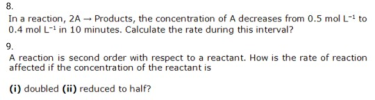 8. In a reaction, 2A - Products, the concentration of A decreases from 0.5 mol L-1 to 0.4 mol L- in 10 minutes. Calculate the rate during this interval? A reaction is second order with respect to a reactant. How is the rate of reaction affected if the concentration of the reactant is (i) doubled (ii) reduced to half?
Which of the following is the correct expression for the rate of appearance of one of...
Which of the following is the correct expression for the rate of appearance of one of the products in the following reaction? 3A + 6B → 5C + 2D What is the change in entropy for the fusion of 2.5 mol of mercury at 234 K? (ΔHfus (Hg) = 23 kJ /mol) If the half-life of a reaction is independent...
For the following reaction: A(g) ⇌ 2 B(g) Given the following information, what is the equilibrium...
For the following reaction: A(g) ⇌ 2 B(g) Given the following information, what is the equilibrium pressure of B in bar? Initial pressure of A = 2.700 bar Initial pressure of B = 0 bar K = 6.4 x 10⁻⁵
9,10,11 9. Consider the decomposition reaction of N2Os. 2 N203(g) → 4NO2(g) + O2(g) follows the...
 9,10,11
9. Consider the decomposition reaction of N2Os. 2 N203(g) → 4NO2(g) + O2(g) follows the first order kinetics with rate constant of 4.8 x 10's. (a) if the initial 165 x 10-2M what is the concentration at 825 s? (b) How long it will take for concentration is 1.65 x 10⁻²M what is the concentrat the concentration of N2Os...
9,10,11
9. Consider the decomposition reaction of N2Os. 2 N203(g) → 4NO2(g) + O2(g) follows the first order kinetics with rate constant of 4.8 x 10's. (a) if the initial 165 x 10-2M what is the concentration at 825 s? (b) How long it will take for concentration is 1.65 x 10⁻²M what is the concentrat the concentration of N2Os...
Part B The graph shows three reaction pathways for the same biological reaction One reaction pathway...
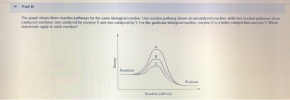 Part B The graph shows three reaction pathways for the same biological reaction One reaction pathway shows an uncatalyzed reaction, while two reaction pathways show catalyzed reactions: one catalyzed by enzyme X and one catalyzed by Y. For this particular biological reaction, enzyme X is a better catalyst than enzyme Y. Which statements apply to each reaction? Products Reaction pathway...
A decomposition reaction has a half-life that inversely depends on the initial concentration of the reactant...
 A decomposition reaction has a half-life that inversely depends on the initial concentration of the reactant What is the order of the reaction? second order first order zero order Order cannot be determined without more information
The rate constant for a reaction at 900 K is 3.15 × 10⁻² 1/s. What is...
The rate constant for a reaction at 900 K is 3.15 × 10⁻² 1/s. What is the reaction order? If the initial concentration of the reactant is 1.25×10⁻¹M, calculate its concentration after 120 second
Consider the reaction: SO2Cl2(g) SO2(g) + Cl2(g) A reaction mixture contains an initial concentration of [SO2Cl2]...
Consider the reaction: SO2Cl2(g) SO2(g) + Cl2(g) A reaction mixture contains an initial concentration of [SO2Cl2] = 0.020M. At equilibrium, [Cl2] = 1.2 x 10⁻² M. Calculate the value of Kc.
Reaction kinetics
If the slope of a hypothetical reaction is the second order is 5 and the initialconcentraition ls 0.2 M. Calculate the concentration of the reactants that havedecomposed if the reaction takes 20sa) 0.01 (6) 0.20O0.19 (d) 0.02
 This is an E1 reaction, I am having trouble getting the products
for it though.
Part 1 (2.5 points) Feedback M See Periodic Table See Hint Draw the intermediate formed in the reaction. Part 2 (2.5 points) Feedback See Hint Draw the product(s) formed in the reaction.
This is an E1 reaction, I am having trouble getting the products
for it though.
Part 1 (2.5 points) Feedback M See Periodic Table See Hint Draw the intermediate formed in the reaction. Part 2 (2.5 points) Feedback See Hint Draw the product(s) formed in the reaction.
 8. In a reaction, 2A - Products, the concentration of A decreases from 0.5 mol L-1 to 0.4 mol L- in 10 minutes. Calculate the rate during this interval? A reaction is second order with respect to a reactant. How is the rate of reaction affected if the concentration of the reactant is (i) doubled (ii) reduced to half?
 9,10,11
9. Consider the decomposition reaction of N2Os. 2 N203(g) → 4NO2(g) + O2(g) follows the first order kinetics with rate constant of 4.8 x 10's. (a) if the initial 165 x 10-2M what is the concentration at 825 s? (b) How long it will take for concentration is 1.65 x 10⁻²M what is the concentrat the concentration of N2Os...
9,10,11
9. Consider the decomposition reaction of N2Os. 2 N203(g) → 4NO2(g) + O2(g) follows the first order kinetics with rate constant of 4.8 x 10's. (a) if the initial 165 x 10-2M what is the concentration at 825 s? (b) How long it will take for concentration is 1.65 x 10⁻²M what is the concentrat the concentration of N2Os...
 Part B The graph shows three reaction pathways for the same biological reaction One reaction pathway shows an uncatalyzed reaction, while two reaction pathways show catalyzed reactions: one catalyzed by enzyme X and one catalyzed by Y. For this particular biological reaction, enzyme X is a better catalyst than enzyme Y. Which statements apply to each reaction? Products Reaction pathway...
 A decomposition reaction has a half-life that inversely depends on the initial concentration of the reactant What is the order of the reaction? second order first order zero order Order cannot be determined without more information
Most questions answered within 3 hours.