10. Draw the product(s) of this E2 elimination reaction and draw the conformation of the substrate...
 10. Draw the product(s) of this E2 elimination reaction and draw the conformation of the substrate that leads to the product(s) and fulfils the stereoelectronic requirements for E2 elimination. (CH3)3COK Pdt augu movie së zo mod core conformation possible products conformation only product I conformation possible products goy yo conformation possible products conformation only product
Please use the following chemical reaction to explain what is chemical equilibrium, and describe it’s characteristics,...
 Please use the following chemical reaction to explain what is
chemical equilibrium, and describe it’s characteristics, in terms
of the molar concentrations of the products.
[C0450 -(1-ak0,+ acor<o:) Jreactatns products
Please use the following chemical reaction to explain what is
chemical equilibrium, and describe it’s characteristics, in terms
of the molar concentrations of the products.
[C0450 -(1-ak0,+ acor<o:) Jreactatns products
Describe the pathophysiology of an isolated left sided LMN lesion of the oculomotor nerve?
describe the pathophysiology of an isolated left sided LMN lesion of the oculomotor nerve?
Classify each of the four compounds below as a conjugated, isolated, or cumulated diene.
 Classify each of the four compounds below as a conjugated,
isolated, or cumulated diene.
Classify each of the four compounds below as a conjugated,
isolated, or cumulated diene.
3. Why is an isolated α-helix rarely seen in a soluble protein?
 3. Why is an isolated α-helix rarely seen in a soluble protein?
a. Write the rate law for this reaction. b. Calculate the rate constant. c. At what...
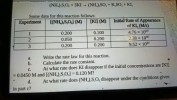 a. Write the rate law for this reaction.
b. Calculate the rate constant.
c. At what rate does KI disappear if the initial concentrations are
[KI] = 0.0450 M and [(NH4)2S2O8] = 0.120 M?
d. At what rate does (NH4)2S2O8 disappear under the conditions
given in part c?
The powers of 10 in the last boxes are 10^-3
Some data...
a. Write the rate law for this reaction.
b. Calculate the rate constant.
c. At what rate does KI disappear if the initial concentrations are
[KI] = 0.0450 M and [(NH4)2S2O8] = 0.120 M?
d. At what rate does (NH4)2S2O8 disappear under the conditions
given in part c?
The powers of 10 in the last boxes are 10^-3
Some data...
6.The conversion of eyelopropan to proenroceds i1 order reaction. CH2 0% CH H2C-CH2 a. At a...
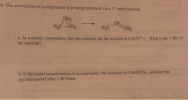 6.The conversion of eyelopropan to proenroceds i1 order reaction. CH2 0% CH H2C-CH2 a. At a certain temperature, the rate constant for the reaction is 5.4x10⁻⁴ s". what is the the reaction? life of b. If the initial concentration of cyclopropane (the reactant) is 0.00530 M, calculate the [cyclopropane] after 1.90 hours
Prelab: Chemical Reactions Name three types of double displacement reactions. How are they defined? What pushes...
Prelab: Chemical Reactions Name three types of double displacement reactions. How are they defined? What pushes the double displacement reactions toward completion? Consider the reaction of aqueous hydrochloric acid and aqueous barium hydroxide. Write balanced molecular, complete ionic, and net ionic equations for this chemical reaction. What are spectator ions? Identify any spectator ions from the reaction in the question...
Draw the structures of all possible products formed in the following reaction involving an acid anhydride dissolved in alcohol.
 Draw the structures of all possible products formed in the following reaction involving an acid anhydride dissolved in alcohol.
Draw the structures of all possible products formed in the following reaction involving an acid anhydride...
 Draw the structures of all possible products formed in the
following reaction involving an acid anhydride dissolved in
alcohol.
Draw the structures of all possible products formed in the
following reaction involving an acid anhydride dissolved in
alcohol.
 10. Draw the product(s) of this E2 elimination reaction and draw the conformation of the substrate that leads to the product(s) and fulfils the stereoelectronic requirements for E2 elimination. (CH3)3COK Pdt augu movie së zo mod core conformation possible products conformation only product I conformation possible products goy yo conformation possible products conformation only product
 Please use the following chemical reaction to explain what is
chemical equilibrium, and describe it’s characteristics, in terms
of the molar concentrations of the products.
[C0450 -(1-ak0,+ acor<o:) Jreactatns products
Please use the following chemical reaction to explain what is
chemical equilibrium, and describe it’s characteristics, in terms
of the molar concentrations of the products.
[C0450 -(1-ak0,+ acor<o:) Jreactatns products
 Classify each of the four compounds below as a conjugated,
isolated, or cumulated diene.
Classify each of the four compounds below as a conjugated,
isolated, or cumulated diene.
 3. Why is an isolated α-helix rarely seen in a soluble protein?
 a. Write the rate law for this reaction.
b. Calculate the rate constant.
c. At what rate does KI disappear if the initial concentrations are
[KI] = 0.0450 M and [(NH4)2S2O8] = 0.120 M?
d. At what rate does (NH4)2S2O8 disappear under the conditions
given in part c?
The powers of 10 in the last boxes are 10^-3
Some data...
a. Write the rate law for this reaction.
b. Calculate the rate constant.
c. At what rate does KI disappear if the initial concentrations are
[KI] = 0.0450 M and [(NH4)2S2O8] = 0.120 M?
d. At what rate does (NH4)2S2O8 disappear under the conditions
given in part c?
The powers of 10 in the last boxes are 10^-3
Some data...
 6.The conversion of eyelopropan to proenroceds i1 order reaction. CH2 0% CH H2C-CH2 a. At a certain temperature, the rate constant for the reaction is 5.4x10⁻⁴ s". what is the the reaction? life of b. If the initial concentration of cyclopropane (the reactant) is 0.00530 M, calculate the [cyclopropane] after 1.90 hours
 Draw the structures of all possible products formed in the
following reaction involving an acid anhydride dissolved in
alcohol.
Draw the structures of all possible products formed in the
following reaction involving an acid anhydride dissolved in
alcohol.
Most questions answered within 3 hours.