For the decomposition of A to B and C A(n) B(g) + C(g) how will the...
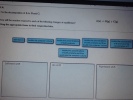 For the decomposition of A to B and C A(n) B(g) + C(g) how will the reaction respond to each of the following changes at equilibrium? Drag the appropriate items to their respective bins. double the concentration of B and haive the double the concentrations add more A double the container volume double the concentrations of both products and then...
For the reaction A → products, the data of an experiment in which [A] 0 = 0.6 mol L-1 are: find ...
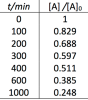 For the reaction A → products, the data of an experiment in
which [A] 0 = 0.6 mol L-1 are:
find a) the order of the reaction y) the reaction rate constant
c) the reaction half-life.
t/min | [AMA]0 100 200 300 400 600 1000 0.829 0.688 0.597 0.511 0.385 0.248
t/min | [AMA]0 100 200 300 400 600 1000...
For the reaction A → products, the data of an experiment in
which [A] 0 = 0.6 mol L-1 are:
find a) the order of the reaction y) the reaction rate constant
c) the reaction half-life.
t/min | [AMA]0 100 200 300 400 600 1000 0.829 0.688 0.597 0.511 0.385 0.248
t/min | [AMA]0 100 200 300 400 600 1000...
5) This El reaction is reversible. Explain how the reaction reverses using an electron-pushing! mechanism with...
 5) This El reaction is reversible. Explain how the reaction reverses using an electron-pushing! mechanism with both alkene products. Furthermore, the E2 reaction is irreversible, explain why. (7 pts) 6-8 dure - E1 Reaction: Dehydration of 2-methyl-2-butanol (in pairs) H2SO4 (aq) ~ + H2O 6.6 Procedure - E2: Dehydrochlorination of 2-chloro-2-methylbutane (in pairs) A KOH/PrOH reflux celluxo . m +KCI...
the problems below tabel they had a marc ar.o . mechanism and product or products indicate stereacherywhere Reaction of...
 the problems below tabel they had a marc ar.o . mechanism and product or products indicate stereacherywhere Reaction of bromopropane and sodium methode in methane CHO b Reaction of 2-bromopropane in ethanol -Br + CH CH OH Reaction of (R) 3-chloro-3-methylheptane in acetic acid ---CHE CH,COOH d. Reaction of the molecule shown with sodium methoxide in aprotic solvent CH H...
I need question 2 please! CHa CH3 он Figure 1: Possible hydroboration-oxidation products of the reaction...
 I need question 2 please!
CHa CH3 он Figure 1: Possible hydroboration-oxidation products of the reaction with 1-methyl-1- cyclohexene H or 2-indanol 1-indanol Figure 2: Hydroboration-oxidation reaction with indene Pre-lab questions 1. What kind of reaction is hydroboration-oxidation, substitution, addition, or elimination? Why? 2. What is the structure of the intermediate formed in the first step of the reaction with...
I need question 2 please!
CHa CH3 он Figure 1: Possible hydroboration-oxidation products of the reaction with 1-methyl-1- cyclohexene H or 2-indanol 1-indanol Figure 2: Hydroboration-oxidation reaction with indene Pre-lab questions 1. What kind of reaction is hydroboration-oxidation, substitution, addition, or elimination? Why? 2. What is the structure of the intermediate formed in the first step of the reaction with...
Select all that apply. Atom A reacts with molecule BC according to the following reaction: 10...
 Select all that apply. Atom A reacts with molecule BC according to the following reaction: 10 points A + BC → products If an atom of A collides with a molecule of BC, but no reaction occurs, what are the possible reasons why? Select all that apply. A. The reactants are moving too rapidly for the reaction to occur. B....
6. The major products of the following reaction are, 8. tor 0.0 7. The reagent needed...
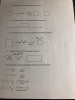 6. The major products of the following reaction are, 8. tor 0.0 7. The reagent needed to complete the following reaction is, 8. The starting material needed to complete the following reaction is HSH 9. The major product of the following reaction is, CH -5: KⓇ CÍ H DMSO 10. Circle which reactions proceed according to an E2 mechanism? othanol...
March 4, 2020 5. The reaction of 'butyl-bromide (CH3)3CBr with water is represented by the equation:...
 March 4, 2020 5. The reaction of 'butyl-bromide (CH3)3CBr with water is represented by the equation: (CH3),CBr + H2O → (CH3)3COH + HBr The following data were obtained from three experiments: Experiment 1 Experiment 2 Experiment 3 Initial [(CH3)3CBr mol L-1 5.0 x 10⁻² 5.0 x 10⁻² 1.0 x 10⁻¹ Initial [H0] mol L 2.0 x 10⁻² 4.0 x 10²...
The Reaction Quotient 9 of 10 > - Review Constants Periodic Table When conducting chemical reactions...
 The Reaction Quotient 9 of 10 > - Review Constants Periodic Table When conducting chemical reactions in the lab or in industrial processes, it can be important to know whether a reaction has reached equilibrium By measuring the reaction quotient, Q. of a chemical reaction and comparing it to the equilibrium constant, K, we can identify whether a reaction is...
please solve with clear steps Part 1:Propane dehydrogenation (PDH) is the extensive pathway to produce propylene,...
 please
solve with clear steps
Part 1:Propane dehydrogenation (PDH) is the extensive pathway to produce propylene, which is one of the most important petrochemical building blocks for the production of a diverse range of products, from solvents to plastics and other valuable intermediates. The other by product of this reaction is hydrogen gas. The reaction is happening at atmospheric pressure....
please
solve with clear steps
Part 1:Propane dehydrogenation (PDH) is the extensive pathway to produce propylene, which is one of the most important petrochemical building blocks for the production of a diverse range of products, from solvents to plastics and other valuable intermediates. The other by product of this reaction is hydrogen gas. The reaction is happening at atmospheric pressure....
 For the decomposition of A to B and C A(n) B(g) + C(g) how will the reaction respond to each of the following changes at equilibrium? Drag the appropriate items to their respective bins. double the concentration of B and haive the double the concentrations add more A double the container volume double the concentrations of both products and then...
 For the reaction A → products, the data of an experiment in
which [A] 0 = 0.6 mol L-1 are:
find a) the order of the reaction y) the reaction rate constant
c) the reaction half-life.
t/min | [AMA]0 100 200 300 400 600 1000 0.829 0.688 0.597 0.511 0.385 0.248
t/min | [AMA]0 100 200 300 400 600 1000...
For the reaction A → products, the data of an experiment in
which [A] 0 = 0.6 mol L-1 are:
find a) the order of the reaction y) the reaction rate constant
c) the reaction half-life.
t/min | [AMA]0 100 200 300 400 600 1000 0.829 0.688 0.597 0.511 0.385 0.248
t/min | [AMA]0 100 200 300 400 600 1000...
 5) This El reaction is reversible. Explain how the reaction reverses using an electron-pushing! mechanism with both alkene products. Furthermore, the E2 reaction is irreversible, explain why. (7 pts) 6-8 dure - E1 Reaction: Dehydration of 2-methyl-2-butanol (in pairs) H2SO4 (aq) ~ + H2O 6.6 Procedure - E2: Dehydrochlorination of 2-chloro-2-methylbutane (in pairs) A KOH/PrOH reflux celluxo . m +KCI...
 the problems below tabel they had a marc ar.o . mechanism and product or products indicate stereacherywhere Reaction of bromopropane and sodium methode in methane CHO b Reaction of 2-bromopropane in ethanol -Br + CH CH OH Reaction of (R) 3-chloro-3-methylheptane in acetic acid ---CHE CH,COOH d. Reaction of the molecule shown with sodium methoxide in aprotic solvent CH H...
 I need question 2 please!
CHa CH3 он Figure 1: Possible hydroboration-oxidation products of the reaction with 1-methyl-1- cyclohexene H or 2-indanol 1-indanol Figure 2: Hydroboration-oxidation reaction with indene Pre-lab questions 1. What kind of reaction is hydroboration-oxidation, substitution, addition, or elimination? Why? 2. What is the structure of the intermediate formed in the first step of the reaction with...
I need question 2 please!
CHa CH3 он Figure 1: Possible hydroboration-oxidation products of the reaction with 1-methyl-1- cyclohexene H or 2-indanol 1-indanol Figure 2: Hydroboration-oxidation reaction with indene Pre-lab questions 1. What kind of reaction is hydroboration-oxidation, substitution, addition, or elimination? Why? 2. What is the structure of the intermediate formed in the first step of the reaction with...
 Select all that apply. Atom A reacts with molecule BC according to the following reaction: 10 points A + BC → products If an atom of A collides with a molecule of BC, but no reaction occurs, what are the possible reasons why? Select all that apply. A. The reactants are moving too rapidly for the reaction to occur. B....
 6. The major products of the following reaction are, 8. tor 0.0 7. The reagent needed to complete the following reaction is, 8. The starting material needed to complete the following reaction is HSH 9. The major product of the following reaction is, CH -5: KⓇ CÍ H DMSO 10. Circle which reactions proceed according to an E2 mechanism? othanol...
 March 4, 2020 5. The reaction of 'butyl-bromide (CH3)3CBr with water is represented by the equation: (CH3),CBr + H2O → (CH3)3COH + HBr The following data were obtained from three experiments: Experiment 1 Experiment 2 Experiment 3 Initial [(CH3)3CBr mol L-1 5.0 x 10⁻² 5.0 x 10⁻² 1.0 x 10⁻¹ Initial [H0] mol L 2.0 x 10⁻² 4.0 x 10²...
 The Reaction Quotient 9 of 10 > - Review Constants Periodic Table When conducting chemical reactions in the lab or in industrial processes, it can be important to know whether a reaction has reached equilibrium By measuring the reaction quotient, Q. of a chemical reaction and comparing it to the equilibrium constant, K, we can identify whether a reaction is...
 please
solve with clear steps
Part 1:Propane dehydrogenation (PDH) is the extensive pathway to produce propylene, which is one of the most important petrochemical building blocks for the production of a diverse range of products, from solvents to plastics and other valuable intermediates. The other by product of this reaction is hydrogen gas. The reaction is happening at atmospheric pressure....
please
solve with clear steps
Part 1:Propane dehydrogenation (PDH) is the extensive pathway to produce propylene, which is one of the most important petrochemical building blocks for the production of a diverse range of products, from solvents to plastics and other valuable intermediates. The other by product of this reaction is hydrogen gas. The reaction is happening at atmospheric pressure....
Most questions answered within 3 hours.