3. In the deuterium -labeled compound below predict the product (s) of the elimination reactions of...
 3. In the deuterium -labeled compound below predict the product (s) of the elimination reactions of the following elimination reaction and tell whether the alkene formed contains deuterium (D) or not. (20 pts) Н.с, сн, OH H2SO&(aq) (i) heat НС NAOCH2CH3 (ii) CH3CH2OH н CH3 heat (iii) Write a detail mechanism for the formation of the product in question 3(i)
16. Considering the relative solvation of reactants and the transition states of substitution reactions of these re...
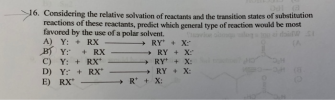 16. Considering the relative solvation of reactants and the transition states of substitution reactions of these reactants, predict which general type of reaction would be most favored by the use of a polar solvent. A) Y: + RX → RY+ + X: B) Y + RX RY + X:- C) Y: + RX - RY+ + X: HOH D) Y:...
Predict the Product. Provide the stable organic product(s) for each reaction below 1. NaBH4, CH,OH 2....
 Predict the Product. Provide the
stable organic product(s) for each reaction below
1. NaBH4, CH,OH 2. HCI, H20 1. NaBH4 (0.50 eq.), CH3OH 2. HCI, H,0 1. LIAIH4 (1 eq.), THF 2. HCI, H20 1. NaBH(OCH3)3, (1 eq.), CH3OH 2. HCI, H2O
Predict the Product. Provide the
stable organic product(s) for each reaction below
1. NaBH4, CH,OH 2. HCI, H20 1. NaBH4 (0.50 eq.), CH3OH 2. HCI, H,0 1. LIAIH4 (1 eq.), THF 2. HCI, H20 1. NaBH(OCH3)3, (1 eq.), CH3OH 2. HCI, H2O
CONCEPT QUESTION Predict the Product. Provide the stable organic product(s) for each reaction below. 1. NaBH4,...
 CONCEPT QUESTION Predict the Product. Provide the stable organic product(s) for each reaction below. 1. NaBH4, CH3OH 2. HCI, H20 1. NaBH4 (1 eq.), CH3OH 2. HCI, H2O H 1. NaBH(OCH3)3, (1 eq.), CH3OH 2. HCI, H20 1. LIAIH4 (1 eq.), THE 2. HCI, H2O
6. (3 points) For each of the following reactions, predict the sign (positive or negative) for...
 6. (3 points) For each of the following reactions, predict the sign (positive or negative) for the AS and AH values. Then determine when the reaction will be spontaneous (always, never, at high temperatures, or at low temperatures). a. CH4(g) + 202 (g) → CO2 (g) + 2H20 (g) b. 4H3PO4(s) - P010 (s) + 6H20 (1) c. HCI (g)...
1A) Write a balanced equation for the following reaction in basic solution. Fe(OH)3 + ClO– →...
1A) Write a balanced equation for the following reaction in basic solution. Fe(OH)3 + ClO– → FeO42−+Cl− 1B) Use VSEPR theory to predict a molecular shape for XeF2 and hence determine the total number of vibrational modes expected to be observed in its IR and Raman spectra. Would any of these absorptions occur at the same frequency in both Raman...
I wanted to bnb know the product of this reaction I. Sketch the MOs in s-cis...
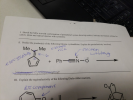 I wanted to bnb know the product of this reaction
I. Sketch the MOs in s-cis conformation of pentadienyl system showing node(s). Indicate the frontier orbitals for cation, anion and radical species with symmetry II. Predict the product(s) of the following fulvene cycloaddition. Explain the periselectivity inw olved. lecon FU III. Explain the regioselectivity of the following Diels-Alder reactions.
I wanted to bnb know the product of this reaction
I. Sketch the MOs in s-cis conformation of pentadienyl system showing node(s). Indicate the frontier orbitals for cation, anion and radical species with symmetry II. Predict the product(s) of the following fulvene cycloaddition. Explain the periselectivity inw olved. lecon FU III. Explain the regioselectivity of the following Diels-Alder reactions.
Question Predict the major product for the following reaction. 1. LDA Н 2. о 3. Но...
 Question Predict the major product for the following reaction. 1. LDA Н 2. о 3. Но ОН ОН Н Н || ОН Н ОН IV V ООООО O A. 11 В. І Ос. IV D.V E. III Click Save and Submit to save and submit. Click Save All Answers to save all answers. Ma
RM-Q26 Predict the product of the reaction. ОН ОН ко Na2Cr201 H2SO4, H20 ? о ОН...
 RM-Q26 Predict the product of the reaction. ОН ОН ко Na2Cr201 H2SO4, H20 ? о ОН ОН о ОН ОН ОН А) B) C) ОН ОН Н ОН 5. D) E) Select an answer and submit. For keyboard navigation, use the up/down arrow keys to select an answer. a а b b с с
III. Predict the major product(s) or fill in the reagent(s) for the following reactions. If there...
 III. Predict the major product(s) or fill in the reagent(s) for the following reactions. If there is no reaction write NR. (6 points each, 36 points total) Show the correct stereochemistry when needed!! 16 H,Cro (excess) -CHO HO 17 1)0, (2 equiv.) 2) Mes (2 equiv.) 18 Ph Ph Ph Ph OH
 3. In the deuterium -labeled compound below predict the product (s) of the elimination reactions of the following elimination reaction and tell whether the alkene formed contains deuterium (D) or not. (20 pts) Н.с, сн, OH H2SO&(aq) (i) heat НС NAOCH2CH3 (ii) CH3CH2OH н CH3 heat (iii) Write a detail mechanism for the formation of the product in question 3(i)
 16. Considering the relative solvation of reactants and the transition states of substitution reactions of these reactants, predict which general type of reaction would be most favored by the use of a polar solvent. A) Y: + RX → RY+ + X: B) Y + RX RY + X:- C) Y: + RX - RY+ + X: HOH D) Y:...
 Predict the Product. Provide the
stable organic product(s) for each reaction below
1. NaBH4, CH,OH 2. HCI, H20 1. NaBH4 (0.50 eq.), CH3OH 2. HCI, H,0 1. LIAIH4 (1 eq.), THF 2. HCI, H20 1. NaBH(OCH3)3, (1 eq.), CH3OH 2. HCI, H2O
Predict the Product. Provide the
stable organic product(s) for each reaction below
1. NaBH4, CH,OH 2. HCI, H20 1. NaBH4 (0.50 eq.), CH3OH 2. HCI, H,0 1. LIAIH4 (1 eq.), THF 2. HCI, H20 1. NaBH(OCH3)3, (1 eq.), CH3OH 2. HCI, H2O
 CONCEPT QUESTION Predict the Product. Provide the stable organic product(s) for each reaction below. 1. NaBH4, CH3OH 2. HCI, H20 1. NaBH4 (1 eq.), CH3OH 2. HCI, H2O H 1. NaBH(OCH3)3, (1 eq.), CH3OH 2. HCI, H20 1. LIAIH4 (1 eq.), THE 2. HCI, H2O
 6. (3 points) For each of the following reactions, predict the sign (positive or negative) for the AS and AH values. Then determine when the reaction will be spontaneous (always, never, at high temperatures, or at low temperatures). a. CH4(g) + 202 (g) → CO2 (g) + 2H20 (g) b. 4H3PO4(s) - P010 (s) + 6H20 (1) c. HCI (g)...
 I wanted to bnb know the product of this reaction
I. Sketch the MOs in s-cis conformation of pentadienyl system showing node(s). Indicate the frontier orbitals for cation, anion and radical species with symmetry II. Predict the product(s) of the following fulvene cycloaddition. Explain the periselectivity inw olved. lecon FU III. Explain the regioselectivity of the following Diels-Alder reactions.
I wanted to bnb know the product of this reaction
I. Sketch the MOs in s-cis conformation of pentadienyl system showing node(s). Indicate the frontier orbitals for cation, anion and radical species with symmetry II. Predict the product(s) of the following fulvene cycloaddition. Explain the periselectivity inw olved. lecon FU III. Explain the regioselectivity of the following Diels-Alder reactions.
 Question Predict the major product for the following reaction. 1. LDA Н 2. о 3. Но ОН ОН Н Н || ОН Н ОН IV V ООООО O A. 11 В. І Ос. IV D.V E. III Click Save and Submit to save and submit. Click Save All Answers to save all answers. Ma
 RM-Q26 Predict the product of the reaction. ОН ОН ко Na2Cr201 H2SO4, H20 ? о ОН ОН о ОН ОН ОН А) B) C) ОН ОН Н ОН 5. D) E) Select an answer and submit. For keyboard navigation, use the up/down arrow keys to select an answer. a а b b с с
 III. Predict the major product(s) or fill in the reagent(s) for the following reactions. If there is no reaction write NR. (6 points each, 36 points total) Show the correct stereochemistry when needed!! 16 H,Cro (excess) -CHO HO 17 1)0, (2 equiv.) 2) Mes (2 equiv.) 18 Ph Ph Ph Ph OH
Most questions answered within 3 hours.