Question 15 Identify correct statements pertaining to reaction energies. The rate of a reaction depends on...
 Question 15 Identify correct statements pertaining to reaction energies. The rate of a reaction depends on the energy change between reactants and products, If Keo < 1, the equilibrium will favor the reactants. IfAG® < 0. Ke will be greater than 1. The reaction step with the highest energy transition state is called the rate determining step. Which of the...
can i get the answer for 4 and 5 4. For the reaction Fe (aq) +...
 can
i get the answer for 4 and 5
4. For the reaction Fe (aq) + SCN (aq) FeSCN2+ (aq), K = 207. a. Write the equilibrium expression for this reaction. b. Based on the size of K, is the equilibrium mixture more reactants or products? 5. If the reaction between Fe* (aq) and SCN (aq) had an equilibrium concentration...
can
i get the answer for 4 and 5
4. For the reaction Fe (aq) + SCN (aq) FeSCN2+ (aq), K = 207. a. Write the equilibrium expression for this reaction. b. Based on the size of K, is the equilibrium mixture more reactants or products? 5. If the reaction between Fe* (aq) and SCN (aq) had an equilibrium concentration...
4. The reaction between cis-1-bromo-2-methylcyclohexane and ethoxide (a very strong base) results in an E2 reaction...
 4. The reaction between cis-1-bromo-2-methylcyclohexane and ethoxide (a very strong base) results in an E2 reaction. (refer to Mechanism 9.8 in your textbook) a. Show the transition state for this reaction. CHE + CH, CH, CH, OH b. Show the formation of the product(s) from the transition state. c. Use the rule from part 3d, to determine the major and...
saw an answer posted already, but think it is wrong as they used Kp = [NOCL]^2/...
 saw an answer posted already, but think it is wrong as they used
Kp = [NOCL]^2/ [NO]^2 x [Cl2]. In this question, NOCl is the
reactant, and I thought Kp = [products] / [reactants]
An evacuated reaction vessel is filled with 3.60 atm of NOCI. When the system reaches equilibrium according to the reaction below, there are 0.160 atm of...
saw an answer posted already, but think it is wrong as they used
Kp = [NOCL]^2/ [NO]^2 x [Cl2]. In this question, NOCl is the
reactant, and I thought Kp = [products] / [reactants]
An evacuated reaction vessel is filled with 3.60 atm of NOCI. When the system reaches equilibrium according to the reaction below, there are 0.160 atm of...
Save Answer « Question 23 of 65 > Strong acid-strong base titration relies on the reaction...
 Save Answer « Question 23 of 65 > Strong acid-strong base titration relies on the reaction of a stong acid with a strong base. Complete each titration reaction by writing the products in molecular form and balancing the equation. States of matter are optional HNO, + KOH Ba(OH), + HCI
5. Answer the following questions for the general reaction shown below. A C) + DD +...
 5. Answer the following questions for the general reaction shown below. A C) + DD + heat a. Is this reaction reversible? Explain. b. How is the system affected if more "D" is added? c. If you wanted to produce as much "C" as possible, would you heat or cool the reaction? Why? d. Besides your answer for e, what...
Which of the following statements is true? [A] Catalysts are an effective means of changing the...
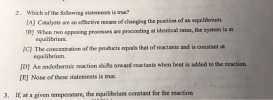 Which of the following statements is true? [A] Catalysts are an effective means of changing the position of an equilibrium. B1 When two opposing processes are proceeding at identical rates, the system is at 2. equilibrium. IC] The concentration of the products equals that of reactants and is constant at equilibrium [D] An endothermic reaction shifts toward reactants when heat...
For the following reaction, all of the reactants and products are in their standard states/standard 1.0...
 For the following reaction, all of the reactants and products are in their standard states/standard 1.0 M concentrations. Which of the following statements must be true? Zn(s) + SnBr2(aq) → ZnBr2(aq) + S (s) E-0.60 V OA AGº for the reaction as written is positive B. Zinc is undergoing reduction OC. None of the above OD. All of the above...
For the thermodynamic function G, ΔG° for a reaction refers to the change in G for...
For the thermodynamic function G, ΔG° for a reaction refers to the change in G for the process in which For the thermodynamic function G, ΔG° for a reaction refers to the change in G for the process in which the separate reactants at 1 atm go to equilibrium at 1 atm. the separate reactants in their standard states are...
For the thermodynamic function G, ΔG° for a reaction refers to the change in G for...
For the thermodynamic function G, ΔG° for a reaction refers to the change in G for the process in which For the thermodynamic function G, ΔG° for a reaction refers to the change in G for the process in which the separate reactants in their standard states are completely converted to separate products in their standard states. the separate reactants...
 Question 15 Identify correct statements pertaining to reaction energies. The rate of a reaction depends on the energy change between reactants and products, If Keo < 1, the equilibrium will favor the reactants. IfAG® < 0. Ke will be greater than 1. The reaction step with the highest energy transition state is called the rate determining step. Which of the...
 can
i get the answer for 4 and 5
4. For the reaction Fe (aq) + SCN (aq) FeSCN2+ (aq), K = 207. a. Write the equilibrium expression for this reaction. b. Based on the size of K, is the equilibrium mixture more reactants or products? 5. If the reaction between Fe* (aq) and SCN (aq) had an equilibrium concentration...
can
i get the answer for 4 and 5
4. For the reaction Fe (aq) + SCN (aq) FeSCN2+ (aq), K = 207. a. Write the equilibrium expression for this reaction. b. Based on the size of K, is the equilibrium mixture more reactants or products? 5. If the reaction between Fe* (aq) and SCN (aq) had an equilibrium concentration...
 4. The reaction between cis-1-bromo-2-methylcyclohexane and ethoxide (a very strong base) results in an E2 reaction. (refer to Mechanism 9.8 in your textbook) a. Show the transition state for this reaction. CHE + CH, CH, CH, OH b. Show the formation of the product(s) from the transition state. c. Use the rule from part 3d, to determine the major and...
 saw an answer posted already, but think it is wrong as they used
Kp = [NOCL]^2/ [NO]^2 x [Cl2]. In this question, NOCl is the
reactant, and I thought Kp = [products] / [reactants]
An evacuated reaction vessel is filled with 3.60 atm of NOCI. When the system reaches equilibrium according to the reaction below, there are 0.160 atm of...
saw an answer posted already, but think it is wrong as they used
Kp = [NOCL]^2/ [NO]^2 x [Cl2]. In this question, NOCl is the
reactant, and I thought Kp = [products] / [reactants]
An evacuated reaction vessel is filled with 3.60 atm of NOCI. When the system reaches equilibrium according to the reaction below, there are 0.160 atm of...
 Save Answer « Question 23 of 65 > Strong acid-strong base titration relies on the reaction of a stong acid with a strong base. Complete each titration reaction by writing the products in molecular form and balancing the equation. States of matter are optional HNO, + KOH Ba(OH), + HCI
 5. Answer the following questions for the general reaction shown below. A C) + DD + heat a. Is this reaction reversible? Explain. b. How is the system affected if more "D" is added? c. If you wanted to produce as much "C" as possible, would you heat or cool the reaction? Why? d. Besides your answer for e, what...
 Which of the following statements is true? [A] Catalysts are an effective means of changing the position of an equilibrium. B1 When two opposing processes are proceeding at identical rates, the system is at 2. equilibrium. IC] The concentration of the products equals that of reactants and is constant at equilibrium [D] An endothermic reaction shifts toward reactants when heat...
 For the following reaction, all of the reactants and products are in their standard states/standard 1.0 M concentrations. Which of the following statements must be true? Zn(s) + SnBr2(aq) → ZnBr2(aq) + S (s) E-0.60 V OA AGº for the reaction as written is positive B. Zinc is undergoing reduction OC. None of the above OD. All of the above...
Most questions answered within 3 hours.