For the thermodynamic function G, ΔG° for a reaction refers to the change in G for...
For the thermodynamic function G, ΔG° for a reaction refers to the change in G for the process in which
For the thermodynamic function G, ΔG° for a reaction refers to the change in G for the process in which
| the separate reactants in their standard states are completely converted to separate products in their standard states. |
| the separate reactants at 1 atm go to equilibrium at 1 atm. |
| the spontaneous reaction occurs. |
| the mixed reactants at 1 atm go to equilibrium at 1 atm. |
Homework Answers
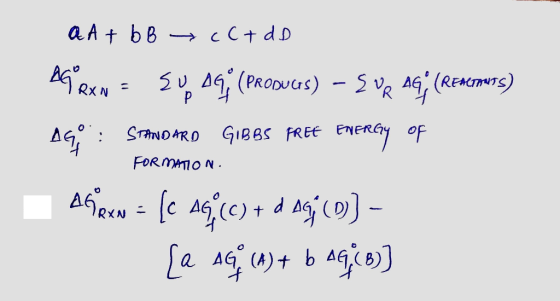
For the thermodynamic function G, ΔG° for a reaction refers to the change in G for the process in which:
Ans: The separate reactants in their standard states are completely converted to separate products in their standard states.
Add Answer to:
For the thermodynamic function G, ΔG° for a
reaction refers to the change in G for...
For the thermodynamic function G, ΔG° for a reaction refers to the change in G for...
For the thermodynamic function G, ΔG° for a reaction refers to the change in G for the process in which For the thermodynamic function G, ΔG° for a reaction refers to the change in G for the process in which the separate reactants at 1 atm go to equilibrium at 1 atm. the separate reactants in their standard states are completely converted to separate products in their standard states. the mixed reactants at 1 atm go to equilibrium at 1...
Calculate ΔG of the reaction, O2(g) + 2NO(g) <--> 2NO(g) assuming that the initial pressures are...
Calculate ΔG of the reaction, O2(g) + 2NO(g) <--> 2NO(g) assuming that the initial pressures are 2.5 atm for NO, 1.5 atm for NO2 and 2.5 atm for O2. Is the forward reaction spontaneous for this reaction? What is the equilibrium constant for this reaction? (ΔGo= -71.4 kJ mol-1)
A,) ΔG o for the reaction H2(g) + I2(g) ⇌ 2HI(g) is 2.60 kJ/mol at 25°C....
A,) ΔG o for the reaction H2(g) + I2(g) ⇌ 2HI(g) is 2.60 kJ/mol at 25°C. Calculate ΔG, and predict the direction in which the reaction is spontaneous. The initial pressures are: PH2 = 3.10 atm PI2 = 1.5 atm PHI 1.75 atm ΔG = kJ/mol b.)The reaction is spontaneous in the forward direction. The reaction is spontaneous in the reverse direction. Cannot be determined.
1. Which of the following conditions defines a non-spontaneous oxidation-reduction reaction? E° + ΔG° - &
1. Which of the following conditions defines a non-spontaneous oxidation-reduction reaction? E° + ΔG° - Keq <1 E° - ΔG° - Keq <1 E° + ΔG°+ Keq >1 E° + ΔG°- Keq >1 E° - ΔG° + Keq <1 2. What information can be obtained from the Figure below? The equivalence point occurs at pH = 7.0 but the pKa is not known from the graph. Both the pOH and the...
2Ca(s)+O2(g) → 2CaO(s) ΔH∘rxn= -1269.8 kJ; ΔS∘rxn= -364.6 J/K For this problem, assume that all reactants...
2Ca(s)+O2(g) → 2CaO(s) ΔH∘rxn= -1269.8 kJ; ΔS∘rxn= -364.6 J/K For this problem, assume that all reactants and products are in their standard states. Calculate the free energy change for the reaction at 29 ∘C. Express your answer using four significant figures. Part A ΔG = ______ kJ Part B Is the reaction spontaneous? spontaneous OR nonspontaneous
Consider the reaction N2(g) + 3H2(g*2NH3(g) Using the standard thermodynamic data in the tables linked above,...
 Consider the reaction N2(g) + 3H2(g*2NH3(g) Using the standard thermodynamic data in the tables linked above, calculate ΔG n for this reaction at 298.15 K if the pressure of each gas is 43.08 mm Hg. ANSWER: kJ/mol Consider the reaction IH2(g) + C2H4(g)>C2Hf(g) Use the standard thermodynamic data in the tables linked above. Calculate Δ@for this reaction at 298.15K if the pressure of C2H6 g is reduced to 10.34 mm Hg, while the pressures of H2(g) and C2H4(g) remain at...
At equilibrium, the free energy change, ΔG, of any system is zero: ΔG=0=ΔH−TΔS So, under equilibrium...
At equilibrium, the free energy change, ΔG, of any system is zero: ΔG=0=ΔH−TΔS So, under equilibrium conditions, this equation can be rearranged as T=ΔHΔS Part A Glacial acetic acid is the concentrated form of acetic acid, the acid in vinegar. The term "glacial" refers to the appearance of the solid form, which resembles glacial ice. What is the melting point of this compound, in degrees Celsius, based on its thermodynamic data shown here? ΔHfus (kJ/mol) = 24.32 ΔSfus [J/(K⋅mol)] =...
The conversion of methane into products that contain two or more carbon atom, such as ethane,...
 The conversion of methane into products that contain two or more
carbon atom, such as ethane, C2H2, is a very
important industrial chemical process. In principle, methane can be
converted directly into ethane and hydrogen.
(1) 2CH4(g) C2H6(g) +
H2(g)
In practice, however, this reaction is carried out in the
presence of oxygen:
(2) 2CH4(g) + 1/2 O2(g) C2H6(g) +
H2O(g)
a) Using the thermodynamic data at 298K, determine ΔG° for each
reaction.
ΔGf° (kJ/mol)
ΔGf° (kJ/mol)
CH4(g)
H2(g)
0...
The conversion of methane into products that contain two or more
carbon atom, such as ethane, C2H2, is a very
important industrial chemical process. In principle, methane can be
converted directly into ethane and hydrogen.
(1) 2CH4(g) C2H6(g) +
H2(g)
In practice, however, this reaction is carried out in the
presence of oxygen:
(2) 2CH4(g) + 1/2 O2(g) C2H6(g) +
H2O(g)
a) Using the thermodynamic data at 298K, determine ΔG° for each
reaction.
ΔGf° (kJ/mol)
ΔGf° (kJ/mol)
CH4(g)
H2(g)
0...
Urea (NH2CONH2), an important nitrogen fertilizer, is produced industrially by the reaction 2NH3(g)+CO2(g)→NH2CONH2(aq)+H2O(l) Given that ΔG∘...
Urea (NH2CONH2), an important nitrogen fertilizer, is produced industrially by the reaction 2NH3(g)+CO2(g)→NH2CONH2(aq)+H2O(l) Given that ΔG∘ = -13.6 kJ, calculate ΔG at 25 ∘C for the following sets of conditions. (Figure 1) 1) 20 atm NH3, 20 atm CO2, 4.0 M NH2CONH2 2) 9.0×10⁻² atm NH3, 9.0×10⁻² atm CO2, 1.0 M NH2CONH2 Is the reaction spontaneous for the conditions in part (a) and/or part (b)? spontaneous for the conditions in part (b), nonspontaneous for the conditions in part (a) nonspontaneous...
The following reaction is exothermic. Which change will shift the equilibrium to the right? 2 SO2...
 The following reaction is exothermic. Which change will shift the equilibrium to the right? 2 SO2 (g) + O2 (g) = 2 So, (9) o Adding So, Decreasing the volume of the reaction flask Removing O2 Heating the reaction QUESTION 11 A positive AGⓇ for a reaction implies The reaction is never spontaneous The products predominate at equilibrium The reaction is always spontaneous The reactants predominate at equilibrium ОО QUESTION 12 Which of the following is TRUE regarding AG and...
 Consider the reaction N2(g) + 3H2(g*2NH3(g) Using the standard thermodynamic data in the tables linked above, calculate ΔG n for this reaction at 298.15 K if the pressure of each gas is 43.08 mm Hg. ANSWER: kJ/mol Consider the reaction IH2(g) + C2H4(g)>C2Hf(g) Use the standard thermodynamic data in the tables linked above. Calculate Δ@for this reaction at 298.15K if the pressure of C2H6 g is reduced to 10.34 mm Hg, while the pressures of H2(g) and C2H4(g) remain at...
 The conversion of methane into products that contain two or more
carbon atom, such as ethane, C2H2, is a very
important industrial chemical process. In principle, methane can be
converted directly into ethane and hydrogen.
(1) 2CH4(g) C2H6(g) +
H2(g)
In practice, however, this reaction is carried out in the
presence of oxygen:
(2) 2CH4(g) + 1/2 O2(g) C2H6(g) +
H2O(g)
a) Using the thermodynamic data at 298K, determine ΔG° for each
reaction.
ΔGf° (kJ/mol)
ΔGf° (kJ/mol)
CH4(g)
H2(g)
0...
The conversion of methane into products that contain two or more
carbon atom, such as ethane, C2H2, is a very
important industrial chemical process. In principle, methane can be
converted directly into ethane and hydrogen.
(1) 2CH4(g) C2H6(g) +
H2(g)
In practice, however, this reaction is carried out in the
presence of oxygen:
(2) 2CH4(g) + 1/2 O2(g) C2H6(g) +
H2O(g)
a) Using the thermodynamic data at 298K, determine ΔG° for each
reaction.
ΔGf° (kJ/mol)
ΔGf° (kJ/mol)
CH4(g)
H2(g)
0...
 The following reaction is exothermic. Which change will shift the equilibrium to the right? 2 SO2 (g) + O2 (g) = 2 So, (9) o Adding So, Decreasing the volume of the reaction flask Removing O2 Heating the reaction QUESTION 11 A positive AGⓇ for a reaction implies The reaction is never spontaneous The products predominate at equilibrium The reaction is always spontaneous The reactants predominate at equilibrium ОО QUESTION 12 Which of the following is TRUE regarding AG and...
Most questions answered within 3 hours.
-
Where is the error in this code sequence?
String s1 = "Hello";
String s2 = "ello";...
asked 10 months ago -
Financial data for Joel de Paris, Inc., for last year
follow:
Joel de Paris, Inc.
Balance...
asked 10 months ago -
Consider this reaction:
Al2(SO4)3 (aq)+ BaCl3
(aq) Al2Cl6 (aq)- +
3BaSO4(s) . What is the...
asked 10 months ago -
Suppose that Savneet is considering increasing her
recent random sample from 20 car rentals to 40...
asked 10 months ago -
Trucks arrive at an unloading terminal at an average rate of 120
per hour.
Trucks arrive...
asked 10 months ago -
Why are methanol and ethanol completely soluble in water while
octanol is not very little soluble....
asked 10 months ago -
A facilities manager at a university reads in a research report
that the mean amount of...
asked 10 months ago -
When the CuSO4 is rehydrated by adding water to the anhydrous
compound, is this an endothermic...
asked 10 months ago -
A ray of sunlight is passing from diamond into crown glass; the
angle of incidence is...
asked 10 months ago -
A block of mass 0.249 kg is placed on top of a light, vertical
spring of...
asked 10 months ago -
how do the kidneys compensate in the presences of acidosis
a) trigger hyperventilate
b) reserve acid...
asked 10 months ago -
Question 501 pts
The rental rate of capital to the firm increases. Which of the
following...
asked 10 months ago